Susan U. Philips - Böcker
Visar alla böcker från författaren Susan U. Philips. Handla med fri frakt och snabb leverans.
3 produkter
3 produkter
Del 17 - Oxford Studies in Anthropological Linguistics
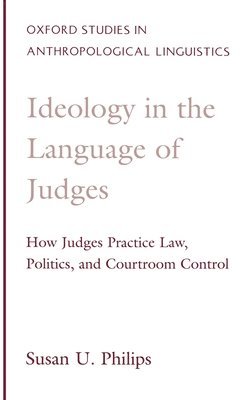
Ideology in the Language of Judges
How Judges Practice Law, Politics, and Courtroom Control
Inbunden, Engelska, 1998
2 058 kr
Skickas inom 5-8 vardagar
Philips looks at the languages of judges in the courtroom to show that, while judges see themselves as impartial agents of the constitutional right to due process, there is actually much diversity in the way that judges interract with defendants due to their interpretations of the law, their attitudes toward courtroom control, and their own political-ideological stances regarding due process. She uses courtroom transcripts, interviews, and the written law itself to show how ideological diversity is organized in legal discourse.
Del 17 - Oxford Studies in Anthropological Linguistics
Ideology in the Language of Judges
How Judges Practice Law, Politics, and Courtroom Control
Häftad, Engelska, 1998
576 kr
Skickas inom 5-8 vardagar
Philips looks at the languages of judges in the courtroom to show that, while judges see themselves as impartial agents of the constitutional right to due process, there is actually much diversity in the way that judges interract with defendants due to their interpretations of the law, their attitudes toward courtroom control, and their own political-ideological stances regarding due process. She uses courtroom transcripts, interviews, and the written law itself to show how ideological diversity is organized in legal discourse.
Del 4 - Studies in the Social and Cultural Foundations of Language
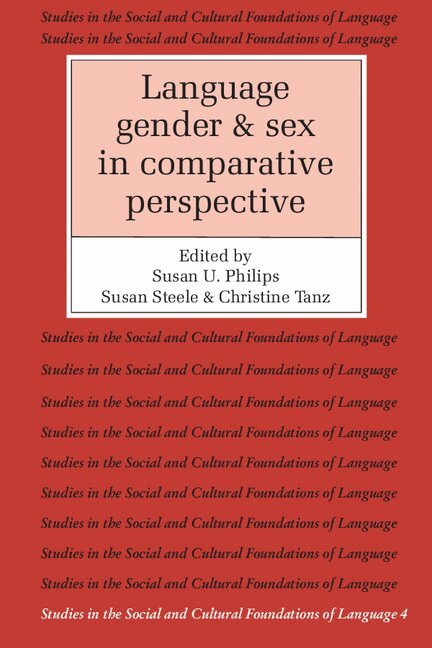
Language, Gender, and Sex in Comparative Perspective
Häftad, Engelska, 1987
422 kr
Skickas inom 7-10 vardagar
Most studies of gender differences in language use have been undertaken from exclusively either a sociocultural or a biological perspective. By contrast, this innovative volume places the analysis of language and gender in the context of a biocultural framework, examining both cultural and biological sources of gender differences in language, as well as the interaction between them. The first two parts of the volume on cultural variation in gender-differentiated language use, comparing Western English-speaking societies with societies elsewhere in the world. The essays are distinguished by an emphasis on the syntax, rather than style or strategy, of gender-differentiated forms of discourse but also often carry out the same forms differently through different choices of language form. These gender differences are shown to be socially organized, although the essays in Part I also raise the possibility that some cross-cultural similarities in the ways males and females differentially use language may be related to sex-based differences in physical and emotional makeup. Part III examines the relationship between language and the brain and shows that although there are differences between the ways males and females process language in the brain, these do not yield any differences in linguistic competence or language use. Taken as a whole, the essays reveal a great diversity in the cultural construction of gender through language and explicity show that while there is some evidence of the influence of biologically based sex differences on the language of women and men, the influence of culture is far greater, and gender differences in language use are better accounted for in terms of culture than in terms of biology. The collection will appeal widely to anthropologists, psychologists, linguists, and other concerned with the understanding of gender roles.