Svein Andersen - Böcker
1 067 kr
Skickas inom 3-6 vardagar
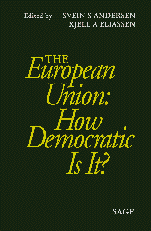
Part One deals with the two major challenges of interest articulation in the EU, political parties and lobbying. The second part discusses how democracy becomes the key element in the linkage between the EU and its member states, focusing on France, Italy and Belgium where the relation to the EU constitutes an important part of the national democratic debate. The third part focuses on democratic aspects of key EU institutions - the European Council, the European Commission and the European Parliament. The final part looks at democracy in relation to possible EU development generally, and in the context of societal change which may tend to undermine the role of parliamentary institutions.
2 873 kr
Tillfälligt slut
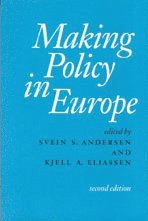
The first part of the book introduces the different perspectives to study of the EU as a political system, and provides a framework for the study of the main actors and institutions in the decision-making process from transnational lobbying within Brussels to the implementation of EU law in national member states.
Part two introduces each of the main sectoral policy areas. The common "market" is introduced and reviewed before students are provided with detailed studies of policies and policy-making in telecommunications, the environment, energy, education, immigration, and policing. In each case the complex interaction between different interests and actors at different levels in the EU apparatus is richly illustrated and the future prospects for further integration fully examined.
The final part of the book looks at the future economic and political structure of the EU and the direction of contemporary studies of the EU and European integration. A completely new chapter reviews European monetary union, another looks at the important enlargement question, and, finally, the editors review the wider implications for Europe and the EU political system.
This book will be essential reading for another generation of students of the EU, European pubic policy and European integration.
In each case the complex interaction between interests and actors at different levels in the EU apparatus is richly illustrated and the future prospects for further integration are examined.
1 094 kr
Skickas inom 3-6 vardagar
The first part of the book introduces the different perspectives to study of the EU as a political system, and provides a framework for the study of the main actors and institutions in the decision-making process from transnational lobbying within Brussels to the implementation of EU law in national member states.
Part two introduces each of the main sectoral policy areas. The common "market" is introduced and reviewed before students are provided with detailed studies of policies and policy-making in telecommunications, the environment, energy, education, immigration, and policing. In each case the complex interaction between different interests and actors at different levels in the EU apparatus is richly illustrated and the future prospects for further integration fully examined.
The final part of the book looks at the future economic and political structure of the EU and the direction of contemporary studies of the EU and European integration. A completely new chapter reviews European monetary union, another looks at the important enlargement question, and, finally, the editors review the wider implications for Europe and the EU political system.
This book will be essential reading for another generation of students of the EU, European pubic policy and European integration.
In each case the complex interaction between interests and actors at different levels in the EU apparatus is richly illustrated and the future prospects for further integration are examined.