Sven B. Lundstedt – författare
Visar alla böcker från författaren Sven B. Lundstedt. Handla med fri frakt och snabb leverans.
3 produkter
3 produkter
E-bok
PDF, Engelska, 2013779 kr
Läs direkt efter köp
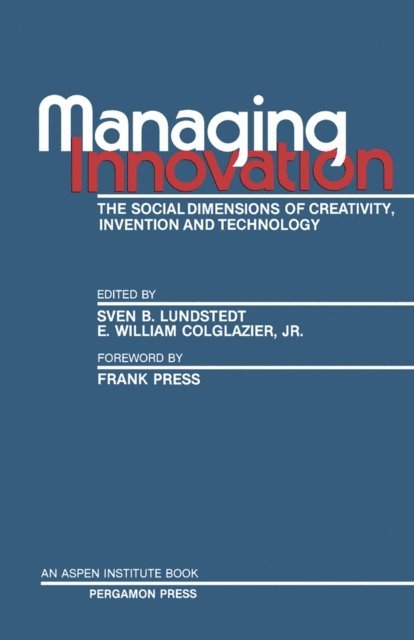
Managing Innovation: The Social Dimensions of Creativity, Invention and Technology focuses on the relationship between inventions and innovations with industrial development and economic advancement. The book stresses the point that advancement in industries and economy can be more successful when these are in balance. Containing the works of various authors, the book proceeds by highlighting the social dimension of invention and innovation. The role of the government in the promotion of innovations and inventions is also noted. The book also reiterates the point that human factors have definitely affected innovation and productivity. This stance is supported by the discussion on a case study in labor-management cooperation. Inventions and innovations in the social dimension are also established to be related with industrial productivity. The book also touches upon how education has influenced the advancement of technology in Japan. The text is best suited to those who are interested in pushing the role of inventions and innovations in shaping the society.
E-bok
PDF, Engelska, 2013673 kr
Läs direkt efter köp
Technological innovations, as well as the social innovations needed to provide adequate support systems for them, are among the important foundations for economic and industrial growth in the world today. Consequently, the discussions in this important volume of the emerg ing "sociotechnical" trends in various industries around the world are highly instructive and timely. We can learn much of value from oth ers around the world who are facing similar problems of economic and industrial development. Sociotechnical innovation requires a global set ting to be fully understood and appreciated because so much new eco nomic activity that serves the economy of the United States, as well as the economies of other countries, is found in other parts of the world including not only manufacturing innovations, but innovations in the service industries. For all of our economic self-interests, we need to view innovation globally. Sociotechnical innovation is linked with the successful development of cutting edge technologies, such as ultra large-scale integrated elec tronic systems, new larger computers, the "myria-process" systems in computing architecture that use thousands of processors, new biochem ical solutions in high-cost feedstock, applications of genetic engineer ing to crop improvement, and biotechnological improvements in the pharmaceutical industries. There are also developments in the materi als field: new fiber-reinforced plastics, rapid solidification technologies, new polymers and ceramics. And there are advances in air transport technologies that may replace current technologies [1].
Häftad, Engelska, 2012
548 kr
Skickas inom 10-15 vardagar
Technological innovations, as well as the social innovations needed to provide adequate support systems for them, are among the important foundations for economic and industrial growth in the world today. Consequently, the discussions in this important volume of the emerg ing "sociotechnical" trends in various industries around the world are highly instructive and timely. We can learn much of value from oth ers around the world who are facing similar problems of economic and industrial development. Sociotechnical innovation requires a global set ting to be fully understood and appreciated because so much new eco nomic activity that serves the economy of the United States, as well as the economies of other countries, is found in other parts of the world including not only manufacturing innovations, but innovations in the service industries. For all of our economic self-interests, we need to view innovation globally. Sociotechnical innovation is linked with the successful development of cutting edge technologies, such as ultra large-scale integrated elec tronic systems, new larger computers, the "myria-process" systems in computing architecture that use thousands of processors, new biochem ical solutions in high-cost feedstock, applications of genetic engineer ing to crop improvement, and biotechnological improvements in the pharmaceutical industries. There are also developments in the materi als field: new fiber-reinforced plastics, rapid solidification technologies, new polymers and ceramics. And there are advances in air transport technologies that may replace current technologies [1].