Svetha Venkatesh - Böcker
Visar alla böcker från författaren Svetha Venkatesh. Handla med fri frakt och snabb leverans.
2 produkter
2 produkter
Del 4 - International Series in Video Computing
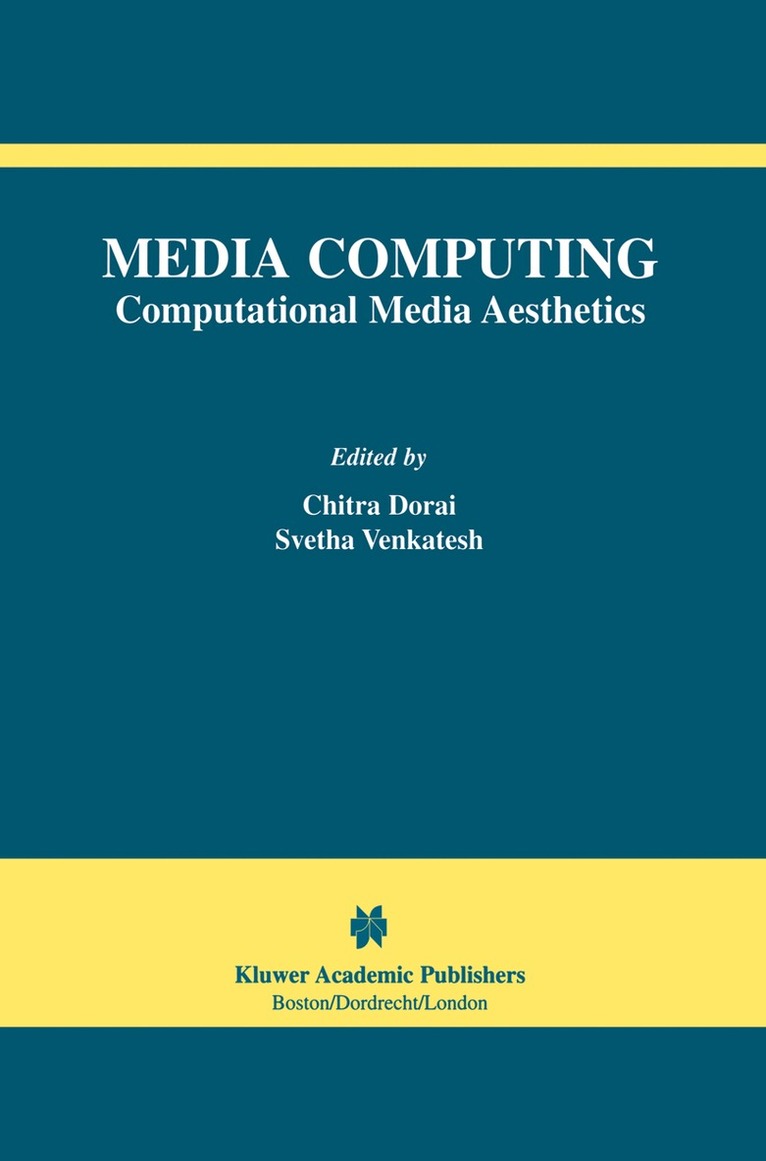
Media Computing
Computational Media Aesthetics
Inbunden, Engelska, 2002
1 069 kr
Skickas inom 10-15 vardagar
With the explosion of digital media and online services, a key challenge is the automation of content annotation, indexing and organizing for efficient media access, retrieval and browsing. A major failing of automated media annotation systems is the semantic gap - the incompatibility between the low-level features that can be computed to describe media and the high-level meaning sought by user queries in searches for audio and video. This text explores the area of computational media aesthetics to bridge the semantic gap. It brings together researchers from multiple disciplines, from computer scientists to content creators from engineers to media specialists, to highlight advances in this area. It examines the elements of media production and aesthetics principles in order to establish the foundation for semantics indexing, and to build innovative and effective technologies for content annotation, search and browsing. The book outlines strategic means and methods to derive high level semantic constructs from automatic analysis of media. It is suitable for the use as a text in courses on multimedia and informational retrieval.
1 101 kr
Skickas inom 10-15 vardagar
Traditionally, scientific fields have defined boundaries, and scientists work on research problems within those boundaries. However, from time to time those boundaries get shifted or blurred to evolve new fields. For instance, the original goal of computer vision was to understand a single image of a scene, by identifying objects, their structure, and spatial arrangements. This has been referred to as image understanding. Recently, computer vision has gradually been making the transition away from understanding single images to analyz ing image sequences, or video understanding. Video understanding deals with understanding of video sequences, e. g. , recognition of gestures, activities, fa cial expressions, etc. The main shift in the classic paradigm has been from the recognition of static objects in the scene to motion-based recognition of actions and events. Video understanding has overlapping research problems with other fields, therefore blurring the fixed boundaries. Computer graphics, image processing, and video databases have obvious overlap with computer vision. The main goal of computer graphics is to gener ate and animate realistic looking images, and videos. Researchers in computer graphics are increasingly employing techniques from computer vision to gen erate the synthetic imagery. A good example of this is image-based rendering and modeling techniques, in which geometry, appearance, and lighting is de rived from real images using computer vision techniques. Here the shift is from synthesis to analysis followed by synthesis.