Svetlana Alpers - Böcker
Visar alla böcker från författaren Svetlana Alpers. Handla med fri frakt och snabb leverans.
8 produkter
8 produkter
2 278 kr
Skickas inom 5-8 vardagar
364 kr
Skickas inom 7-10 vardagar
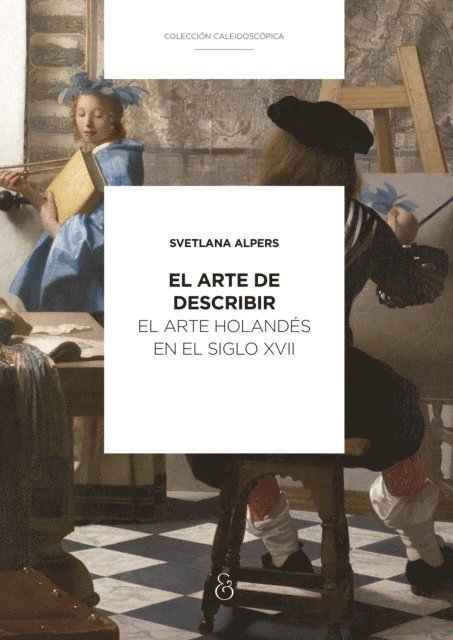
"The art historian after Erwin Panofsky and Ernst Gombrich is not only participating in an activity of great intellectual excitement; he is raising and exploring issues which lie very much at the centre of psychology, of the sciences and of history itself. Svetlana Alpers's study of 17th-century Dutch painting is a splendid example of this excitement and of the centrality of art history among current disciples. Professor Alpers puts forward a vividly argued thesis. There is, she says, a truly fundamental dichotomy between the art of the Italian Renaissance and that of the Dutch masters. . . . Italian art is the primary expression of a 'textual culture,' this is to say of a culture which seeks emblematic, allegorical or philosophical meanings in a serious painting. Alberti, Vasari and the many other theoreticians of the Italian Renaissance teach us to 'read' a painting, and to read it in depth so as to elicit and construe its several levels of signification. The world of Dutch art, by the contrast, arises from and enacts a truly 'visual culture.' It serves and energises a system of values in which meaning is not 'read' but 'seen,' in which new knowledge is visually recorded."—George Steiner, Sunday Times"There is no doubt that thanks to Alpers's highly original book the study of the Dutch masters of the seventeenth century will be thoroughly reformed and rejuvenated. . . . She herself has the verve, the knowledge, and the sensitivity to make us see familiar sights in a new light."—E. H. Gombrich, New York Review of Books
381 kr
Skickas inom 7-10 vardagar
316 kr
Skickas inom 7-10 vardagar
The image of a tortured genius working in near isolation has long dominated our conceptions of the artist's studio. Examples are abound: think Jackson Pollock dripping resin on a cicada carcass in his shed in the Hamptons. But times have changed; ever since Andy Warhol declared his art space a 'factory', artists have begun to envision themselves as the leaders of production teams, and their sense of what it means to be in the studio has altered just as dramatically as their practices. "The Studio Reader" pulls back the curtain from the art world to reveal the real activities behind artistic production. What does it mean to be in the studio? What is the space of the studio in the artist's practice? How do studios help artists envision their agency and, beyond that, their own lives? This forward-thinking anthology features an all-star array of contributors, ranging from Svetlana Alpers, Bruce Nauman, and Robert Storr to Daniel Buren, Carolee Schneemann, and Buzz Spector, each of whom locates the studio both spatially and conceptually - at the center of an art world that careens across institutions, markets, and disciplines.A companion for anyone engaged with the spectacular sites of art at its making, "The Studio Reader" reconsiders this crucial space as an actual way of being that illuminates our understanding of both artists and the world they inhabit.
342 kr
Skickas inom 7-10 vardagar
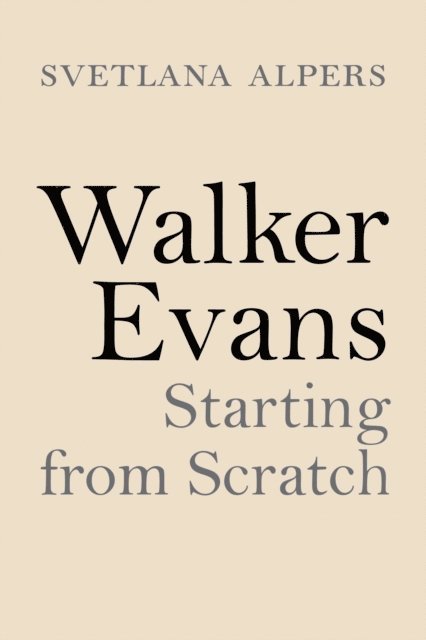
A magisterial study of celebrated photographer Walker EvansWalker Evans (1903–75) was a great American artist photographing people and places in the United States in unforgettable ways. He is known for his work for the Farm Security Administration, addressing the Great Depression, but what he actually saw was the diversity of people and the damage of the long Civil War. In Walker Evans, renowned art historian Svetlana Alpers explores how Evans made his distinctive photographs. Delving into a lavish selection of Evans’s work, Alpers uncovers rich parallels between his creative approach and those of numerous literary and cultural figures, locating Evans within the wide context of a truly international circle.Alpers demonstrates that Evans’s practice relied on his camera choices and willingness to edit multiple versions of a shot, as well as his keen eye and his distant straight-on view of visual objects. Illustrating the vital role of Evans’s dual love of text and images, Alpers places his writings in conversation with his photographs. She brings his techniques into dialogue with the work of a global cast of important artists—from Flaubert and Baudelaire to Elizabeth Bishop and William Faulkner—underscoring how Evans’s travels abroad in such places as France and Cuba, along with his expansive literary and artistic tastes, informed his quintessentially American photographic style.A magisterial account of a great twentieth-century artist, Walker Evans urges us to look anew at the act of seeing the world—to reconsider how Evans saw his subjects, how he saw his photographs, and how we can see his images as if for the first time.
258 kr
Skickas inom 7-10 vardagar
A magisterial study of celebrated photographer Walker EvansWalker Evans (1903–75) was a great American artist photographing people and places in the United States in unforgettable ways. He is known for his work for the Farm Security Administration, addressing the Great Depression, but what he actually saw was the diversity of people and the damage of the long Civil War. In Walker Evans, renowned art historian Svetlana Alpers explores how Evans made his distinctive photographs. Delving into a lavish selection of Evans’s work, Alpers uncovers rich parallels between his creative approach and those of numerous literary and cultural figures, locating Evans within the wide context of a truly international circle.Alpers demonstrates that Evans’s practice relied on his camera choices and willingness to edit multiple versions of a shot, as well as his keen eye and his distant straight-on view of visual objects. Illustrating the vital role of Evans’s dual love of text and images, Alpers places his writings in conversation with his photographs. She brings his techniques into dialogue with the work of a global cast of important artists—from Flaubert and Baudelaire to Elizabeth Bishop and William Faulkner—underscoring how Evans’s travels abroad in such places as France and Cuba, along with his expansive literary and artistic tastes, informed his quintessentially American photographic style.A magisterial account of a great twentieth-century artist, Walker Evans urges us to look anew at the act of seeing the world—to reconsider how Evans saw his subjects, how he saw his photographs, and how we can see his images as if for the first time.
284 kr
Skickas inom 3-6 vardagar
413 kr
Skickas inom 5-8 vardagar