Svitlana Krasynska – författare
Visar alla böcker från författaren Svitlana Krasynska. Handla med fri frakt och snabb leverans.
4 produkter
4 produkter
Del 78 - Harvard Series in Ukrainian Studies
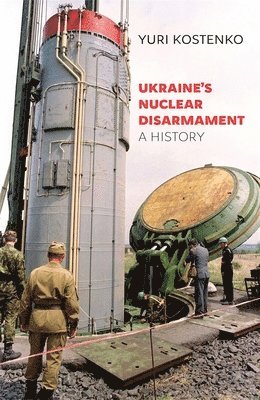
Ukraine’s Nuclear Disarmament
A History
Inbunden, Engelska, 2021
797 kr
Skickas inom 5-8 vardagar
In December 1994, Ukraine gave up the third-largest nuclear arsenal in the world and signed the Non-Proliferation Treaty, having received assurances that its sovereignty would be respected and secured by Russia, the United States, and the United Kingdom. Based on original and heretofore unavailable documents, Yuri Kostenko’s account of the negotiations between Ukraine, Russia, and the US reveals for the first time the internal debates of the Ukrainian government as well as the pressure exerted upon it by its international partners.Kostenko presents an insider’s view on the issue of nuclear disarmament and raises the question of whether the complete and immediate dismantlement of the country’s enormous nuclear arsenal was strategically the right decision, especially in view of the 2014 annexation of Crimea by Russia, one of the guarantors of Ukraine’s sovereignty under denuclearization.
Del 83 - Harvard Series in Ukrainian Studies
Self-Organization
The Power and Limits of Ukraine's Informal Civil Society
Inbunden, Engelska, 1996
1 036 kr
Kommande
Using Ukraine as a case-in-point, Svitlana Krasynska engages diverse bodies of literature and rich empirical data to reveal the vital role and unique potential of below-the-radar civic engagement in contexts where informal practices abound—a phenomenon largely neglected by scholars of civil society who traditionally focus on formal civic organizations.Civil society in Eastern Europe has long been labeled weak based on a general lack of citizen participation in formal civil society organizations—a key criterion for assessing civic engagement in comparative studies. However, such assessment of civil society fails to recognize the role and impact of informal civic engagement in contexts where informality permeates economic, political, and social spheres. Ukraine offers a valuable counterargument of the importance of informal civil society in Eastern Europe, especially in the post-Soviet countries.Krasynska convincingly shows that informality constitutes an essential component of civil society, shaping popular approaches to addressing social, economic, and political issues. The trailblazing findings in Self-Organization will be of interest to scholars of democratization, informality, and area studies, and they will aid development practitioners and policy makers in determining a more effective approach to helping fledgling democracies around the world.
Del 78 - Harvard Series in Ukrainian Studies
Ukraine’s Nuclear Disarmament
A History
Häftad, Engelska, 2023
254 kr
Skickas inom 5-8 vardagar
In December 1994, Ukraine gave up the third-largest nuclear arsenal in the world and signed the Non-Proliferation Treaty, having received assurances that its sovereignty would be respected and secured by Russia, the United States, and the United Kingdom. Based on original and heretofore unavailable documents, Yuri Kostenko’s account of the negotiations between Ukraine, Russia, and the US reveals for the first time the internal debates of the Ukrainian government as well as the pressure exerted upon it by its international partners.Kostenko presents an insider’s view on the issue of nuclear disarmament and raises the question of whether the complete and immediate dismantlement of the country’s enormous nuclear arsenal was strategically the right decision, especially in view of the 2014 annexation of Crimea by Russia, one of the guarantors of Ukraine’s sovereignty under denuclearization.
Del 1 - Brill's Nonprofit Sector Research Series
Nonprofit Sector in Eastern Europe, Russia, and Central Asia
Civil Society Advances and Challenges
Inbunden, Engelska, 2018
3 186 kr
Skickas inom 5-8 vardagar
The Nonprofit Sector in Eastern Europe, Russia, and Central Asia (EERCA), edited by David Horton Smith, Alisa V. Moldavanova, and Svitlana Krasynska, uniquely provides a research overview of the nonprofit sector and nonprofit organizations in eleven former Soviet republics, with each central chapter written by local experts. Such chapters, with our editorial introductions, present up-to-date versions of works previously published in EERCA native languages. With a Foreword by Susan Rose-Ackerman (Yale University), introductory and concluding chapters also explain the editors’ theoretical approach, setting the whole volume in several, relevant, larger intellectual contexts, and summarize briefly the gist of the book. The many post-Soviet countries show much variety in their current situation, ranging from democratic to totalitarian regimes.