Sylvain Lassarre - Böcker
Visar alla böcker från författaren Sylvain Lassarre. Handla med fri frakt och snabb leverans.
3 produkter
3 produkter
1 914 kr
Skickas inom 5-8 vardagar
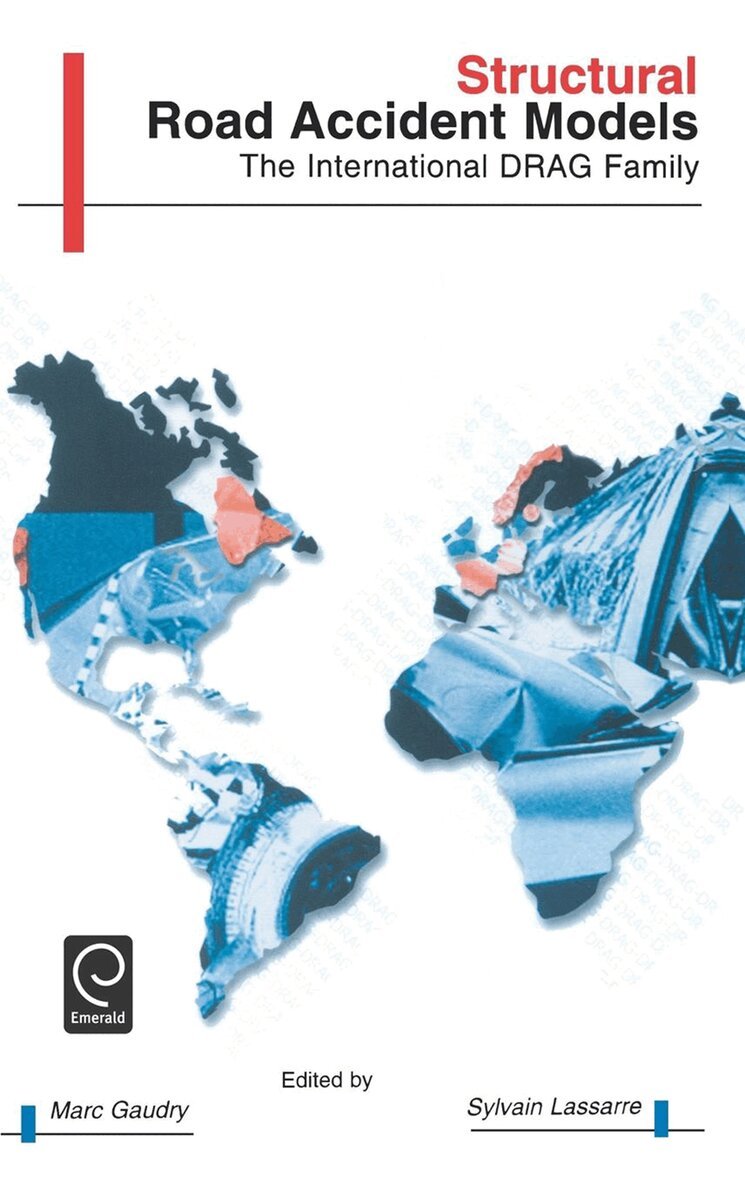
DRAG (from un modele de la Demande Routiere, des Accidents et leur Gravite) is a complex computer model that simulates accident propensities under detailed conditions. The DRAG approach constitutes the largest road accident modelling effort ever undertaken. Gaudry is the creator and developer of DRAG and this work explains its nature, purpose and value. Such a model, which explains accidents for a whole region, province or country, has advantages in answering many questions asked about accidents (such as the role of the economic cycle, weather, prices, insurance etc.) that other models fail to take fully into account. DRAG research is underpinned by a fundamental theoretical innovation which sees a 3-level approach to analysing the determinants of the number of road victims in a given accident: Exposure (the distance travelled), Accident Frequency Risk and Accident Severity Risk (i.e. the number of victims of each type of accident). In applying flexible mathematical forms, the DRAG model also allows significant conceptual and empirical claims to be made about the importance of detecting responses that reverse themselves (to alcohol, and to other factors). Under Gaudry's guidance, a family of DRAG-inspired models has grown up, based on their development for different countries and this book explores each national model in turn. As more countries seek to adopt the DRAG approach, this book serves as a timely, unique and valuable guide to the model.
1 588 kr
Skickas inom 10-15 vardagar
The "Tra?c and Granular Flow '07" conference was the seventh of a series of international conferences that started in 1995 in Julic .. h (Germany). Since then, the conference took place in Duisburg (1997), Stuttgart (1999), Nagoya (2001), Delft (2003) and Berlin (2005). The aim of TGF conferences is to facilitate the exchanges between various ?elds dealing with transport. When the conference was created, the ?elds that were represented were road tra?c and granular ?ow - hence the name of the series. Since then, the scope of the conference has been enlarged to include in particular collective motion in biology (molecular motors), a subject which turns out to have many connections with the two original ones. Transversal themes have emerged. For TGF07, a session was speci?cally devoted to the subject of networks. An important theme is also the one of self-propelled particles. It ranges from granular ?ows with anisotropic grains, to collective motion of animals, and to pedestrian tra?c. We were very happy to organize the 2007 occurrence of TGF in Orsay (France), at the University Paris-Sud.The conference was organized mainly by the Laboratory of Theoretical Physics (LPT), with the help of the Labo- tory FAST (Fluides, Automatique et Syst' emes Thermiques) - these two la- ratories are both associated to the CNRS (Centre National pour la Recherche Scienti?que) - and of the GARIG Group at INRETS.
1 588 kr
Skickas inom 10-15 vardagar
The "Tra?c and Granular Flow '07" conference was the seventh of a series of international conferences that started in 1995 in Julic .. h (Germany). Since then, the conference took place in Duisburg (1997), Stuttgart (1999), Nagoya (2001), Delft (2003) and Berlin (2005). The aim of TGF conferences is to facilitate the exchanges between various ?elds dealing with transport. When the conference was created, the ?elds that were represented were road tra?c and granular ?ow - hence the name of the series. Since then, the scope of the conference has been enlarged to include in particular collective motion in biology (molecular motors), a subject which turns out to have many connections with the two original ones. Transversal themes have emerged. For TGF07, a session was speci?cally devoted to the subject of networks. An important theme is also the one of self-propelled particles. It ranges from granular ?ows with anisotropic grains, to collective motion of animals, and to pedestrian tra?c. We were very happy to organize the 2007 occurrence of TGF in Orsay (France), at the University Paris-Sud.The conference was organized mainly by the Laboratory of Theoretical Physics (LPT), with the help of the Labo- tory FAST (Fluides, Automatique et Syst' emes Thermiques) - these two la- ratories are both associated to the CNRS (Centre National pour la Recherche Scienti?que) - and of the GARIG Group at INRETS.