T. Cebeci – författare
Visar alla böcker från författaren T. Cebeci. Handla med fri frakt och snabb leverans.
7 produkter
7 produkter
E-bok
PDF, Engelska, 20121 416 kr
Läs direkt efter köp
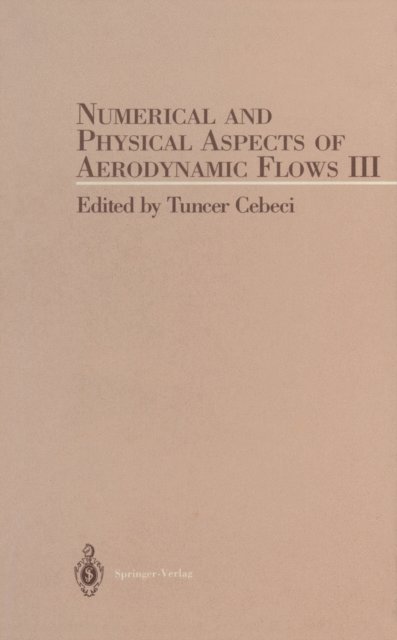
The Third Symposium on Numerical and Physical Aspects of Aerodynamic Flows, like its immediate predecessor, was organized with emphasis on the calculation of flows relevant to aircraft, ships, and missiles. Fifty-five papers and 20 brief communications were presented at the Symposium, which was held at the California State University at Long Beach from 21 to 24 January 1985. A panel discussion was chaired by A. M. O. Smith and includeq state ments by T. T. Huang, C. E. lobe, l. Nielsen, and C. K. Forester on priorities for future research. The first lecture in memory of Professor Keith Stewartson was delivered by J. T. Stuart and is reproduced in this volume together with a selection of the papers presented at the Symposium. In Volume II of this series, papers were selected so as to provide a clear indication of the range of procedures available to represent two-dimensional flows, their physical foundation, and their predictive ability. In this volume, the emphasis is on three-dimensional flows with a section of five papers concerned with unsteady flows and a section of seven papers on three dimensional flows: The papers deal mainly with calculation methods and encompass subsonic and transonic, attached and separated flows. The selec tion has been made so as to fulfill the same purpose for three-dimensional flows as did Volume II for two-dimensional flows.
Häftad, Engelska, 2011
1 082 kr
Skickas inom 10-15 vardagar
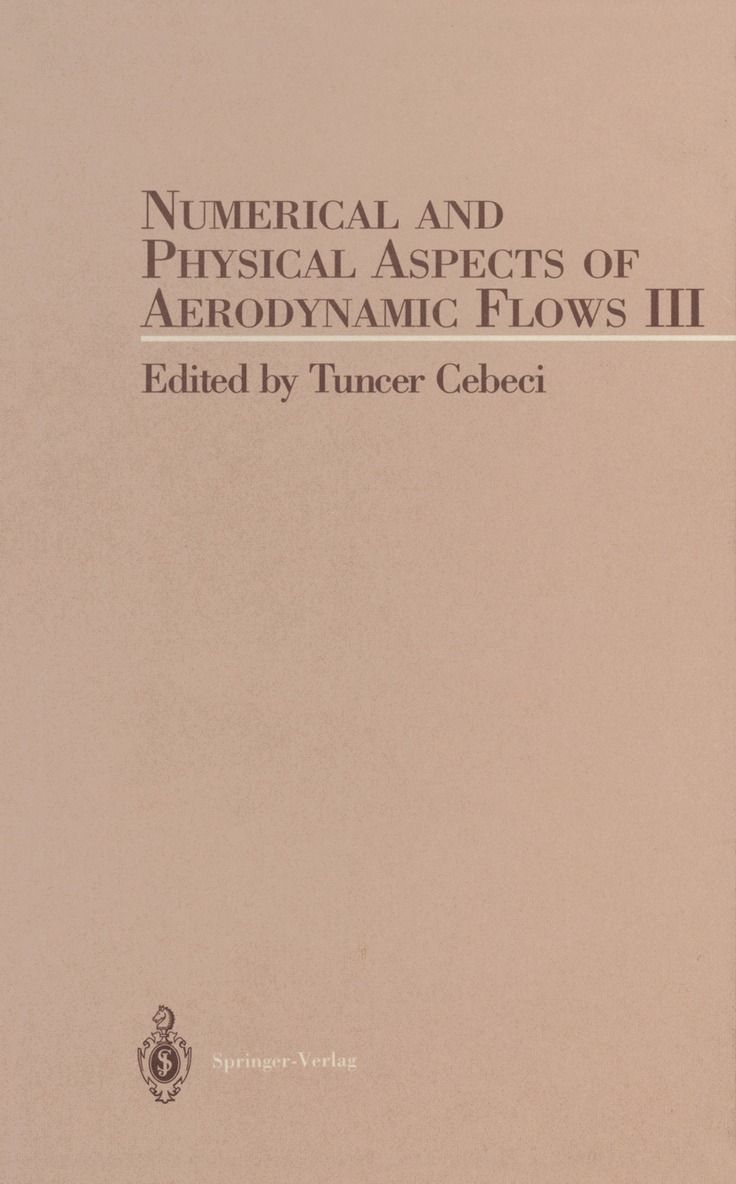
The Third Symposium on Numerical and Physical Aspects of Aerodynamic Flows, like its immediate predecessor, was organized with emphasis on the calculation of flows relevant to aircraft, ships, and missiles. Fifty-five papers and 20 brief communications were presented at the Symposium, which was held at the California State University at Long Beach from 21 to 24 January 1985. A panel discussion was chaired by A. M. O. Smith and includeq state ments by T. T. Huang, C. E. lobe, l. Nielsen, and C. K. Forester on priorities for future research. The first lecture in memory of Professor Keith Stewartson was delivered by J. T. Stuart and is reproduced in this volume together with a selection of the papers presented at the Symposium. In Volume II of this series, papers were selected so as to provide a clear indication of the range of procedures available to represent two-dimensional flows, their physical foundation, and their predictive ability. In this volume, the emphasis is on three-dimensional flows with a section of five papers concerned with unsteady flows and a section of seven papers on three dimensional flows: The papers deal mainly with calculation methods and encompass subsonic and transonic, attached and separated flows. The selec tion has been made so as to fulfill the same purpose for three-dimensional flows as did Volume II for two-dimensional flows.
E-bok
PDF, Engelska, 20131 140 kr
Läs direkt efter köp
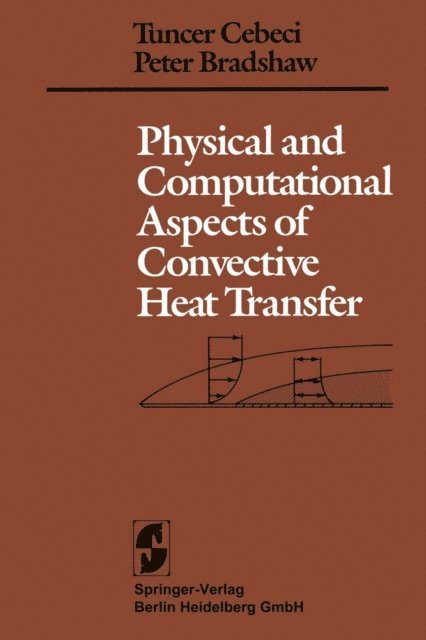
This volume is concerned with the transport of thermal energy in flows of practical significance. The temperature distributions which result from convective heat transfer, in contrast to those associated with radiation heat transfer and conduction in solids, are related to velocity characteristics and we have included sufficient information of momentum transfer to make the book self-contained. This is readily achieved because of the close relation ship between the equations which represent conservation of momentum and energy: it is very desirable since convective heat transfer involves flows with large temperature differences, where the equations are coupled through an equation of state, as well as flows with small temperature differences where the energy equation is dependent on the momentum equation but the momentum equation is assumed independent of the energy equation. The equations which represent the conservation of scalar properties, including thermal energy, species concentration and particle number density can be identical in form and solutions obtained in terms of one dependent variable can represent those of another. Thus, although the discussion and arguments of this book are expressed in terms of heat transfer, they are relevant to problems of mass and particle transport. Care is required, however, in making use of these analogies since, for example, identical boundary conditions are not usually achieved in practice and mass transfer can involve more than one dependent variable.
E-bok
PDF, Engelska, 20131 367 kr
Läs direkt efter köp
The Second Symposium on Numerical and Physical Aspects of Aerodynamic Flows was held at California State University, Long Beach, from 17 to 20 January 1983. Forty-eight papers were presented, including Keynote Lec tures by A. M. 0. Smith and J. N. Nielsen, in ten technical sessions which were supplemented and complemented by two Open Forum Sessions, involving a further sixteen technical presentations and a Panel Discussion on the "Identification of priorities for the development of calculation methods for aerodynamic bodies. " The Symposium was attended by 120 research workers from nine countries and, as in the First Symposium, provided a basis for research workers to communicate, to assess the present status of the subject and to formulate priorities for the future. In contrast to the First Symposium, the papers and discussion were focused more clearly on the subject of flows involving the interaction between viscous and inviscid regions and the calculation of pressure, velocity and temperature characteristics as a function of geometry, angle of attack and Mach number. Rather more than half the papers were concerned with two-dimensional configurations and the remainder with wings, missiles and ships. This volume presents a selection of the papers concerned with two dimensional flows and a review article specially prepared to provide essen tial background information and link the topics of the individual papers.
Häftad, Engelska, 2013
1 080 kr
Skickas inom 10-15 vardagar
The Second Symposium on Numerical and Physical Aspects of Aerodynamic Flows was held at California State University, Long Beach, from 17 to 20 January 1983. Forty-eight papers were presented, including Keynote Lec tures by A. M. 0. Smith and J. N. Nielsen, in ten technical sessions which were supplemented and complemented by two Open Forum Sessions, involving a further sixteen technical presentations and a Panel Discussion on the "Identification of priorities for the development of calculation methods for aerodynamic bodies. " The Symposium was attended by 120 research workers from nine countries and, as in the First Symposium, provided a basis for research workers to communicate, to assess the present status of the subject and to formulate priorities for the future. In contrast to the First Symposium, the papers and discussion were focused more clearly on the subject of flows involving the interaction between viscous and inviscid regions and the calculation of pressure, velocity and temperature characteristics as a function of geometry, angle of attack and Mach number. Rather more than half the papers were concerned with two-dimensional configurations and the remainder with wings, missiles and ships. This volume presents a selection of the papers concerned with two dimensional flows and a review article specially prepared to provide essen tial background information and link the topics of the individual papers.
E-bok
PDF, Engelska, 20131 367 kr
Läs direkt efter köp
This volume contains revised and edited forms of papers presented at the Symposium on Numerical and Physical Aspects of Aerodynamic Flows, held at the California State University from 19 to 21 January 1981. The Symposium was organized to bring together leading research workers in those aspects of aerodynamic flows represented by the five parts and to fulfill the following purposes : first, to allow the presentation of technical papers which provide a basis for research workers to assess the present status of the subject and to formulate priorities for the future; and second, to promote informal discussion and thereby to assist the communication and develop ment of novel concepts. The format ofthe content ofthe volume is similar to that ofthe Symposium and addresses, in separate parts: Numerical Fluid Dynamics, Interactive Steady Boundary Layers, Singularities in Unsteady Boundary Layers, Transonic Flows, and Experimental Fluid Dynamics. The motivation for most of the work described relates to the internal and extern al aerodynamics of aircraft and to the development and appraisal of design methods based on numerical solutions to conservation equations in differential forms, for corresponding components. The chapters concerned with numerical fluid dynamics can, perhaps, be interpreted in a more general context, but the emphasis on boundary-Iayer flows and the special consideration oftransonic flows reflects the interest in external flows and the recent advances which have allowed the calculation methods to encompass transonic regions.
Häftad, Engelska, 2014
1 080 kr
Skickas inom 10-15 vardagar
This volume contains revised and edited forms of papers presented at the Symposium on Numerical and Physical Aspects of Aerodynamic Flows, held at the California State University from 19 to 21 January 1981. The Symposium was organized to bring together leading research workers in those aspects of aerodynamic flows represented by the five parts and to fulfill the following purposes : first, to allow the presentation of technical papers which provide a basis for research workers to assess the present status of the subject and to formulate priorities for the future; and second, to promote informal discussion and thereby to assist the communication and develop ment of novel concepts. The format ofthe content ofthe volume is similar to that ofthe Symposium and addresses, in separate parts: Numerical Fluid Dynamics, Interactive Steady Boundary Layers, Singularities in Unsteady Boundary Layers, Transonic Flows, and Experimental Fluid Dynamics. The motivation for most of the work described relates to the internal and extern al aerodynamics of aircraft and to the development and appraisal of design methods based on numerical solutions to conservation equations in differential forms, for corresponding components. The chapters concerned with numerical fluid dynamics can, perhaps, be interpreted in a more general context, but the emphasis on boundary-Iayer flows and the special consideration oftransonic flows reflects the interest in external flows and the recent advances which have allowed the calculation methods to encompass transonic regions.