T. Gunji - Böcker
Visar alla böcker från författaren T. Gunji. Handla med fri frakt och snabb leverans.
4 produkter
4 produkter
1 204 kr
Skickas inom 10-15 vardagar
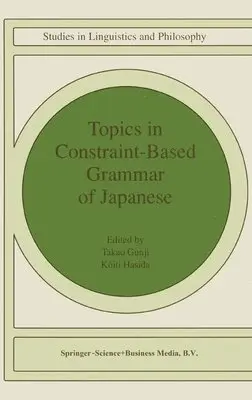
This book is a collection of articles on Japanese grammars written in a framework broadly construed as constraint-based. Having evolved from a progress report on the Japanese phrase structure grammar (JPSG) project, it implements ideas from recent developments in phrase structure grammar formalism, such as head-drive phrase structure grammar (HPSG). Part I gives an overview of JPSG, introducing fundamental assumptions and discussing mostly syntactic and semantic aspects of Japanese in the constraint-based formalism, as well as the implementation of a parser based on the grammar. The papers in Part II discuss mostly pragmatic aspects of Japanese. Innovative concepts are introduced in Part I, such as the concept of cost, which plays a central role both in the treatment of quantifiers and phonology, and is used extensively in the treatment of conditionals in Part II. Stress is also placed on the role of discourse participants; the analysis of relativization adopted in Part I is partly based on zero pronominals, whose interpretation is left to pragmatics. This issue is further pursued in Part II and may serve as one possible avenue to explore pragmatics.
Del 68 - Studies in Linguistics and Philosophy
Topics in Constraint-Based Grammar of Japanese
Häftad, Engelska, 1999
551 kr
Skickas inom 10-15 vardagar
Innovative concepts are introduced in Part I, such as the concept of cost, which plays a central role both in the treatment of quantifiers and phonology, and is used extensively in the treatment of conditionals in Part II. Stress is also placed on the role of discourse participants; the analysis of relativization adopted in Part I is partly based on zero pronominals, whose interpretation is left to pragmatics. This issue is further pursued in Part II and may serve as one possible avenue to explore pragmatics.
1 624 kr
Skickas inom 10-15 vardagar
This book is a considerable revision and extension of my thesis for The Ohio State University completed in 1981: A Phrase Structural Analysis of the Japanese Language (Gunji 1981a). The book discusses some of the major grammatical constructions of Japanese in a version of phrase structure grammar called Japanese Phrase Structure Grammar (JPSG), which is loosely based on such frameworks for phrase structure grammar as Generalized Phrase Structure Grammar (GPSG) and Head-driven Phrase Structure Grammar (HPSG). Particular emphasis is placed on the binding and control of pronouns (both implicit - "zero" - and explicit ones, including reflexives) in complementation structures (chapter 4) and adjunction structures (chapter 5). Even though this book started as a revision of my 1981 thesis, the resultant book has few traces of my thinking then. The 1981 thesis was closely related to an early version of GPSG, which was then at a very preliminary stage, and I had only a few preprints of papers by Gerald Gazdar and others to read. GPSG itself has evolved during the past. several years, culminating in a book published last year (Gazdar, Klein, Pullum, and Sag 1985), which differs from the early theory in many ways.
1 624 kr
Skickas inom 10-15 vardagar
This book is a considerable revision and extension of my thesis for The Ohio State University completed in 1981: A Phrase Structural Analysis of the Japanese Language (Gunji 1981a). The book discusses some of the major grammatical constructions of Japanese in a version of phrase structure grammar called Japanese Phrase Structure Grammar (JPSG), which is loosely based on such frameworks for phrase structure grammar as Generalized Phrase Structure Grammar (GPSG) and Head-driven Phrase Structure Grammar (HPSG). Particular emphasis is placed on the binding and control of pronouns (both implicit - "zero" - and explicit ones, including reflexives) in complementation structures (chapter 4) and adjunction structures (chapter 5). Even though this book started as a revision of my 1981 thesis, the resultant book has few traces of my thinking then. The 1981 thesis was closely related to an early version of GPSG, which was then at a very preliminary stage, and I had only a few preprints of papers by Gerald Gazdar and others to read. GPSG itself has evolved during the past. several years, culminating in a book published last year (Gazdar, Klein, Pullum, and Sag 1985), which differs from the early theory in many ways.