T. Pawlowski - Böcker
Visar alla böcker från författaren T. Pawlowski. Handla med fri frakt och snabb leverans.
6 produkter
6 produkter
1 578 kr
Skickas inom 10-15 vardagar
The 25 years up to 1999 have seen a tremendous growth in the application of statistical and modelling techniques to ecological problems. This expansion has been accelerated by the increasing availability of software, books and computing power. However, the suitability of some of these approaches to data analysis, in a relatively knowledge-poor discipline such as ecology, can be questioned on grounds of appropriateness and robustness. One reason for these concerns is that many ecological problems are at best poorly defined and most lack algorithmic solutions. Machine learning methods offer the potential for a different approach to these difficult problems. One definition of machine learning is that it is concerned with inducing knowledge from data, where the data could be patterns in a game of chess or patterns in the species composition of natural communities. Unfortunately ecologists have little experience of these relatively recent and novel approaches to understanding data.This is a problem that is made more complex because there is no simple taxonomy of machine learning methods and there are relatively few examples in the mainstream ecological literature to encourage exploration. This text is aimed at introducing machine learning methods to a readership of professional ecologists. All but one of the chapters have been written by ecologists and biologists who highlight the application of a particular method to a particular class of problem. Examples include the identification of species, optimal mate choice, predicting species distributions and modelling landscape features. A group of experienced machine learning workers, who have become interested in environmental problems, have written a chapter that demonstrates how machine learning methods can be used to discover equations that describe the dynamic behaviour of ecological systems. The final chapter reviews "real learning", offering the potential for greater dialogue between the biological and machine learning communities.
1 064 kr
Skickas inom 10-15 vardagar
What is aesthetic value? A property in an object? An experience of a perceiving person? An ideal object existing in a mysterious sphere, inaccessible to normal cognition? Does it appear in one form only, or in many forms, perhaps infinitely many? Is it something constant, immutable, or rather something susceptible to change, depending on the individual, the cultural milieu, or the epoch? Is a rational defence of aesthetic value judgements possible, or is any discussion of this topic meaningless? The above questions arise out of the most complicated philosophic problems. Volumes have been written on each of them. The discussions which continue over the centuries, the plurality of views and suggested solutions, indicate that all issues are controversial and contestable. Each view can adduce some arguments supporting it; each has some weaknesses. Another source of difficulty is the vagueness and ambiguity of the language in which the problems are discussed. This makes it hard to understand the ideas of particular thinkers and sometimes makes it impossible to decide whether different formulations express the actual divergence of views or only the verbal preferences of their authors. Let us add that this imperfection does not simply spring from inaccuracy on the part of scholars, but also results from the complexity of the problems themselves. The matter is further complicated by important factors of a social character.
1 578 kr
Skickas inom 10-15 vardagar
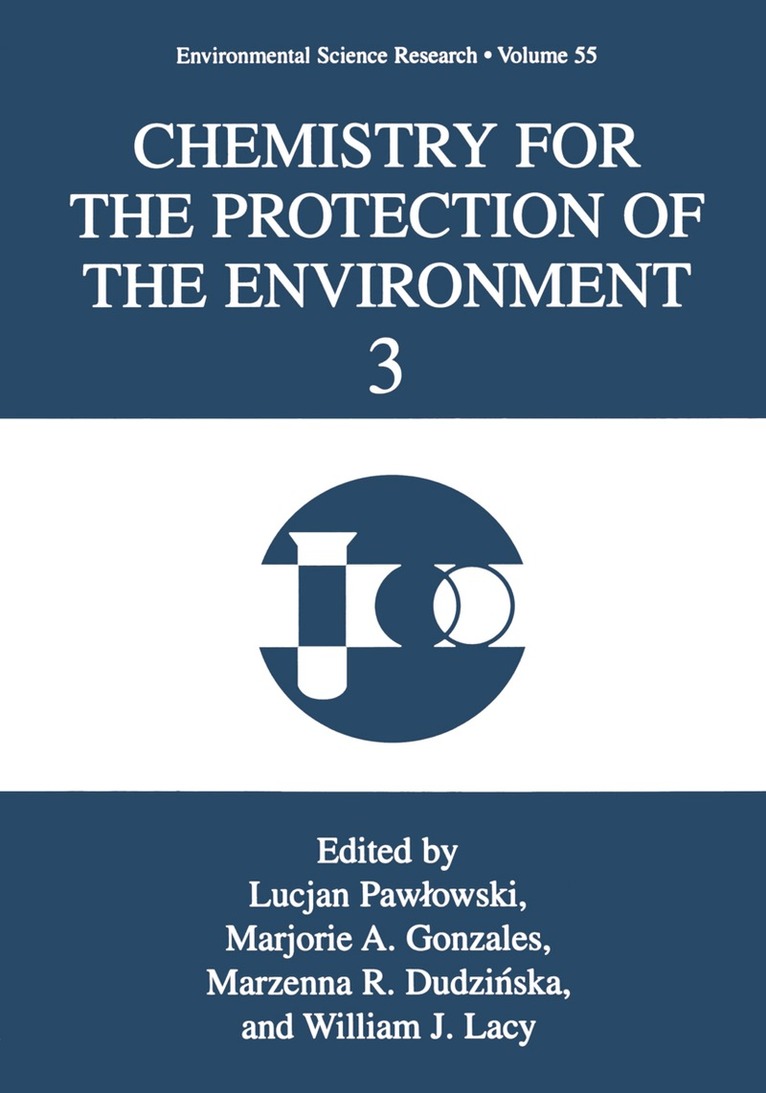
The first meeting in this series was organized by Prof. Pawlowski and Dr. Lacy in 1976 at the Marie Curie-Sklodowska University in Lublin, Poland. The conference dealt with various physicochemical methodologies for water and wastewater treatment research projects that were jointly sponsored by US EP A and Poland. The great interest expressed by the participants led the organizers to expand the scope of the second conference, which was also held in Poland in September 1979. The third and enlarged symposium was again successfully held in 1981 in Lublin, Poland. At that time the participating scientists and engineers expressed their desire to broaden the coverage as well as the title of the conference series. The International Committee, ap proved the title "Chemistry for the Protection of the Environment" and designated that date of the fourth conference, CPE IV, which was convened in September 1983 at the Paul Sabatier University in Toulouse, France, and was hosted and arranged by Prof. A. Verdier. This conference series included participants from various government agencies, academia, and the private sector, representing industrialized countries as well as emerging nations, both the East and West in an independent, non politica! forum.
1 064 kr
Skickas inom 10-15 vardagar
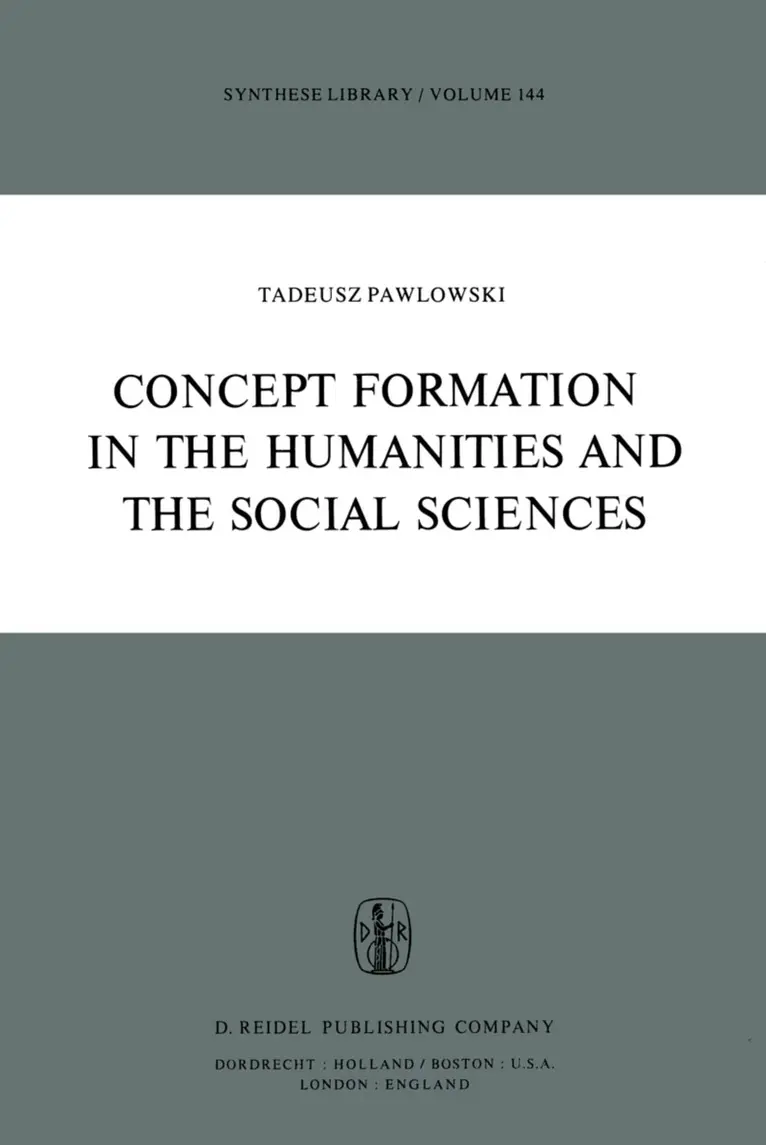
Uniqueness of style versus plurality of styles: in terms of these aesthetic categories one of the most important differences between the recent past and the present can be described. This difference manifests itself in all spheres of life - in fashion, in everyday life, in the arts, in science. What is of interest for my purposes in this book are its manifestations in the processes of con cept formation as they occur in the humanities, broadly conceived. Here the following methodological approaches seem to dominate the scene. 1. A tendency to apply semiotic concepts in various fields of research. 2. Attempts to introduce metrical concepts and measurement, even into disciplines tra ditionally considered as unamenable to mathematical treatment, like aesthetics and theory of art. 3. Efforts to fmd ways of formulating empirically testable, operational criteria for the application of concepts, especially concepts which refer to objects directly not observable, like dispositions, attitudes, character or personality traits. Care is also taken to take advantage of the conceptual apparatus of methodology to express problems in the humanities with the highest possible degree of clarity and precision. 4. Analysis of the p~rsuasive function oflanguage and its possible uses in science and in everyday life. The above tendencies are present in this book. It is divided into two parts: I. Methods of Concept Formation, and II. Applications. In the first part some general methods of concept formation are presented and their merits discussed.
1 064 kr
Skickas inom 10-15 vardagar
Uniqueness of style versus plurality of styles: in terms of these aesthetic categories one of the most important differences between the recent past and the present can be described. This difference manifests itself in all spheres of life - in fashion, in everyday life, in the arts, in science. What is of interest for my purposes in this book are its manifestations in the processes of con cept formation as they occur in the humanities, broadly conceived. Here the following methodological approaches seem to dominate the scene. 1. A tendency to apply semiotic concepts in various fields of research. 2. Attempts to introduce metrical concepts and measurement, even into disciplines tra ditionally considered as unamenable to mathematical treatment, like aesthetics and theory of art. 3. Efforts to fmd ways of formulating empirically testable, operational criteria for the application of concepts, especially concepts which refer to objects directly not observable, like dispositions, attitudes, character or personality traits. Care is also taken to take advantage of the conceptual apparatus of methodology to express problems in the humanities with the highest possible degree of clarity and precision. 4. Analysis of the p~rsuasive function oflanguage and its possible uses in science and in everyday life. The above tendencies are present in this book. It is divided into two parts: I. Methods of Concept Formation, and II. Applications. In the first part some general methods of concept formation are presented and their merits discussed.
1 064 kr
Skickas inom 10-15 vardagar
What is aesthetic value? A property in an object? An experience of a perceiving person? An ideal object existing in a mysterious sphere, inaccessible to normal cognition? Does it appear in one form only, or in many forms, perhaps infinitely many? Is it something constant, immutable, or rather something susceptible to change, depending on the individual, the cultural milieu, or the epoch? Is a rational defence of aesthetic value judgements possible, or is any discussion of this topic meaningless? The above questions arise out of the most complicated philosophic problems. Volumes have been written on each of them. The discussions which continue over the centuries, the plurality of views and suggested solutions, indicate that all issues are controversial and contestable. Each view can adduce some arguments supporting it; each has some weaknesses. Another source of difficulty is the vagueness and ambiguity of the language in which the problems are discussed. This makes it hard to understand the ideas of particular thinkers and sometimes makes it impossible to decide whether different formulations express the actual divergence of views or only the verbal preferences of their authors. Let us add that this imperfection does not simply spring from inaccuracy on the part of scholars, but also results from the complexity of the problems themselves. The matter is further complicated by important factors of a social character.