T. Szabo – författare
Visar alla böcker från författaren T. Szabo. Handla med fri frakt och snabb leverans.
3 produkter
3 produkter
E-bok
Engelska, 2013756 kr
Läs direkt efter köp
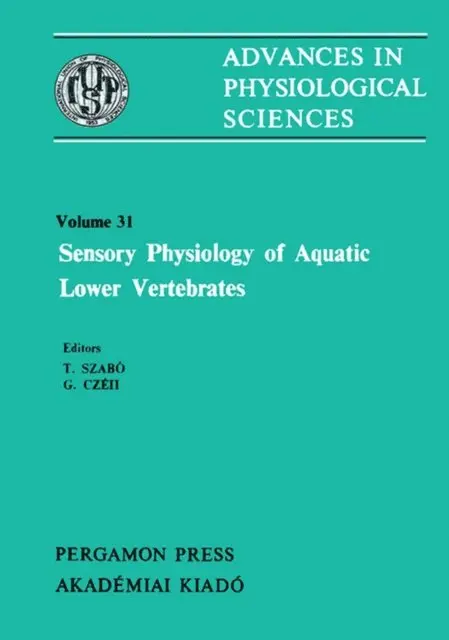
Advances in Physiological Sciences, Volume 31: Sensory Physiology of Aquatic Lower Vertebrates covers the proceedings of the symposia of the 28th International Congress of Physiology. The book presents 17 papers that detail advance findings in the sensory physiology of aquatic lower vertebrates. The coverage of the text includes electroreceptors in Indian catfish teleosts; electroreceptive microampulla in the African mudfish Clarias lazera; and species specificity of electric organ discharges in a sympatric group of gymnotoid fish from Manaus. The book also presents comparative studies, such as the sex differences in the electric organ discharge of Eigenmannia virescens and the effect of gonadal maturation; and behavioral studies, such as social behavior in mormyrid fish. The book will be of great interest to marine biologists, ethologists, and zoologists.
E-bok
PDF, Engelska, 20121 722 kr
Läs direkt efter köp
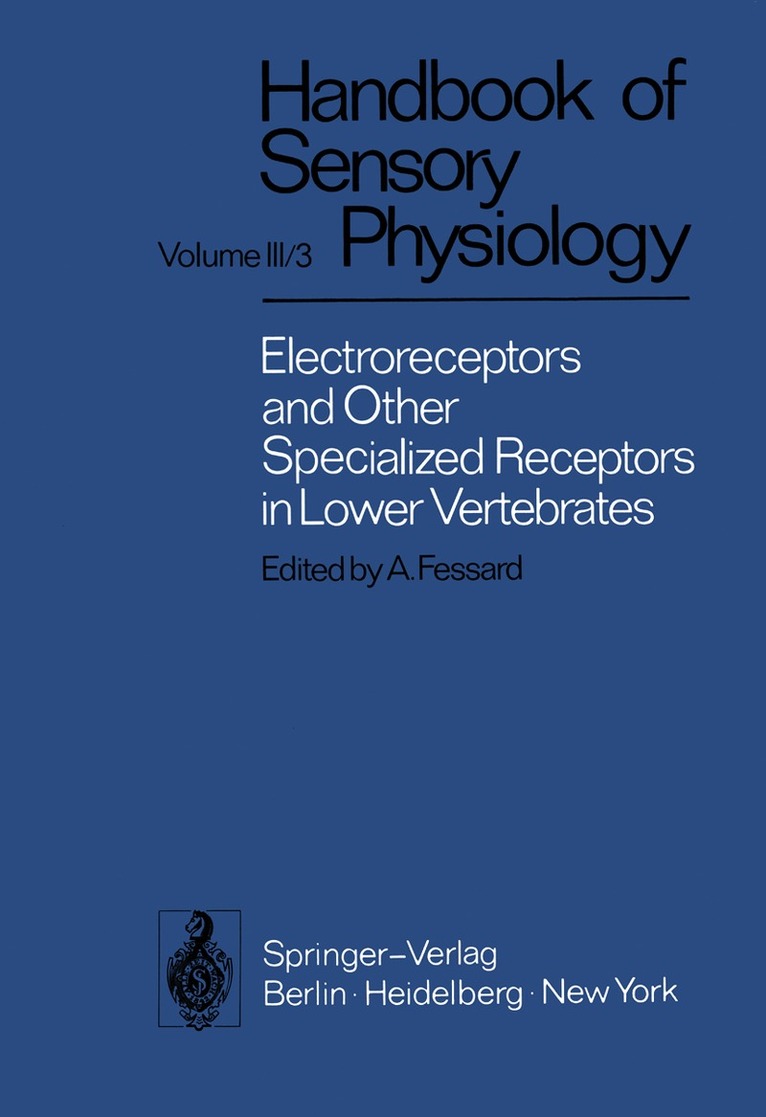
The originality of this volume is to reveal to the reader the fascination of some unfamiliar sensory organs that are sometimes ignored and often misunderstood. These receptors have only recently been identified and their functional specificity is in some cases still a matter for discussion. The four classes of sensory organs considered here differ widely from one another in many respects. One might even say that the only thing they have in common is that they belong to cold-blooded vertebrates. These classes are: 1. the directionally sensitive lateral-line mechanoreceptors of fishes and amphi bians (Chapter 7); 2. the pseudobranchial organs of some teleosts, equipped with pressoreceptors and at least three other types of receptors (osmo- and chemoreceptors) (Chapter 8); 3. the infrared-sensitive pit organs of some snake families (Chapter 9) ; 4. the various kinds of electroreceptors found in several marine and freshwater fish families (Chapters 2 to 6). The first three classes of receptors mentioned above thus rate only one chapter each, whereas five chapters are devoted to the electroreceptors. Electroreception has aroused enormous interest among physiologists in specialties ranging from molecular biology to animal behavior. The resulting quantity of research and discussion fully justifies this disproportion. However, it cannot be denied that the contents of the volume must appear unbalanced and heterogeneous, yet it should not be perceived as a mere juxtaposition of particular and unrelated cases.
Häftad, Engelska, 2011
1 446 kr
Skickas inom 10-15 vardagar
The originality of this volume is to reveal to the reader the fascination of some unfamiliar sensory organs that are sometimes ignored and often misunderstood. These receptors have only recently been identified and their functional specificity is in some cases still a matter for discussion. The four classes of sensory organs considered here differ widely from one another in many respects. One might even say that the only thing they have in common is that they belong to cold-blooded vertebrates. These classes are: 1. the directionally sensitive lateral-line mechanoreceptors of fishes and amphi bians (Chapter 7); 2. the pseudobranchial organs of some teleosts, equipped with pressoreceptors and at least three other types of receptors (osmo- and chemoreceptors) (Chapter 8); 3. the infrared-sensitive pit organs of some snake families (Chapter 9) ; 4. the various kinds of electroreceptors found in several marine and freshwater fish families (Chapters 2 to 6). The first three classes of receptors mentioned above thus rate only one chapter each, whereas five chapters are devoted to the electroreceptors. Electroreception has aroused enormous interest among physiologists in specialties ranging from molecular biology to animal behavior. The resulting quantity of research and discussion fully justifies this disproportion. However, it cannot be denied that the contents of the volume must appear unbalanced and heterogeneous, yet it should not be perceived as a mere juxtaposition of particular and unrelated cases.