Tadao Kasami – författare
Visar alla böcker från författaren Tadao Kasami. Handla med fri frakt och snabb leverans.
3 produkter
3 produkter
Inbunden, Engelska, 2000
1 105 kr
Skickas inom 10-15 vardagar
The symposium "Prehistoric Iberia: genetics, anthropology and linguistics" was held in the Circulo de Bellas Artes, Madrid on 16th -17th November 1998. The idea was bringing together specialists who could address not clearly resolved historic and prehistoric issues regarding ancient Iberian and Mediterranean populations, following a multidisciplinary approach. This was necessary in the light of the new bulk of genetic, archeological and linguistic data obtained with the new DNA technology and the recent discoverings in the other fields. Genes may now be easily studied in populations, particularly HLA genes and markers of the mitochondrial DNA and the Y chromosome. Basques, Iberians, North Africans, Berbers (Imazighen) and Mediterraneans have presently been widely studied. The genetic emerging picture is that Mediterraneans are closely related from West (Basque, Iberians, Berbers) to East (Jews, Lebanese, Cretans); however, Greeks are outliers in all the analyses done by using HLA genes. Anthropologists and archeologists showed how there was no people substitution during the revolutionary Mesolithic-Neolithic transition; in addition, cultural relationships were found between Iberia and predinastic Egypt (EI Badari culture). Basque language translation into Spanish has been the key for relating most Mediterranean extinct languages. The Usko-Mediterranean languages were once spoken in a wide African and European area, which also included parts of Asia. This was the "old language" that was slowly substituted by Eurasian languages starting approximately after the Bronze Age (or 2,000 years BC).
Del 443 - Springer International Series in Engineering and Computer Science
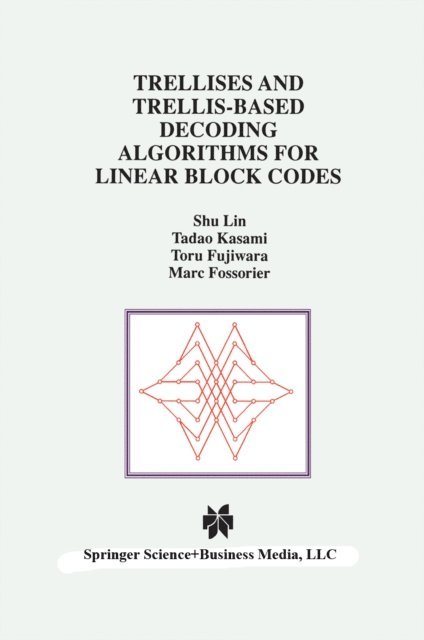
Trellises and Trellis-Based Decoding Algorithms for Linear Block Codes
Inbunden, Engelska, 1998
1 611 kr
Skickas inom 10-15 vardagar
As the demand for data reliability increases, coding for error control becomes increasingly important in data transmission systems and has become an integral part of almost all data communication system designs. In recent years, various trellis-based soft-decoding algorithms for linear block codes have been devised. New ideas developed in the study of trellis structure of block codes can be used for improving decoding and analyzing the trellis complexity of convolutional codes. These recent developments provide practicing communication engineers with more choices when designing error control systems. This text combines trellises and trellis-based decoding algorithms for linear codes together in a simple and unified form. The approach is to explain the material in an easily understood manner with minimal mathematical rigour. The book is intended for practicing communication engineers who want to have a fast grasp and understanding of the subject. Only material considered essential and useful for practical applications is included. This book can also be used as a text for advanced courses on the subject.
Del 443 - Springer International Series in Engineering and Computer Science
Trellises and Trellis-Based Decoding Algorithms for Linear Block Codes
Häftad, Engelska, 2012
1 620 kr
Skickas inom 10-15 vardagar
As the demand for data reliability increases, coding for error control becomes increasingly important in data transmission systems and has become an integral part of almost all data communication system designs. In recent years, various trellis-based soft-decoding algorithms for linear block codes have been devised. New ideas developed in the study of trellis structure of block codes can be used for improving decoding and analyzing the trellis complexity of convolutional codes. These recent developments provide practicing communication engineers with more choices when designing error control systems. Trellises and Trellis-based Decoding Algorithms for Linear Block Codes combines trellises and trellis-based decoding algorithms for linear codes together in a simple and unified form. The approach is to explain the material in an easily understood manner with minimal mathematical rigor. Trellises and Trellis-based Decoding Algorithms for Linear Block Codes is intended for practicing communication engineers who want to have a fast grasp and understanding of the subject. Only material considered essential and useful for practical applications is included. This book can also be used as a text for advanced courses on the subject.