Tafadzwanashe Mabhaudhi – författare
Visar alla böcker från författaren Tafadzwanashe Mabhaudhi. Handla med fri frakt och snabb leverans.
5 produkter
5 produkter
Häftad, Engelska, 2026
1 938 kr
Skickas inom 10-15 vardagar
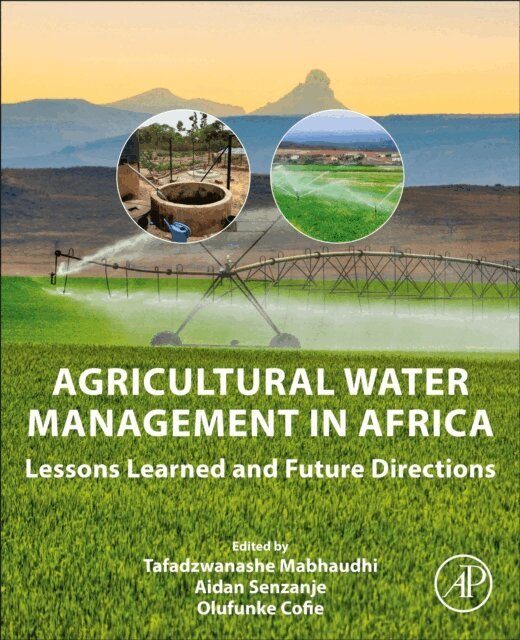
Agricultural Water Management in Africa presents a comprehensive look at the current state of irrigation development and agricultural water management (AWM) practices across Africa and the Global South. Going beyond just assessment, the book offers actionable guidelines, forward-looking scenarios, and strategic investment plans to help prioritize and implement irrigation and AWM initiatives in the face of climate change.At the heart of Africa’s push for agricultural transformation is the African Union’s (AU) Framework for Irrigation Development and Agricultural Water Management. This framework lays out four key development pathways to drive impactful change in water management across the continent: (i) enhanced water control and watershed management in rain-fed agriculture; (ii) farmer-led irrigation development that empowers local growers; (iii) modernization and expansion of irrigation schemes; (iv) utilization of unconventional water sources for sustainable irrigation.The book maps out the progress and potential of these pathways on a continental scale, showcasing how the AU-IDAWM framework can shape Africa’s water-secure agricultural future. To enrich this perspective, it also draws on case studies from Asia and Latin America, creating space for meaningful South-South knowledge exchange. It thoughtfully examines cross-cutting themes such as the water-energy-food nexus and the circular economy, placing AWM in the broader context of sustainability and climate resilience.Whether you are a policymaker, researcher, practitioner, or development partner, this volume delivers critical insights into how smarter water management can drive agricultural growth, food security, and environmental stewardship in Africa and beyond.Highlights fit-for-purpose irrigation strategies at scale and identifies opportunities and challenges of irrigation practicesExpands understanding of the pathways for AWM, presenting operation and maintenance proceduresIncludes bespoke designs guided by the AWM pathway approach
E-bok
Engelska, 20262 453 kr
Läs direkt efter köp
Agricultural Water Management in Africa presents a comprehensive look at the current state of irrigation development and agricultural water management (AWM) practices across Africa and the Global South. Going beyond just assessment, the book offers actionable guidelines, forward-looking scenarios, and strategic investment plans to help prioritize and implement irrigation and AWM initiatives in the face of climate change.At the heart of Africa's push for agricultural transformation is the African Union's (AU) Framework for Irrigation Development and Agricultural Water Management. This framework lays out four key development pathways to drive impactful change in water management across the continent: (i) enhanced water control and watershed management in rain-fed agriculture; (ii) farmer-led irrigation development that empowers local growers; (iii) modernization and expansion of irrigation schemes; (iv) utilization of unconventional water sources for sustainable irrigation.The book maps out the progress and potential of these pathways on a continental scale, showcasing how the AU-IDAWM framework can shape Africa's water-secure agricultural future. To enrich this perspective, it also draws on case studies from Asia and Latin America, creating space for meaningful South-South knowledge exchange. It thoughtfully examines cross-cutting themes such as the water-energy-food nexus and the circular economy, placing AWM in the broader context of sustainability and climate resilience.Whether you are a policymaker, researcher, practitioner, or development partner, this volume delivers critical insights into how smarter water management can drive agricultural growth, food security, and environmental stewardship in Africa and beyond. - Highlights fit-for-purpose irrigation strategies at scale and identifies opportunities and challenges of irrigation practices- Expands understanding of the pathways for AWM, presenting operation and maintenance procedures- Includes bespoke designs guided by the AWM pathway approach
Inbunden, Engelska, 2024
1 475 kr
Skickas inom 10-15 vardagar
The main aim of this book is to illustrate circular models for sustainable resource management. It highlights the benefits of transformative approaches in integrating, simplifying, and facilitating understanding of complex systems and transforming systems towards greater sustainability while achieving multiple social, economic, and environmental outcomes. It provides pathways towards strategic policy decisions on socio-economic transformation supported by case studies.Features:Discusses exploration of a transitional path to the circular economy, explored from the point of view of waste and technology.Explains transformational change towards sustainable socio-ecological interactions.Reviews provision of pathways towards sustainability through scenario development.Provides assessment of progress towards Sustainable Development Goals.Presents cross-sectoral and multicentric approaches towards circularity.This book is aimed at researchers and professionals in water and environmental engineering, circular economy, sustainability, and environmental studies.The Open Access version of this book, available at www.taylorfrancis.com, has been made available under a Creative Commons [Attribution-Non-Commercial (CC-BY-NC)] 4.0 license.
Häftad, Engelska, 2025
797 kr
Skickas inom 10-15 vardagar
The main aim of this book is to illustrate circular models for sustainable resource management. It highlights the benefits of transformative approaches in integrating, simplifying, and facilitating understanding of complex systems and transforming systems towards greater sustainability while achieving multiple social, economic, and environmental outcomes. It provides pathways towards strategic policy decisions on socio-economic transformation supported by case studies.Features:Discusses exploration of a transitional path to the circular economy, explored from the point of view of waste and technology.Explains transformational change towards sustainable socio-ecological interactions.Reviews provision of pathways towards sustainability through scenario development.Provides assessment of progress towards Sustainable Development Goals.Presents cross-sectoral and multicentric approaches towards circularity.This book is aimed at researchers and professionals in water and environmental engineering, circular economy, sustainability, and environmental studies.The Open Access version of this book, available at www.taylorfrancis.com, has been made available under a Creative Commons [Attribution-Non-Commercial (CC-BY-NC)] 4.0 license.
Inbunden, Engelska, 2025
2 373 kr
Skickas inom 10-15 vardagar
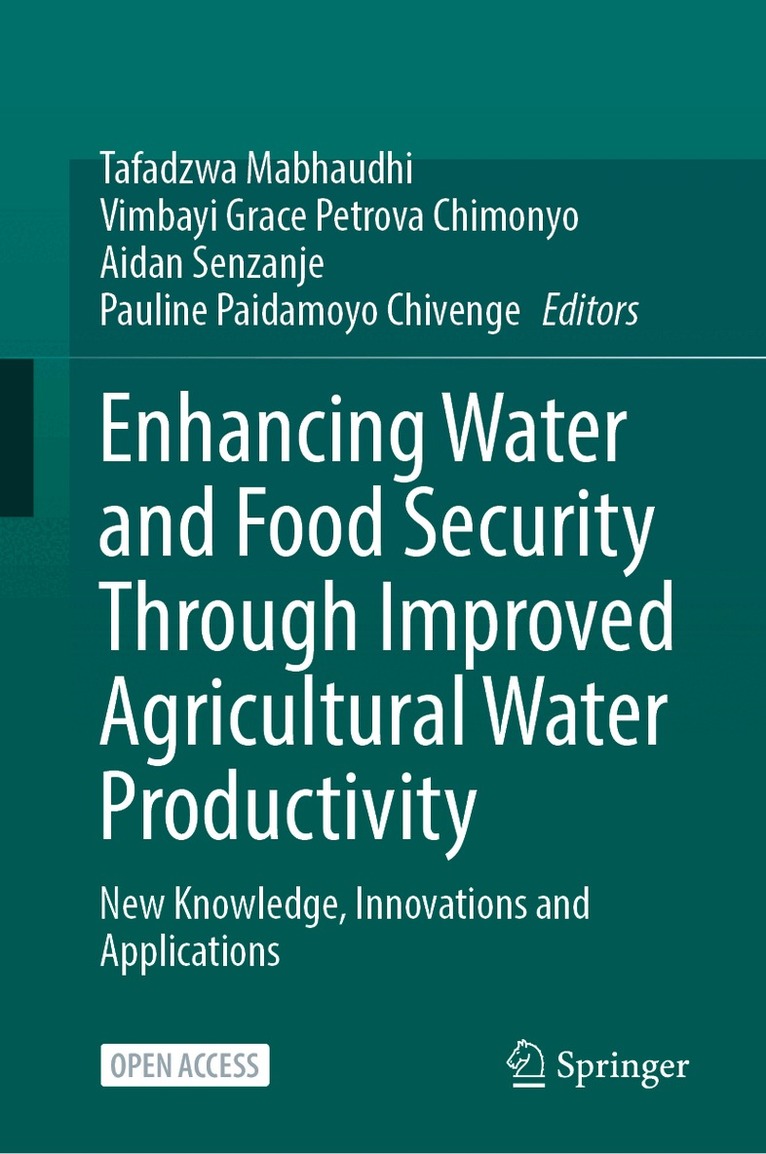
This open-access edited book provides a synthesis of knowledge on Water Productivity (WP) and its role in addressing global challenges related to water and food insecurity, as well as climate change. It explores how increasing WP can contribute to achieving several Sustainable Development Goals (SDGs) in the global South, with a focus on SDG 2, 6, and 12.The volume connects WP with emerging approaches such as the water-energy-food nexus, sustainable food systems, and the circular economy. It features case studies, critical analyses, and meta-analyses that bridge the science-policy-practice interface. The book also delves into WP's relation to global priorities, policies, and the empowerment of vulnerable communities, highlighting the non-negotiable rights to water and food. Governance, policies, and institutions are discussed in the context of enhancing WP in farmer-led irrigation and scaling WP technologies. The book also covers emerging methods for determining WP, assessing linkages to nutrition, health, and well-being, and integrating climate change adaptation and mitigation strategies.This is a guide for regional and international experts, professionals, and scholars interested in agricultural water management in the global south. The book has the potential to inform multi-regional and sectoral policies, particularly in Africa, and contribute to sustainable development through better resource management.