Taleghani-Nikazm Carmen Taleghani-Nikazm – författare
Visar alla böcker från författaren Taleghani-Nikazm Carmen Taleghani-Nikazm. Handla med fri frakt och snabb leverans.
2 produkter
2 produkter
E-bok
Engelska, 20201 305 kr
Läs direkt efter köp
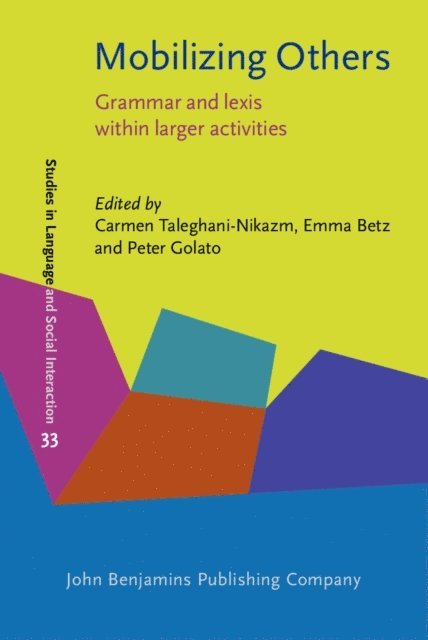
Requesting, recruitment, and other ways of mobilizing others to act have garnered much interest in Conversation Analysis and Interactional Linguistics. This volume takes a holistic perspective on the practices that we use to get others to act either with us, or for us. It argues for a more explicit focus on 'activity' in unpacking the linguistic and embodied choices we make in designing mobilizing moves. Drawing on studies from a variety of different languages and settings, the collected studies in this volume illustrate how interactants design their turns not only for specific recipients, but also for a specific interactional situation. In doing so, speakers are able to mobilize others' cooperation, contribution, or assistance in the most appropriate and economical ways. By focusing on 'situation design' across languages and settings, this volume provides new insights into the ways in which the ongoing activity, with its attendant participation structures, shapes the design, placement, and understanding of moves which mobilize others to act.
E-bok
PDF, Engelska, 20061 195 kr
Läs direkt efter köp
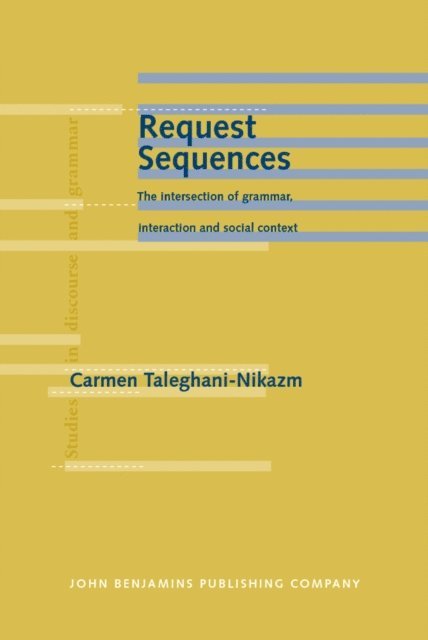
This monograph provides a micro-analytic description of instances of requests in everyday German conversation. Using the framework of CA, the study systematically analyzes the grammatical and syntactical structure of the request-turn and its response and of the conversational exchanges before and within the request base sequence, and the placement of the request sequence within the larger social interaction. Through an empirical analysis of individual cases of request sequences in German, the monograph describes in detail: (a) how speakers employ grammar and syntax as resources to construct turns at talk and accomplish the social action of request; (b) how speakers use grammatical and syntactical forms of the language to coordinate the production of the social action of requests; (c) how speakers use grammar and syntax as interactional resources to manage affiliative and remedial work (i.e., face work) when performing delicate social actions such as requests; and (d) how the context of the request activity impacts the grammatical and syntactical constructions of speakers' utterances. Additionally, the monograph demonstrates that both the grammatical construction of turns and their placement within the talk are oriented to the sequential context of the interaction.