Tamara Munzner – författare
Visar alla böcker från författaren Tamara Munzner. Handla med fri frakt och snabb leverans.
5 produkter
5 produkter
Inbunden, Engelska, 2014
1 019 kr
Skickas inom 5-8 vardagar
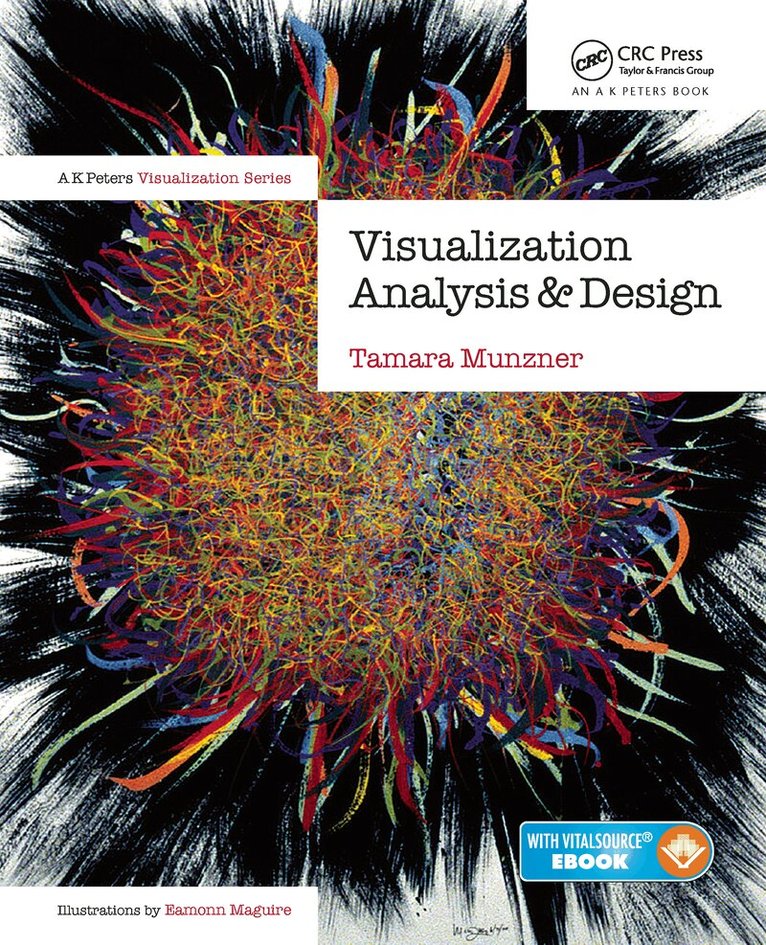
Learn How to Design Effective Visualization SystemsVisualization Analysis and Design provides a systematic, comprehensive framework for thinking about visualization in terms of principles and design choices. The book features a unified approach encompassing information visualization techniques for abstract data, scientific visualization techniques for spatial data, and visual analytics techniques for interweaving data transformation and analysis with interactive visual exploration. It emphasizes the careful validation of effectiveness and the consideration of function before form.The book breaks down visualization design according to three questions: what data users need to see, why users need to carry out their tasks, and how the visual representations proposed can be constructed and manipulated. It walks readers through the use of space and color to visually encode data in a view, the trade-offs between changing a single view and using multiple linked views, and the ways to reduce the amount of data shown in each view. The book concludes with six case studies analyzed in detail with the full framework.A companion website featuring: figures, slides, further reading, course usage, author interviews and more can be found here: https://www.cs.ubc.ca/~tmm/vadbook/. The book is suitable for a broad set of readers, from beginners to more experienced visualization designers. It does not assume any previous experience in programming, mathematics, human–computer interaction, or graphic design and can be used in an introductory visualization course at the graduate or undergraduate level.
E-bok
PDF, Engelska, 20141 281 kr
Läs direkt efter köp
Learn How to Design Effective Visualization SystemsVisualization Analysis and Design provides a systematic, comprehensive framework for thinking about visualization in terms of principles and design choices. The book features a unified approach encompassing information visualization techniques for abstract data, scientific visualization techniques
E-bok
Engelska, 20141 281 kr
Läs direkt efter köp
Learn How to Design Effective Visualization SystemsVisualization Analysis and Design provides a systematic, comprehensive framework for thinking about visualization in terms of principles and design choices. The book features a unified approach encompassing information visualization techniques for abstract data, scientific visualization techniques
Häftad, Engelska, 2010
316 kr
Skickas inom 10-15 vardagar
Displaying multiple levels of data visually has been proposed to address the challenge of limited screen space. Although many previous empirical studies have addressed different aspects of this question, the information visualization research community does not currently have a clearly articulated consensus on how, when, or even if displaying data at multiple levels is effective.To shed more light on this complex topic, we conducted a systematic review of 22 existing multi-level interface studies to extract high-level design guidelines. To facilitate discussion, we cast our analysis findings into a four-point decision tree: (1) When are multi-level displays useful? (2) What should the higher visual levels display? (3) Should the different visual levels be displayed simultaneously, or one at a time? (4) Should the visual levels be embedded in a single display, or separated into multiple displays? Our analysis resulted in three design guidelines: (1) the number of levels in display anddata should match; (2) high visual levels should only display task-relevant information; (3) simultaneous display, rather than temporal switching, is suitable for tasks with multi-level answers.Table of Contents: Introduction / Terminology / Methodology / Summary of Studies / Decision 1: Single or Multi-level Interface? / Decision 2: How to Create the High-Level Displays? / Decision 3: Simultaneous or Temporal Displays of the Multiple Visual Levels / Decision 4: How to Spatially Arrange the Visual Levels, Embedded or Separate? / Limitations of Study / Design Recommendations / Discussion and Future Work
E-bok
PDF, Engelska, 2022393 kr
Läs direkt efter köp
Displaying multiple levels of data visually has been proposed to address the challenge of limited screen space. Although many previous empirical studies have addressed different aspects of this question, the information visualization research community does not currently have a clearly articulated consensus on how, when, or even if displaying data at multiple levels is effective.To shed more light on this complex topic, we conducted a systematic review of 22 existing multi-level interface studies to extract high-level design guidelines. To facilitate discussion, we cast our analysis findings into a four-point decision tree: (1) When are multi-level displays useful? (2) What should the higher visual levels display? (3) Should the different visual levels be displayed simultaneously, or one at a time? (4) Should the visual levels be embedded in a single display, or separated into multiple displays? Our analysis resulted in three design guidelines: (1) the number of levels in display anddata should match; (2) high visual levels should only display task-relevant information; (3) simultaneous display, rather than temporal switching, is suitable for tasks with multi-level answers.Table of Contents: Introduction / Terminology / Methodology / Summary of Studies / Decision 1: Single or Multi-level Interface? / Decision 2: How to Create the High-Level Displays? / Decision 3: Simultaneous or Temporal Displays of the Multiple Visual Levels / Decision 4: How to Spatially Arrange the Visual Levels, Embedded or Separate? / Limitations of Study / Design Recommendations / Discussion and Future Work