Tamás Roska - Böcker
Visar alla böcker från författaren Tamás Roska. Handla med fri frakt och snabb leverans.
5 produkter
5 produkter
Towards the Visual Microprocessor
VLSI Design and the Use of Cellular Neural Network Universal Machines
Inbunden, Engelska, 2000
2 880 kr
Skickas inom 11-20 vardagar
Written by a group of leading researchers in the field, this is a pioneering work, providing a concise analysis of the topic by the inventors of the CNN universal machine and the supercomputer chip. Opening with a foreword by the respected academic, Professor Leon Chua, the book progresses to explore circuit design, prototyping and analogical algorithms. Subjects covered include the VLSI design and implementation of CNNs, the testing of CNN chips and a detailed analysis of the new system for prototyping and interfacing the CNN universal chips? Includes applications in: Neurocomputing, Machine Vision, Image Processing and VLSI Signal Processing? Provides simple algorithms to design and synthesise complex circuits? Written and edited by world authorities in this field, including Leon Chua who invented CNNs in the late 1980s.This text follows on from Roska's previous success - Cellular Neural Networks and D3 - with this groundbreaking work about a rapidly developing and increasingly influential field of circuit theory. This text would be of great interest to a broad audience including postgraduate and advanced students, researchers and professionals in electrical and electronic engineering, computer science, mathematics and neurobiology.
1 070 kr
Skickas inom 7-10 vardagar
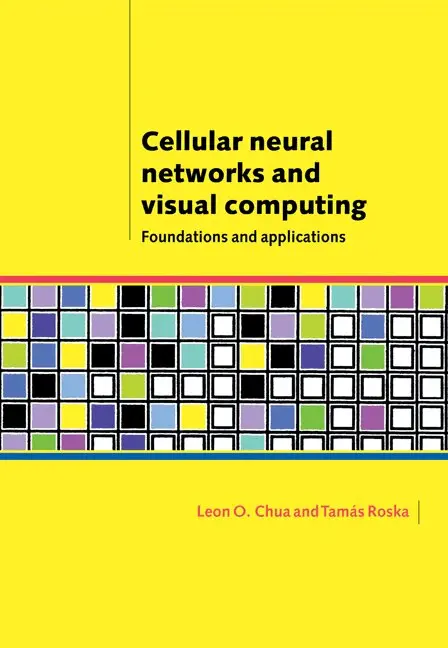
Cellular Nonlinear/neural Network (CNN) technology is both a revolutionary concept and an experimentally proven new computing paradigm. Analogic cellular computers based on CNNs are set to change the way analog signals are processed and are paving the way to an analog computing industry. This unique undergraduate level textbook includes many examples and exercises, including CNN simulator and development software accessible via the Internet. It is an ideal introduction to CNNs and analogic cellular computing for students, researchers and engineers from a wide range of disciplines. Although its prime focus is on visual computing, the concepts and techniques described in the book will be of great interest to those working in other areas of research including modeling of biological, chemical and physical processes. Leon Chua, co-inventor of the CNN, and Tamás Roska are both highly respected pioneers in the field.
1 797 kr
Skickas inom 7-10 vardagar
Cellular Nonlinear/neural Network (CNN) technology is both a revolutionary concept and an experimentally proven new computing paradigm. Analogic cellular computers based on CNNs are set to change the way analog signals are processed and are paving the way to an analog computing industry. This unique undergraduate level textbook includes many examples and exercises, including CNN simulator and development software accessible via the Internet. It is an ideal introduction to CNNs and analogic cellular computing for students, researchers and engineers from a wide range of disciplines. Although its prime focus is on visual computing, the concepts and techniques described in the book will be of great interest to those working in other areas of research including modeling of biological, chemical and physical processes. Leon Chua, co-inventor of the CNN, and Tamás Roska are both highly respected pioneers in the field.
1 578 kr
Skickas inom 10-15 vardagar
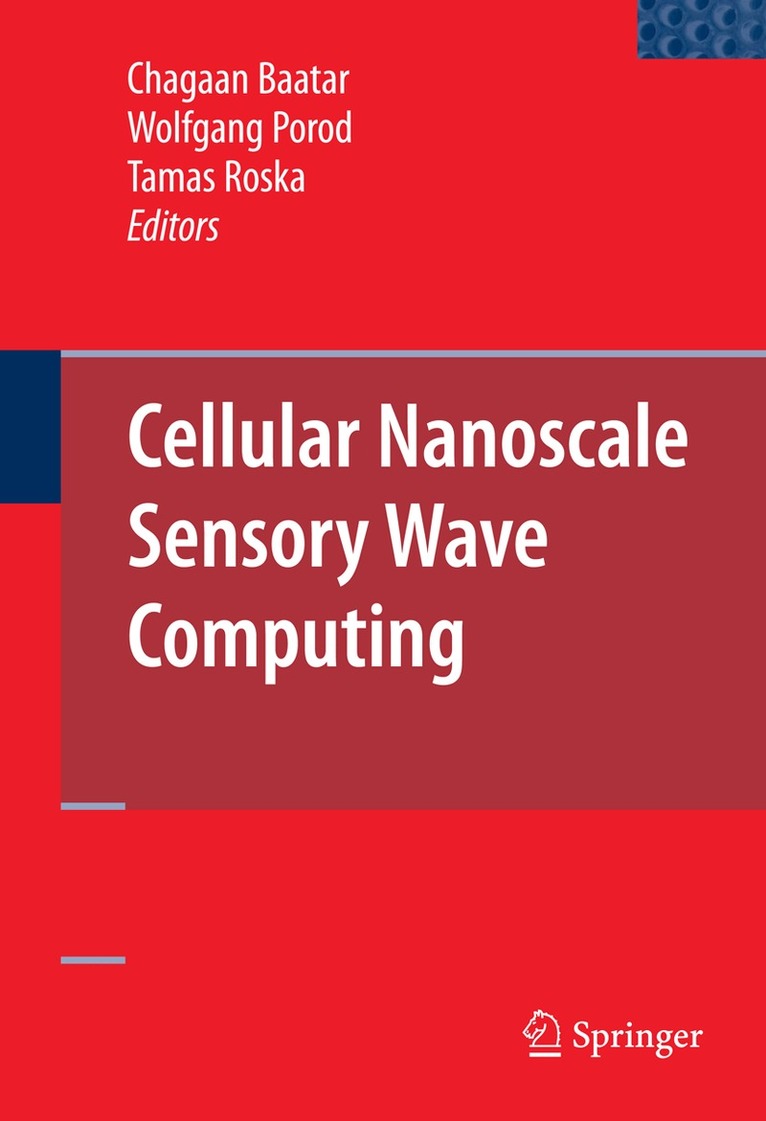
This book is loosely based on a Multidisciplinary University Research Initiative (MURI) project and a few supplemental projects sponsored by the Of?ce of Naval Research (ONR) during the time frame of 2004–2009. The initial technical scope and vision of the MURI project was formulated by Drs. Larry Cooper and Joel Davis, both program of?cers at ONR at the time. The unifying theme of this MURI project and its companionefforts is the concept of cellular nonlinear/neuralnetwork (CNN) technology and its various extensions and chip implementations, including nanoscale sensors and the broadening ?eld of cellular wave computing. In recent years, CNN-based vision system drew much attention from vision scientists to device technologists and computer architects. Due to its early - plementation in a two-dimensional (2D) topography, it found success in early vision technologyapplications, such as focal-plane arrays, locally adaptable sensor/ processor integration, resulting in extremely high frame rates of 10,000 frames per second. More recently it drew increasing attention from computer architects, due to its intrinsic local interconnect architecture and parallel processing paradigm. As a result, a few spin-off companies have already been successful in bringing cel- lar wave computing and CNN technology to the market. This book aims to capture some of the recent advances in the ?eld of CNN research and a few select areas of applications.
1 578 kr
Skickas inom 10-15 vardagar
This book is loosely based on a Multidisciplinary University Research Initiative (MURI) project and a few supplemental projects sponsored by the Of?ce of Naval Research (ONR) during the time frame of 2004–2009. The initial technical scope and vision of the MURI project was formulated by Drs. Larry Cooper and Joel Davis, both program of?cers at ONR at the time. The unifying theme of this MURI project and its companionefforts is the concept of cellular nonlinear/neuralnetwork (CNN) technology and its various extensions and chip implementations, including nanoscale sensors and the broadening ?eld of cellular wave computing. In recent years, CNN-based vision system drew much attention from vision scientists to device technologists and computer architects. Due to its early - plementation in a two-dimensional (2D) topography, it found success in early vision technologyapplications, such as focal-plane arrays, locally adaptable sensor/ processor integration, resulting in extremely high frame rates of 10,000 frames per second. More recently it drew increasing attention from computer architects, due to its intrinsic local interconnect architecture and parallel processing paradigm. As a result, a few spin-off companies have already been successful in bringing cel- lar wave computing and CNN technology to the market. This book aims to capture some of the recent advances in the ?eld of CNN research and a few select areas of applications.