Tanja Temmerman - Böcker
Visar alla böcker från författaren Tanja Temmerman. Handla med fri frakt och snabb leverans.
4 produkter
4 produkter
692 kr
Skickas inom 5-8 vardagar
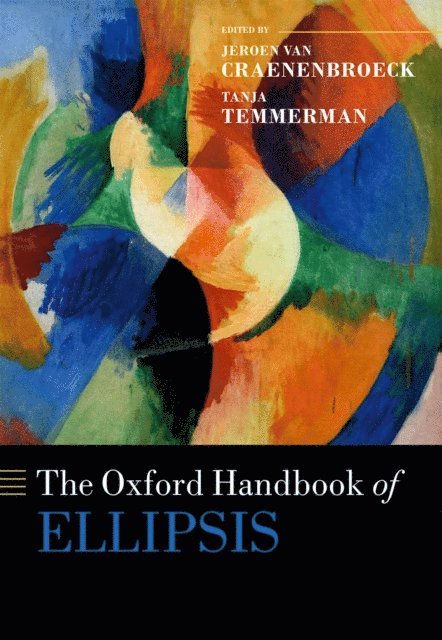
This Handbook is the first volume to provide a comprehensive, in-depth, and balanced discussion of ellipsis phenomena, whereby the meaning of an utterance is richer than would be expected based solely on its linguistic form. Natural language abounds in these apparently incomplete expressions, such as I laughed but Ed didn't, in which the final portion of the sentence, the verb 'laugh', remains unpronounced but is still understood. The range of phenomena involved raise general and fundamental questions about the workings of grammar, but also constitute a treasure trove of fine-grained points of inter- and intralinguistic variation.The volume is divided into four parts. In the first, authors examine the role that ellipsis plays and how it is analysed in different theoretical frameworks and linguistic subdisciplines, such as HPSG, construction grammar, inquisitive semantics, and computational linguistics. Chapters in the second part highlight the usefulness of ellipsis as a diagnostic tool for other linguistic phenomena including movement and islands and codeswitching, while part III focuses instead on the types of elliptical constructions found in natural language, such as sluicing, gapping, and null complement anaphora. Finally, the last part of the book contains case studies that investigate elliptical phenomena in a wide variety of languages, including Dutch, Japanese, Persian, and Finnish Sign Language.
2 679 kr
Skickas inom 7-10 vardagar
This handbook is the first volume to provide a comprehensive, in-depth, and balanced discussion of ellipsis phenomena, whereby the meaning of an utterance is richer than would be expected based solely on its linguistic form. Natural language abounds in these apparently incomplete expressions, such as I laughed but Ed didn't, in which the final portion of the sentence, the verb 'laugh', remains unpronounced but is still understood. The range of phenomena involved raise general and fundamental questions about the workings of grammar, but also constitute a treasure trove of fine-grained points of inter- and intralinguistic variation.The volume is divided into four parts. In the first, authors examine the role that ellipsis plays and how it is analysed in different theoretical frameworks and linguistic subdisciplines, such as HPSG, construction grammar, inquisitive semantics, and computational linguistics. Chapters in the second part highlight the usefulness of ellipsis as a diagnostic tool for other linguistic phenomena including movement and islands and codeswitching, while part III focuses instead on the types of elliptical constructions found in natural language, such as sluicing, gapping, and null complement anaphora. Finally, the last part of the book contains case studies that investigate elliptical phenomena in a wide variety of languages, including Dutch, Japanese, Persian, and Finnish Sign Language.
2 025 kr
Skickas inom 5-8 vardagar
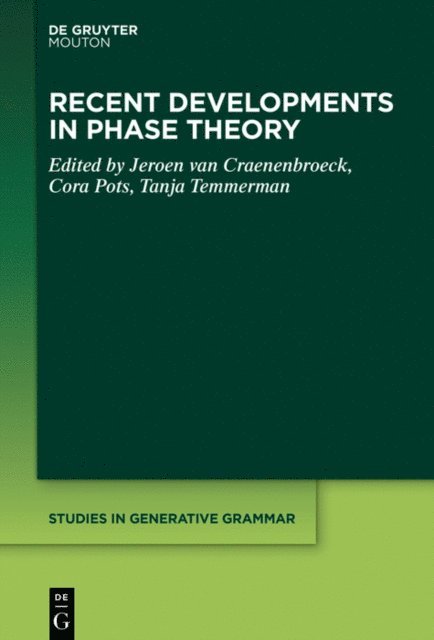
The overarching goal of this volume is to explore a number of recent developments in Phase Theory (both theoretical and empirical), thus contributing to our overall understanding of the concept of phases.The volume is divided into three parts, of which the first focuses on the traditional role played by phases in defining successive cyclicity, while at the same time examining the interaction between that traditional role and Chomsky (2013)’s proposal about labeling. The second part focuses on the question of whether only the highest projection of the clausal and nominal domain, CP and DP, are phases or whether those domains also contain an internal phase: vP and NP/NumP/QP, while the third part contains two chapters that focus on the extent to which ellipsis can be used as a reliable diagnostic for phasehood.As a whole, the volume provides a detailed and in-depth view on a number of recent developments in Phase Theory, which will likely continue to dominate the debate for several years to come.
294 kr
Skickas inom 5-8 vardagar
The overarching goal of this volume is to explore a number of recent developments in Phase Theory (both theoretical and empirical), thus contributing to our overall understanding of the concept of phases.The volume is divided into three parts, of which the first focuses on the traditional role played by phases in defining successive cyclicity, while at the same time examining the interaction between that traditional role and Chomsky (2013)’s proposal about labeling. The second part focuses on the question of whether only the highest projection of the clausal and nominal domain, CP and DP, are phases or whether those domains also contain an internal phase: vP and NP/NumP/QP, while the third part contains two chapters that focus on the extent to which ellipsis can be used as a reliable diagnostic for phasehood.As a whole, the volume provides a detailed and in-depth view on a number of recent developments in Phase Theory, which will likely continue to dominate the debate for several years to come.