Tapan Mitra – författare
Visar alla böcker från författaren Tapan Mitra. Handla med fri frakt och snabb leverans.
7 produkter
7 produkter
Häftad, Engelska, 2009
542 kr
Skickas inom 5-8 vardagar
Inbunden, Engelska, 2006
1 664 kr
Skickas inom 10-15 vardagar
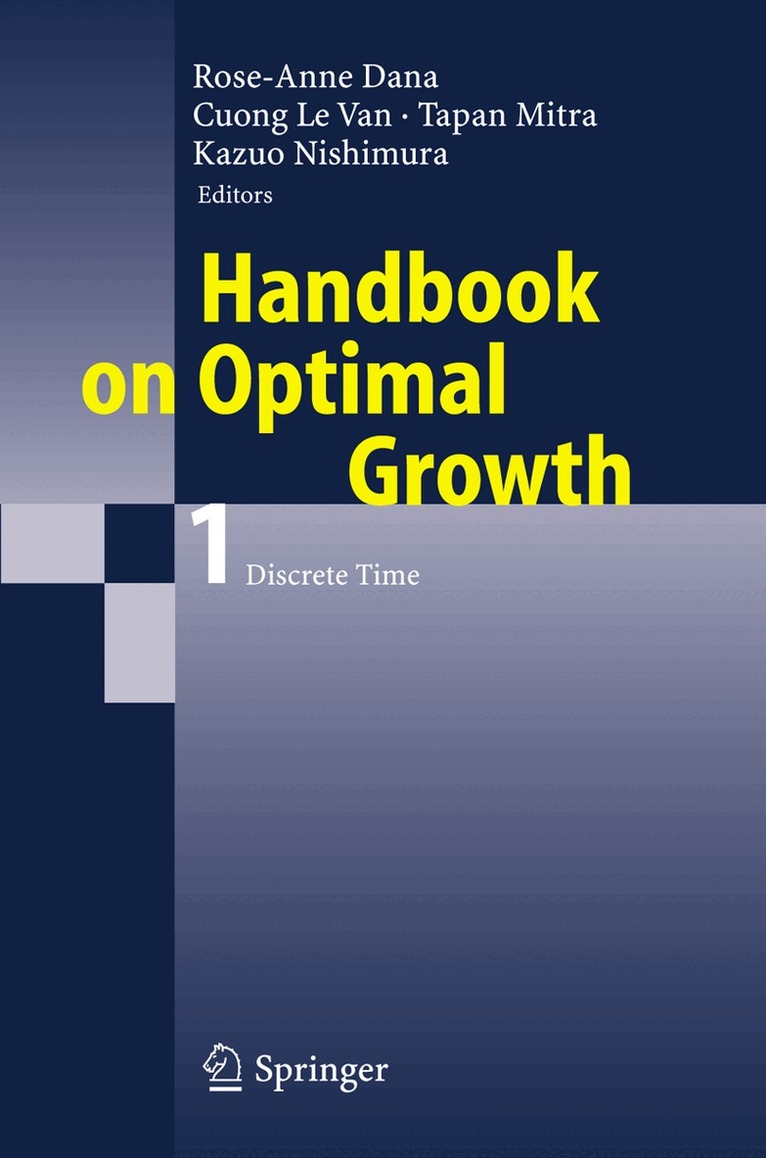
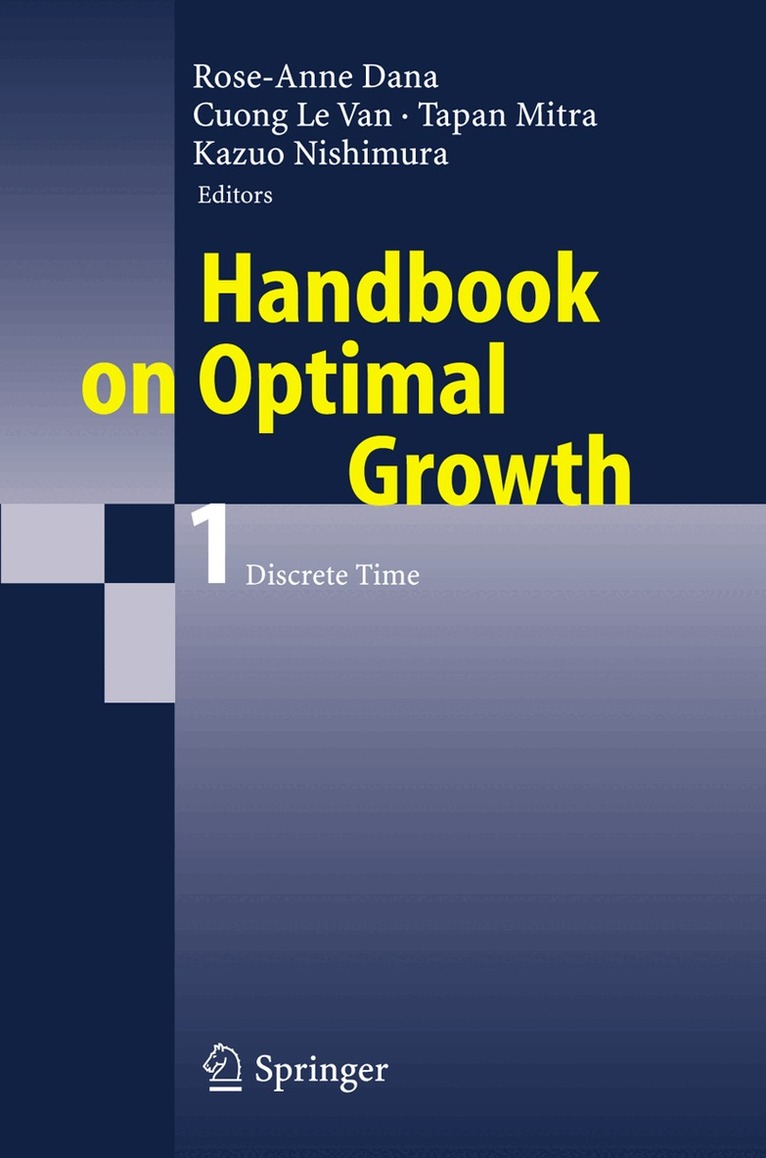
The problem of e?cient or optimal allocation of resources is a fundamental concern of economic analysis. The theory of optimal economic growth can be viewedasanaspectofthiscentraltheme,whichemphasizesingeneraltheissues arising in the allocation of resources over an in?nite time horizon, and in p- ticular the consumption-investment decision process in models in which there is no natural ”terminal date”. This broad scope of ”optimal growth theory” is one which has evolved over time, as economists have discovered new interp- tations of its central results, as well as new applications of its basic methods. The purpose of this handbook is to provide surveys of some signi?cant results of the theory of optimal growth,as well as the techniques of dynamic optimi- tion theory on which they are based. Armed with the results and methods of this theory, a researcher should be in an advantageous position to apply these versatile methods of analysis to new issues in the area of dynamic economics, as well as to contribute to the further development of the mathematical te- niques of optimization over time. The survey included in this volume all have as a common starting point the seminal contribution of Frank Ramsey (1928).
E-bok
PDF, Engelska, 20062 110 kr
Läs direkt efter köp
The problem of e?cient or optimal allocation of resources is a fundamental concern of economic analysis. The theory of optimal economic growth can be viewedasanaspectofthiscentraltheme,whichemphasizesingeneraltheissues arising in the allocation of resources over an in?nite time horizon, and in p- ticular the consumption-investment decision process in models in which there is no natural ”terminal date”. This broad scope of ”optimal growth theory” is one which has evolved over time, as economists have discovered new interp- tations of its central results, as well as new applications of its basic methods. The purpose of this handbook is to provide surveys of some signi?cant results of the theory of optimal growth,as well as the techniques of dynamic optimi- tion theory on which they are based. Armed with the results and methods of this theory, a researcher should be in an advantageous position to apply these versatile methods of analysis to new issues in the area of dynamic economics, as well as to contribute to the further development of the mathematical te- niques of optimization over time. The survey included in this volume all have as a common starting point the seminal contribution of Frank Ramsey (1928).
Inbunden, Engelska, 2000
1 616 kr
Skickas inom 10-15 vardagar
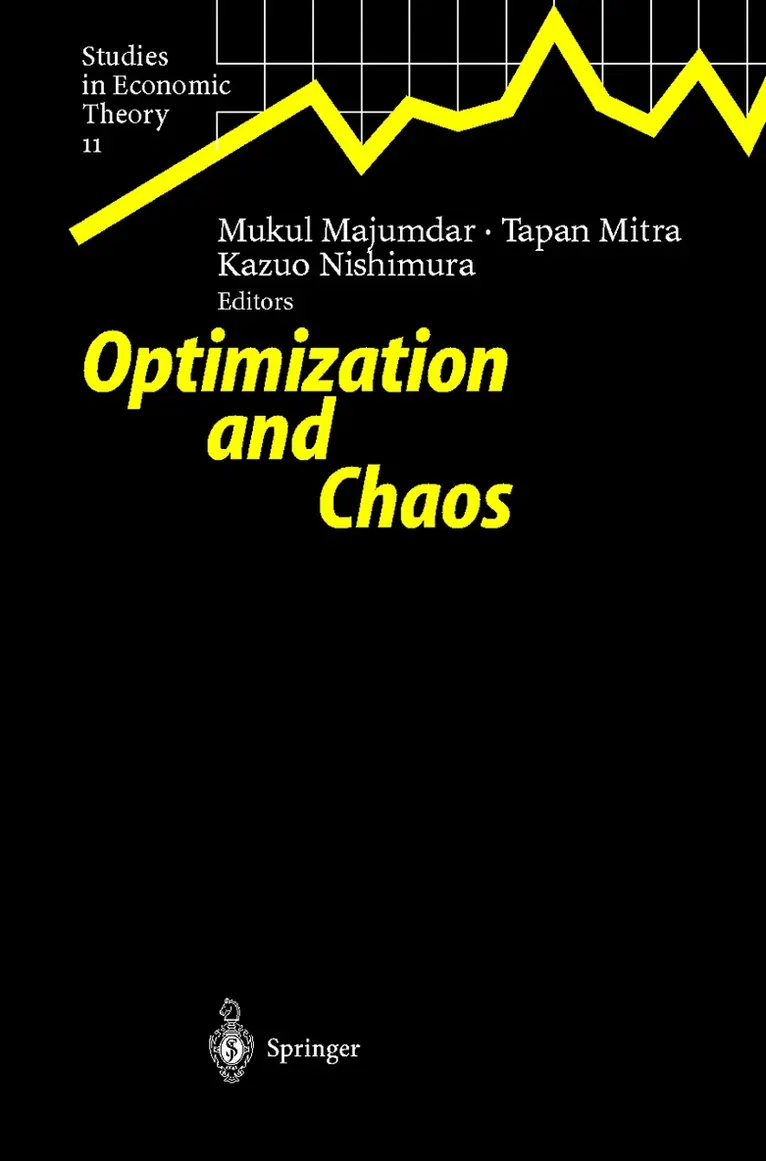
The book begins with an introduction to some of the basic concepts and results on chaotic dynamical systems. Next it turns to a detailed self-contained summary of the literature on discounted dynamic optimization. The first two chapters are of particular pedagogical interest. The volume also brings together a number of outstanding advanced research papers on complex behavior of dynamic economic models. These make it clear that complexity cannot be dismissed as "exceptional" or "pathological" and, for explanation and prediction of economic variables, it is imperative to develop models with special structures suggested by empirical studies. Graduate students in economics will find the book valuable for an introduction to optimization and chaos. Specialists will find new directions to explore themes like robustness of chaotic behavior and the role of discounting in generating cycles and complexity.
Häftad, Engelska, 2010
1 616 kr
Skickas inom 10-15 vardagar
The problem of e?cient or optimal allocation of resources is a fundamental concern of economic analysis. The theory of optimal economic growth can be viewedasanaspectofthiscentraltheme,whichemphasizesingeneraltheissues arising in the allocation of resources over an in?nite time horizon, and in p- ticular the consumption-investment decision process in models in which there is no natural ”terminal date”. This broad scope of ”optimal growth theory” is one which has evolved over time, as economists have discovered new interp- tations of its central results, as well as new applications of its basic methods. The purpose of this handbook is to provide surveys of some signi?cant results of the theory of optimal growth,as well as the techniques of dynamic optimi- tion theory on which they are based. Armed with the results and methods of this theory, a researcher should be in an advantageous position to apply these versatile methods of analysis to new issues in the area of dynamic economics, as well as to contribute to the further development of the mathematical te- niques of optimization over time. The survey included in this volume all have as a common starting point the seminal contribution of Frank Ramsey (1928).
Häftad, Engelska, 2010
1 616 kr
Skickas inom 10-15 vardagar
The book begins with an introduction to some of the basic concepts and results on chaotic dynamical systems. Next it turns to a detailed self-contained summary of the literature on discounted dynamic optimization. The first two chapters are of particular pedagogical interest. The volume also brings together a number of outstanding advanced research papers on complex behavior of dynamic economic models. These make it clear that complexity cannot be dismissed as "exceptional" or "pathological" and, for explanation and prediction of economic variables, it is imperative to develop models with special structures suggested by empirical studies. Graduate students in economics will find the book valuable for an introduction to optimization and chaos. Specialists will find new directions to explore themes like robustness of chaotic behavior and the role of discounting in generating cycles and complexity.
E-bok
PDF, Engelska, 20132 049 kr
Läs direkt efter köp
This collection of essays brings together some articles on dynamic optimization models that exhibit chaotic behavior. Chapters 3, 4, 5, 6, 7, and 9 appeared in a Symposium on Chaotic Dynamical Systems in Economic Theory (Volume 4, Number 5, 1994). Also, Chapters 10,11, and 12 appeared in the Journal of Economic The ory. We would like to thank the authors, and Academic Press for permission to reprint. We are grateful to Professor C.D. Aliprantis for suggesting the idea of a book structured around the Economic Theory Symposium, and without the support and patience of Dr. Mueller this project could not have been completed. We would like to thank Ms. Amy Gowan who cheerfully per formed the arduous task of typing the manuscript. Thanks are also due to Xiao Qing Yu, Tridip Ray and Malabika Majumdar for their help at various stages in the preparation of the manuscript. For a course on dynamic optimization addressed to students with a good background in economic theory and real analysis, one can assign Chapter 2 as a partial introduction to the basic tech niques. Chapters 3 and 4 can be assigned to provide examples of simple optmization models generating complicated behavior.