Ted Gittinger – författare
Visar alla böcker från författaren Ted Gittinger. Handla med fri frakt och snabb leverans.
2 produkter
2 produkter
Häftad, Engelska, 1997
279 kr
Skickas inom 10-15 vardagar
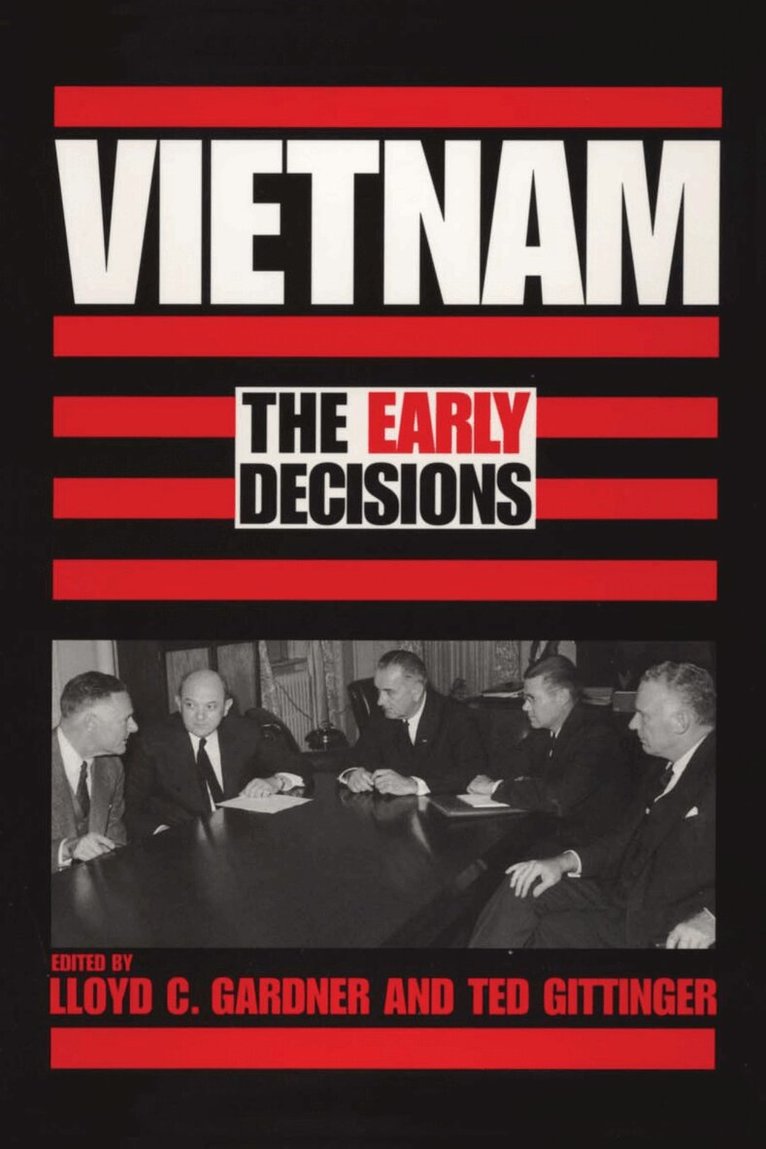
Haunting questions remain about our involvement in Vietnam. Perhaps the most persistent of these is whether President Kennedy would have ended American involvement in Vietnam if he had lived.For many Americans, Oliver Stone's film JFK left no doubt that before his assassination Kennedy had determined to quit Vietnam. Yet the historical record offers a more complex answer. In this fresh look at the archival evidence, noted scholars take up the challenge to provide us with their conclusions about the early decisions that put the United States on the path to the greatest American tragedy since the Civil War. The tensions and turmoil that accompanied those decisions reveal the American presidency at the center of a storm of conflicting advice.The book is divided into four sections. Parts one and two delve into the political and military contexts of the early decisions. Part three raises the intriguing questions of Kennedy's and Johnson's roles in the conflict, particularly the thorny issue of whether Kennedy did, in fact, intend to withdraw from Vietnam and whether Johnson reversed that policy. Part four reveals an uncanny parallel between early Soviet policy toward Hanoi and U.S. policy toward Saigon.
E-bok
PDF, Engelska, 2004357 kr
Läs direkt efter köp
The Search for Peace in Vietnam, 1964-1968, the newest edition in the Texas A&M University Press Series on Foreign Relations and the Presidency, is a collection of essays that analyze the Vietnam War in terms of its significance to the global arena. Under the guidance of editors Lloyd C. Gardner and Ted Gittinger, the contributors, representing both communist and capitalist backgrounds, examine whether the Vietnam War was responsible for the transformation of the international system, using a formula postulated by series editor H. W. Brands, which looks at the international system at the beginning of the war and at the end, and measuring how much of the difference in the two periods is the result of the war.Topics include Robert J. McMahon''s assessment of the war''s legacy to Southeast Asia; Xiaoming Zhang''s analysis of Chinese involvement as an element in the Sino-Soviet rivalry; Ilya Gaiduk''s account of the Soviet Indochina policy within the context of Moscow''s relations with the outside world; Judith A. Klinghoffer''s examination of the war''s role in determining American foreign policy in the Middle East; Hiroshi Fujimoto''s discussion of whether America''s Cold War policy of regionalism affected Japan''s economic prosperity; and other analyses by H. W. Brands, Lloyd C. Gardner, Robert K. Brigham, Frank Costigliola, Kil J. Yi, and Quang Zhai. John Prados ends the book questioning whether the Vietnam War was, in essence, just a sideshow in international relations and attempts to understand the war''s place in the world and its impact on the place of the United States.The Search for Peace in Vietnam, 1964-1968 brings together a diverse group of scholars representing various viewpoints and backgrounds regarding the Vietnam War. The book breaks free from the mold of many American analyses of Vietnam, which place the war solely in the context of America''s involvement and detriment, and endeavors to look further for both causes and effects. A true scholarly work, The Search for Peace in Vietnam, 1964-1968 challenges readers to think about this pivotal point in international history in a new way.