Ted Steinberg – författare
Visar alla böcker från författaren Ted Steinberg. Handla med fri frakt och snabb leverans.
10 produkter
10 produkter
Häftad, Engelska, 2006
220 kr
Skickas inom 5-8 vardagar
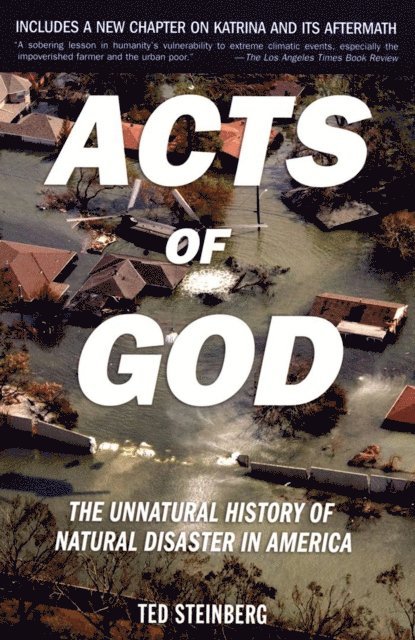
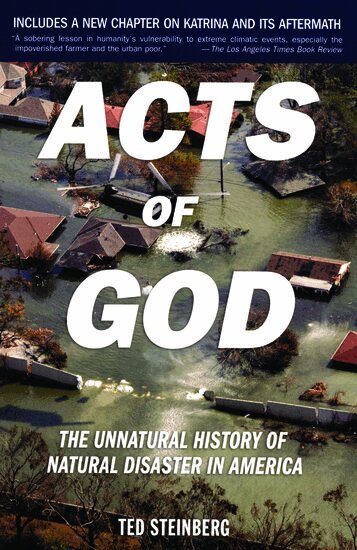
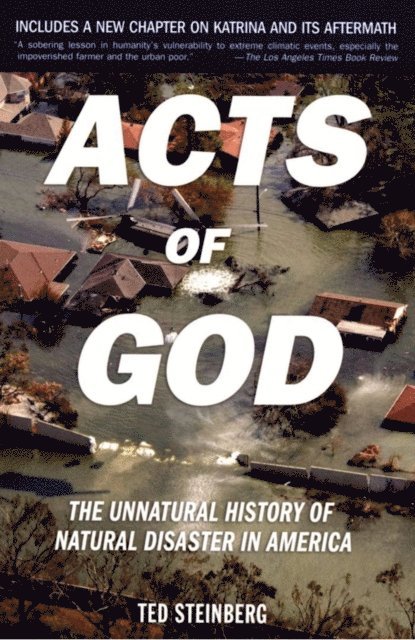
As the waters of the Mississippi River and Lake Pontchartrain began to pour into New Orleans, people began asking the big question--could any of this have been avoided? How much of the damage from Hurricane Katrina was bad luck, and how much was poor city planning? Steinberg's Acts of God is a provocative history of natural disasters in the United States. This revised edition features a new chapter analyzing the failed response to Hurricane Katrina, a disaster Steinberg warned could happen when the book first was published. Focusing on America's worst natural disasters, Steinberg argues that it is wrong to see these tragedies as random outbursts of nature's violence or expressions of divine judgment. He reveals how the decisions of business leaders and government officials have paved the way for the greater losses of life and property, especially among those least able to withstand such blows--America's poor, elderly, and minorities. Seeing nature or God as the primary culprit, Steinberg explains, has helped to hide the fact that some Americans are simply better able to protect themselves from the violence of nature than others. In the face of revelations about how the federal government mishandled the Katrina calamity, this book is a must-read before further wind and water sweep away more lives. Acts of God is a call to action that needs desperately to be heard.
E-bok
PDF, Engelska, 2002213 kr
Läs direkt efter köp
In this ambitious and provocative text, environmental historian Ted Steinberg offers a sweeping history of our nation--a history that, for the first time, places the environment at the very center of our story. Written with exceptional clarity, Down to Earth re-envisions the story of America "from the ground up." It reveals how focusing on plants, animals, climate, and other ecological factors can radically change the way that we think about the past. Examining such familiar topics as colonization, the industrial revolution, slavery, the Civil War, and the emergence of modern-day consumer culture, Steinberg recounts how the natural world influenced the course of human history. From the colonists'' attempts to impose order on the land to modern efforts to sell the wilderness as a consumer good, the author reminds readers that many critical episodes in our history were, in fact, environmental events. He highlights the ways in which we have attempted to reshape and control nature, from Thomas Jefferson''s surveying plan, which divided the national landscape into a grid, to the transformation of animals, crops, and even water into commodities. The text is ideal for courses in environmental history, environmental studies, urban studies, economic history, and American history. Passionately argued and thought-provoking, Down to Earth retells our nation''s history with nature in the foreground--a perspective that will challenge our view of everything from Jamestown to Disney World.
E-bok
PDF, Engelska, 2000142 kr
Läs direkt efter köp
With the exception of the 9/11 disaster, the top ten most costly catastrophes in U.S. history have all been natural disasters--five of them hurricanes--and all have occurred since 1989. Why this tremendous plague on our homes? In Acts of God, environmental historian Ted Steinberg explains that much of the death and destruction has been well within the realm of human control. Steinberg exposes the fallacy of seeing such calamities as simply random events. Beginning with the 1886 Charleston and 1906 San Francisco earthquakes, and continuing to the present, Steinberg explores the unnatural history of natural calamity, the decisions of business leaders and government officials that have paved the way for the greater losses of life and property, especially among those least able to withstand such blows--America''s poor, elderly, and minorities. Seeing nature or God as the primary culprit, Steinberg argues, has helped to hide the fact that some Americans are better protected from the violence of nature than their counterparts lower down the socioeconomic ladder. Sure to provoke discussion, Acts of God is a call to action that must be heard.
E-bok
PDF, Engelska, 2006205 kr
Läs direkt efter köp
As the waters of the Mississippi River and Lake Pontchartrain began to pour into New Orleans, people began asking the big question--could any of this have been avoided? How much of the damage from Hurricane Katrina was bad luck, and how much was poor city planning?Steinberg''s Acts of God is a provocative history of natural disasters in the United States. This revised edition features a new chapter analyzing the failed response to Hurricane Katrina, a disaster Steinberg warned could happen when the book first was published. Focusing on America''s worst natural disasters, Steinberg argues that it is wrong to see these tragedies as random outbursts of nature''s violence or expressions of divine judgment. He reveals how the decisions of business leaders and government officials have paved the way for the greater losses of life and property, especially among those least able to withstand such blows--America''s poor, elderly, and minorities. Seeing nature or God as the primary culprit, Steinberg explains, has helped to hide the fact that some Americans are simply better able to protect themselves from the violence of nature than others.In the face of revelations about how the federal government mishandled the Katrina calamity, this book is a must-read before further wind and water sweep away more lives. Acts of God is a call to action that needs desperately to be heard.
E-bok
Engelska, 2006205 kr
Läs direkt efter köp
As the waters of the Mississippi River and Lake Pontchartrain began to pour into New Orleans, people began asking the big question--could any of this have been avoided? How much of the damage from Hurricane Katrina was bad luck, and how much was poor city planning?Steinberg''s Acts of God is a provocative history of natural disasters in the United States. This revised edition features a new chapter analyzing the failed response to Hurricane Katrina, a disaster Steinberg warned could happen when the book first was published. Focusing on America''s worst natural disasters, Steinberg argues that it is wrong to see these tragedies as random outbursts of nature''s violence or expressions of divine judgment. He reveals how the decisions of business leaders and government officials have paved the way for the greater losses of life and property, especially among those least able to withstand such blows--America''s poor, elderly, and minorities. Seeing nature or God as the primary culprit, Steinberg explains, has helped to hide the fact that some Americans are simply better able to protect themselves from the violence of nature than others.In the face of revelations about how the federal government mishandled the Katrina calamity, this book is a must-read before further wind and water sweep away more lives. Acts of God is a call to action that needs desperately to be heard.
Häftad, Engelska, 2007
299 kr
Skickas inom 5-8 vardagar
The rise of the perfect lawn represents one of the most profound transformations in the history of the American landscape. American Green, Ted Steinberg's witty exposé of this bizarre phenomenon, traces the history of the lawn from its explosion in the postwar suburban community of Levittown to the present love affair with turf colorants, leaf blowers, and riding mowers.
Inbunden, Engelska, 2019
546 kr
Skickas inom 5-8 vardagar
A frank and engaging exploration of the burgeoning academic field of environmental historyInspired by the pioneering work of preeminent environmental historian Donald Worster, the contributors to A Field on Fire: The Future of Environmental History reflect on the past and future of this discipline. Featuring wide-ranging essays by leading environmental historians from the United States, Europe, and China, the collection challenges scholars to rethink some of their orthodoxies, inviting them to approach familiar stories from new angles, to integrate new methodologies, and to think creatively about the questions this field is well positioned to answer. Worster's groundbreaking research serves as the organizational framework for the collection. Editors Mark D. Hersey and Ted Steinberg have arranged the book into three sections corresponding to the primary concerns of Worster's influential scholarship: the problem of natural limits, the transnational nature of environmental issues, and the question of method. Under the heading “Facing Limits,” five essays explore the inherent tensions between democracy, technology, capitalism, and the environment. The “Crossing Borders” section underscores the ways in which environmental history moves easily across national and disciplinary boundaries. Finally, “Doing Environmental History” invokes Worster's work as an essayist by offering self-conscious reflections about the practice and purpose of environmental history. The essays aim to provoke a discussion on the future of the field, pointing to untapped and underdeveloped avenues ripe for further exploration. A forward thinker like Worster presents bold challenges to a new generation of environmental historians on everything from capitalism and the Anthropocene to war and wilderness. This engaging volume includes a very special afterword by one of Worster's oldest friends, the eminent intellectual historian Daniel Rodgers, who has known Worster for close to fifty years.
E-bok
Engelska, 2019913 kr
Läs direkt efter köp
A frank and engaging exploration of the burgeoning academic field of environmental history Inspired by the pioneering work of preeminent environmental historian Donald Worster, the contributors to A Field on Fire: The Future of Environmental History reflect on the past and future of this discipline. Featuring wide-ranging essays by leading environmental historians from the United States, Europe, and China, the collection challenges scholars to rethink some of their orthodoxies, inviting them to approach familiar stories from new angles, to integrate new methodologies, and to think creatively about the questions this field is well positioned to answer. Worster’s groundbreaking research serves as the organizational framework for the collection. Editors Mark D. Hersey and Ted Steinberg have arranged the book into three sections corresponding to the primary concerns of Worster’s influential scholarship: the problem of natural limits, the transnational nature of environmental issues, and the question of method. Under the heading “Facing Limits,” five essays explore the inherent tensions between democracy, technology, capitalism, and the environment. The “Crossing Borders” section underscores the ways in which environmental history moves easily across national and disciplinary boundaries. Finally, “Doing Environmental History” invokes Worster’s work as an essayist by offering self-conscious reflections about the practice and purpose of environmental history. The essays aim to provoke a discussion on the future of the field, pointing to untapped and underdeveloped avenues ripe for further exploration. A forward thinker like Worster presents bold challenges to a new generation of environmental historians on everything from capitalism and the Anthropocene to war and wilderness. This engaging volume includes a very special afterword by one of Worster’s oldest friends, the eminent intellectual historian Daniel Rodgers, who has known Worster for close to fifty years.
Häftad, Engelska, 2015
295 kr
Skickas inom 3-6 vardagar
E-bok
Engelska, 2014142 kr
Läs direkt efter köp
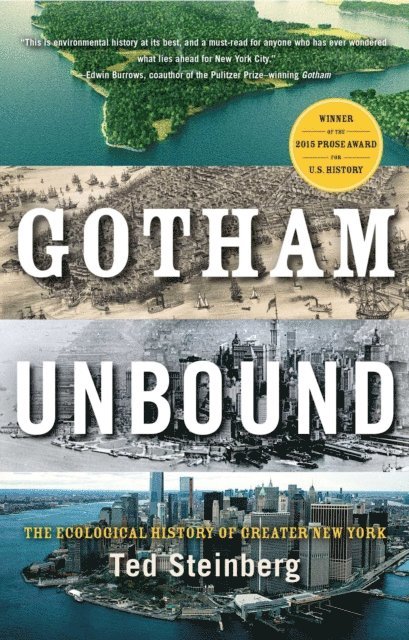
Winner of the 2015 PROSE Award for US History A “fascinating, encyclopedic history…of greater New York City through an ecological lens” (Publishers Weekly, starred review)—the sweeping story of one of the most man-made spots on earth.Gotham Unbound recounts the four-century history of how hundreds of square miles of open marshlands became home to six percent of the nation’s population. Ted Steinberg brings a vanished New York back to vivid, rich life. You will see the metropolitan area anew, not just as a dense urban goliath but as an estuary once home to miles of oyster reefs, wolves, whales, and blueberry bogs. That world gave way to an onslaught managed by thousands, from Governor John Montgomerie, who turned water into land, and John Randel, who imposed a grid on Manhattan, to Robert Moses, Charles Urstadt, Donald Trump, and Michael Bloomberg. “Weighty and wonderful…Resting on a sturdy foundation of research and imagination, Steinberg’s volume begins with Henry Hudson’s arrival aboard the Half Moon in 1609 and ends with another transformative event—Hurricane Sandy in 2012” (The Plain Dealer, Cleveland). This book is a powerful account of the relentless development that New Yorkers wrought as they plunged headfirst into the floodplain and transformed untold amounts of salt marsh and shellfish beds into a land jam-packed with people, asphalt, and steel, and the reeds and gulls that thrive among them. With metropolitan areas across the globe on a collision course with rising seas, Gotham Unbound helps explain how one of the most important cities in the world has ended up in such a perilous situation. “Steinberg challenges the conventional arguments that geography is destiny….And he makes the strong case that for all the ecological advantages of urban living, hyperdensity by itself is not necessarily a sound environmental strategy” (The New York Times).