Tenko Raykov – författare
Visar alla böcker från författaren Tenko Raykov. Handla med fri frakt och snabb leverans.
13 produkter
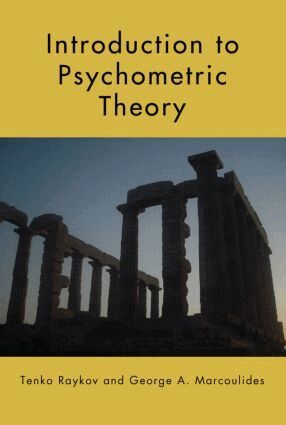
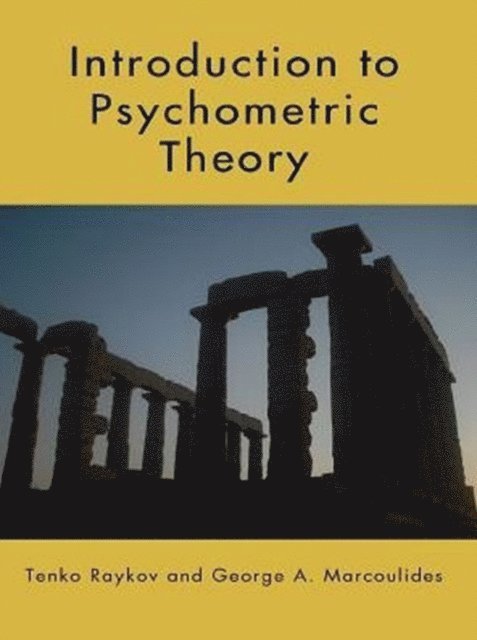
Introduction to Psychometric Theory
Av Tenko Raykov, George A. Marcoulides
Inbunden, 2010
2200 kr
Lägg i varukorg
This new text provides a state-of the-art introduction to educational and psychological testing and measurement theory that reflects many intellectual developments of the past two decades. The book introduces psychometric theory using a latent variable modeling (LVM) framework and emphasizes …
First Course in Structural Equation Modeling
Av Tenko Raykov, George A. Marcoulides
Inbunden, 2006
2512 kr
Lägg i varukorg
In this book, authors Tenko Raykov and George A. Marcoulides introduce students to the basics of structural equation modeling (SEM) through a conceptual, nonmathematical approach. For ease of understanding, the few mathematical formulas presented are used in a conceptual or illustrative nature, …
First Course in Structural Equation Modeling
Av Tenko Raykov, George A. Marcoulides
Häftad, 2006
851 kr
Lägg i varukorg
In this book, authors Tenko Raykov and George A. Marcoulides introduce students to the basics of structural equation modeling (SEM) through a conceptual, nonmathematical approach. For ease of understanding, the few mathematical formulas presented are used in a conceptual or illustrative nature, …
Introduction to Applied Multivariate Analysis
Av Tenko Raykov, George A. Marcoulides
Inbunden, 2008
2441 kr
Lägg i varukorg
This comprehensive text introduces readers to the most commonly used multivariate techniques at an introductory, non-technical level. By focusing on the fundamentals, readers are better prepared for more advanced applied pursuits, particularly on topics that are most critical to the behavioral, …
First Course in Structural Equation Modeling
Av George A. Marcoulides, Tenko Raykov
E-bok, 2012
983 kr
Lägg i varukorg
In this book, authors Tenko Raykov and George A. Marcoulides introduce students to the basics of structural equation modeling (SEM) through a conceptual, nonmathematical approach. For ease of understanding, the few mathematical formulas presented are used in a conceptual or illustrative nature, …
First Course in Structural Equation Modeling
Av George A. Marcoulides, Tenko Raykov
E-bok, 2012
1004 kr
Lägg i varukorg
In this book, authors Tenko Raykov and George A. Marcoulides introduce students to the basics of structural equation modeling (SEM) through a conceptual, nonmathematical approach. For ease of understanding, the few mathematical formulas presented are used in a conceptual or illustrative nature, …
Introduction to Applied Multivariate Analysis
Av George A. Marcoulides, Tenko Raykov
E-bok, 2008
2805 kr
Lägg i varukorg
This comprehensive text introduces readers to the most commonly used multivariate techniques at an introductory, non-technical level. By focusing on the fundamentals, readers are better prepared for more advanced applied pursuits, particularly on topics that are most critical to the behavioral, …
Introduction to Psychometric Theory
Av George A. Marcoulides, Tenko Raykov
E-bok, 2011
2626 kr
Lägg i varukorg
This new text provides a state-of the-art introduction to educational and psychological testing and measurement theory that reflects many intellectual developments of the past two decades. The book introduces psychometric theory using a latent variable modeling (LVM) framework and emphasizes …
Introduction to Psychometric Theory
Av George A. Marcoulides, Tenko Raykov
E-bok, 2011
2684 kr
Lägg i varukorg
This new text provides a state-of the-art introduction to educational and psychological testing and measurement theory that reflects many intellectual developments of the past two decades. The book introduces psychometric theory using a latent variable modeling (LVM) framework and emphasizes …
Basic Statistics
An Introduction with R
Av Tenko Raykov, George A. Marcoulides
Inbunden, 2012
2133 kr
Lägg i varukorg
Basic Statistics provides an accessible and comprehensive introduction to statistics using the free, state-of-the-art, powerful software program R. This book is designed to both introduce students to key concepts in statistics and to provide simple instructions for using R.This concise book:Teaches …
Basic Statistics
An Introduction with R
Av Tenko Raykov, George A. Marcoulides
Häftad, 2012
1066 kr
Lägg i varukorg
Basic Statistics provides an accessible and comprehensive introduction to statistics using the free, state-of-the-art, powerful software program R. This book is designed to both introduce students to key concepts in statistics and to provide simple instructions for using R.This concise book:Teaches …
Basic Statistics
An Introduction with R
Av Tenko Raykov, George A. Marcoulides
E-bok, 2012
1169 kr
Lägg i varukorg
Basic Statistics provides an accessible and comprehensive introduction to statistics using the free, state-of-the-art, powerful software program R. This book is designed to both introduce students to key concepts in statistics and to provide simple instructions for using R. This concise book: …
Course in Item Response Theory and Modeling with Stata
Av Tenko Raykov, George A. Marcoulides
Häftad, 2018
815 kr
Lägg i varukorg
Over the past several decades, item response theory (IRT) and item response modeling (IRM) have become increasingly popular in the behavioral, educational, social, business, marketing, clinical, and health sciences. In this book, Raykov and Marcoulides begin with a nontraditional approach to IRT …