Teodiano Bastos-Filho – författare
Visar alla böcker från författaren Teodiano Bastos-Filho. Handla med fri frakt och snabb leverans.
8 produkter
Introduction to Non-Invasive EEG-Based Brain-Computer Interfaces for Assistive Technologies
Inbunden, 2020
2198 kr
Lägg i varukorg
This book aims to bring to the reader an overview of different applications of brain-computer interfaces (BCIs) based on more than 20 years of experience working on these interfaces. The author provides a review of the human brain and EEG signals, describing the human brain, anatomically and …
Introduction to Non-Invasive EEG-Based Brain-Computer Interfaces for Assistive Technologies
Häftad, 2023
817 kr
Lägg i varukorg
This book aims to bring to the reader an overview of different applications of brain-computer interfaces (BCIs) based on more than 20 years of experience working on these interfaces. The author provides a review of the human brain and EEG signals, describing the human brain, anatomically and …
Introduction to Non-Invasive EEG-Based Brain-Computer Interfaces for Assistive Technologies
E-bok, 2020
942 kr
Lägg i varukorg
This book aims to bring to the reader an overview of different applications of brain-computer interfaces (BCIs) based on more than 20 years of experience working on these interfaces. The author provides a review of the human brain and EEG signals, describing the human brain, anatomically and …
Introduction to Non-Invasive EEG-Based Brain-Computer Interfaces for Assistive Technologies
E-bok, 2020
942 kr
Lägg i varukorg
This book aims to bring to the reader an overview of different applications of brain-computer interfaces (BCIs) based on more than 20 years of experience working on these interfaces. The author provides a review of the human brain and EEG signals, describing the human brain, anatomically and …
Devices for Mobility and Manipulation for People with Reduced Abilities
Av Sridhar Poosapadi Arjunan, Dinesh Kumar m. fl.
E-bok, 2014
1571 kr
Lägg i varukorg
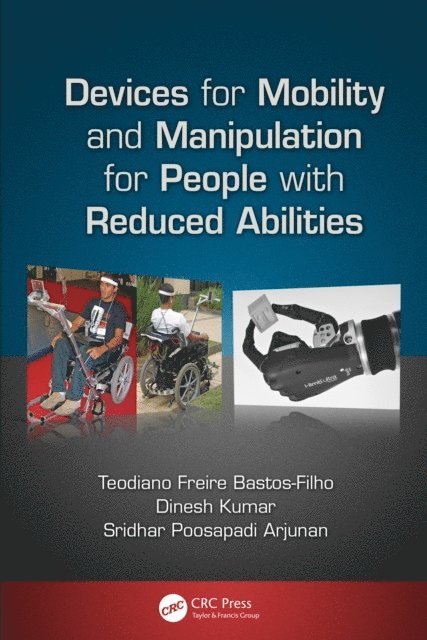
The development and application of assistive technology can help those with reduced abilities improve their quality of life and reduce their dependence on others. Written in layman''s terms, Devices for Mobility and Manipulation for People with Reduced Abilities provides research and information on …
Devices for Mobility and Manipulation for People with Reduced Abilities
Av Teodiano Bastos-Filho, Dinesh Kumar m. fl.
Häftad, 2017
1372 kr
Lägg i varukorg
The development and application of assistive technology can help those with reduced abilities improve their quality of life and reduce their dependence on others. Written in layman’s terms, Devices for Mobility and Manipulation for People with Reduced Abilities provides research and information on …
Devices for Mobility and Manipulation for People with Reduced Abilities
Av Teodiano Bastos-Filho, Dinesh Kumar m. fl.
Inbunden, 2014
3534 kr
Lägg i varukorg
The development and application of assistive technology can help those with reduced abilities improve their quality of life and reduce their dependence on others. Written in layman’s terms, Devices for Mobility and Manipulation for People with Reduced Abilities provides research and information on …
Devices for Mobility and Manipulation for People with Reduced Abilities
Av Sridhar Poosapadi Arjunan, Dinesh Kumar m. fl.
E-bok, 2014
1623 kr
Lägg i varukorg
The development and application of assistive technology can help those with reduced abilities improve their quality of life and reduce their dependence on others. Written in layman''s terms, Devices for Mobility and Manipulation for People with Reduced Abilities provides research and information on …