The late Yujiro Hayami - Böcker
Visar alla böcker från författaren The late Yujiro Hayami. Handla med fri frakt och snabb leverans.
3 produkter
3 produkter
2 662 kr
Skickas inom 5-8 vardagar
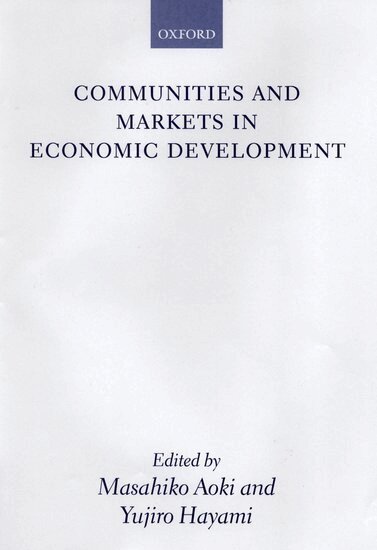
This book explores the role of community in facilitating the transition to market relationships in economic development, and in controlling and sustaining local public goods such as irrigation, forests, grazing land, and fishing grounds. Previously it was customary to classify economic systems in terms of varying combinations of state and market control of resource allocation. In contrast, this book recognizes community as the third major element of economic systems. This new approach also departs from the conventional view that markets and community norms should be treated as mutually exclusive means of organizing economic activity, instead clarifying the situations in which they may become complementary. Further discussion focuses on the conditions under which management of local commons can, and should, be delegated to local communities rather than subjected to the control of central government. These and other issues are investigated by twenty-one leading scholars from economic history, development economics, agricultural economics, and institutional economics. The resulting volume is the latest in a set of four books about East Asian developmental experiences, co-sponsored by the Economic Institute of the World Bank and the Stanford Institute of Economic Policy Research. It will appeal to economists and other social scientists with an interest in economic development, history, comparative systems, and institutional economics.
2 528 kr
Skickas inom 5-8 vardagar
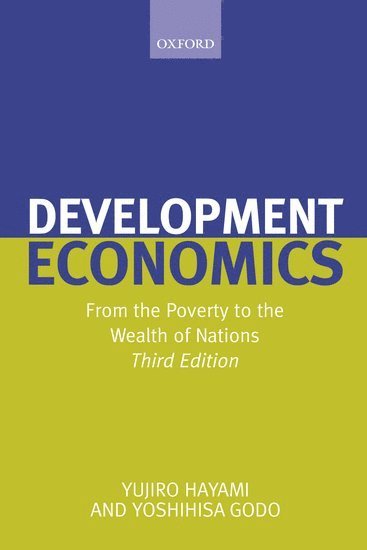
This book provides a comprehensive, systematic treatise on development economics, combining classical political economy, modern institutional theory, and current development issues. It addresses one basic question: Why has a small set of countries achieved a high level of affluence while the majority remains poor and stagnant? This fully revised and updated third edition also incorporates analyses of several recent changes and newly emerged problems relevant to the global economy.
885 kr
Skickas inom 5-8 vardagar
This textbook provides a comprehensive, systematic treatise on development economics, combining classical political economy, modern institutional theory, and current development issues. Grown out of twenty years' experience of teaching in the United States and Japan, its treatment is global, although the organizing principle is the East Asian development experience. Taking a comparative institutional analysis approach, it also outlines quantitative characteristics of Third World development in terms of population growth, natural resource depletion, capital accumulation, and technological change.Development Economics addresses one major question: Why has a small set of countries achieved a high level of affluence while the majority remain poor and stagnant? One obvious factor is a the ability to adopt and develop advanced technology, due in large measure to the difficulty experienced by low-income economies in preparing appropriate institutions for borrowing advanced technology given their social and cultural constraints. This volume explores the nature of these constraints, with the aim of identifying the means to remove them, and examines countries where the constraints have been successfully lifted---most notably Japan and East Asian NIEs.This fully revised and updated third edition also incorporates analyses of several recent changes and newly emerged problems relevant to the global economy: recurrent economic crises in Latin America contrasted with the recovery of East Asia from the 1997-8 financial crisis; a paradigm change in international development assistance from 'the Washington Consensus' to the 'the Post-Washington Consensus', with a major shift in its focus from economic growth to poverty reduction as manifested in the United Nations' Millennium Development Goals; and the stalemate in international collaboration on the environment as represented by delays in the ratification of the Kyoto Protocol. In exploring these issues, Development Economics provides important lessons on what institutions can promote economic growth, reduce poverty, and conserve the environment through the borrowing of technology.