Themistoklis Aravossitas – författare
583 kr
Skickas inom 10-15 vardagar
2 136 kr
Skickas inom 10-15 vardagar
515 kr
Skickas inom 7-10 vardagar
686 kr
Läs direkt efter köp
Recently intensified global mobility has reinforced the interest for ethnolinguistic diversity and multilingualism in education and society. Interdisciplinary Research Approaches to Multilingual Education brings together current interdisciplinary perspectives in multilingual and second language education to examine research and language teaching in specific countries, as well as different aspects of multilingual education that include language policies and ICT applications.
Containing context-specific practical interventions and relevant theoretical approaches, it considers the contemporary challenges of language policies and practices to inform teacher and curriculum development based on international empirical research. The chapters of this book are centered around the following themes:
Educational programs and policies
Teaching and learning
Linguistic diversity
ICT and language learning
This book will be of great interest to academics, researchers and postgraduate students in language education, bilingual education, second/foreign language learning, CALL, and applied linguistics. It will also appeal to educational administrators and those involved with language education policies.
686 kr
Läs direkt efter köp
Recently intensified global mobility has reinforced the interest for ethnolinguistic diversity and multilingualism in education and society. Interdisciplinary Research Approaches to Multilingual Education brings together current interdisciplinary perspectives in multilingual and second language education to examine research and language teaching in specific countries, as well as different aspects of multilingual education that include language policies and ICT applications.
Containing context-specific practical interventions and relevant theoretical approaches, it considers the contemporary challenges of language policies and practices to inform teacher and curriculum development based on international empirical research. The chapters of this book are centered around the following themes:
Educational programs and policies
Teaching and learning
Linguistic diversity
ICT and language learning
This book will be of great interest to academics, researchers and postgraduate students in language education, bilingual education, second/foreign language learning, CALL, and applied linguistics. It will also appeal to educational administrators and those involved with language education policies.
Language Diversity in Greece
Local Challenges with International Implications
1 577 kr
Skickas inom 10-15 vardagar
1 992 kr
Läs direkt efter köp
This volume explores how linguistic and cultural diversity in Greece, caused by various waves of emigration and immigration, has transformed Greek society and its educational system. It examines the country’s current linguistic diversity, which is characterised by the languages of immigrants, repatriates, refugees, Roma, Muslim minorities, and Pomaks as well as linguistic varieties and dialects; and how schools and the state have designed and implemented programmes to deal with the significant educational challenges posed by these culturally and linguistically diverse groups.
In this regard, the book takes into account the nature and evolution of Greek society; Greece’s traditional role as a labour-exporting country with a long history of migration to other countries; and major political, economic and social developments, such as the collapse of communism, the opening of borders in Eastern Europe, and the influx of immigrants from Muslim countries.
Language Diversity in Greece
Local Challenges with International Implications
1 577 kr
Skickas inom 10-15 vardagar
1 838 kr
Skickas inom 10-15 vardagar
2 366 kr
Läs direkt efter köp
4 717 kr
Skickas inom 10-15 vardagar
6 150 kr
Läs direkt efter köp
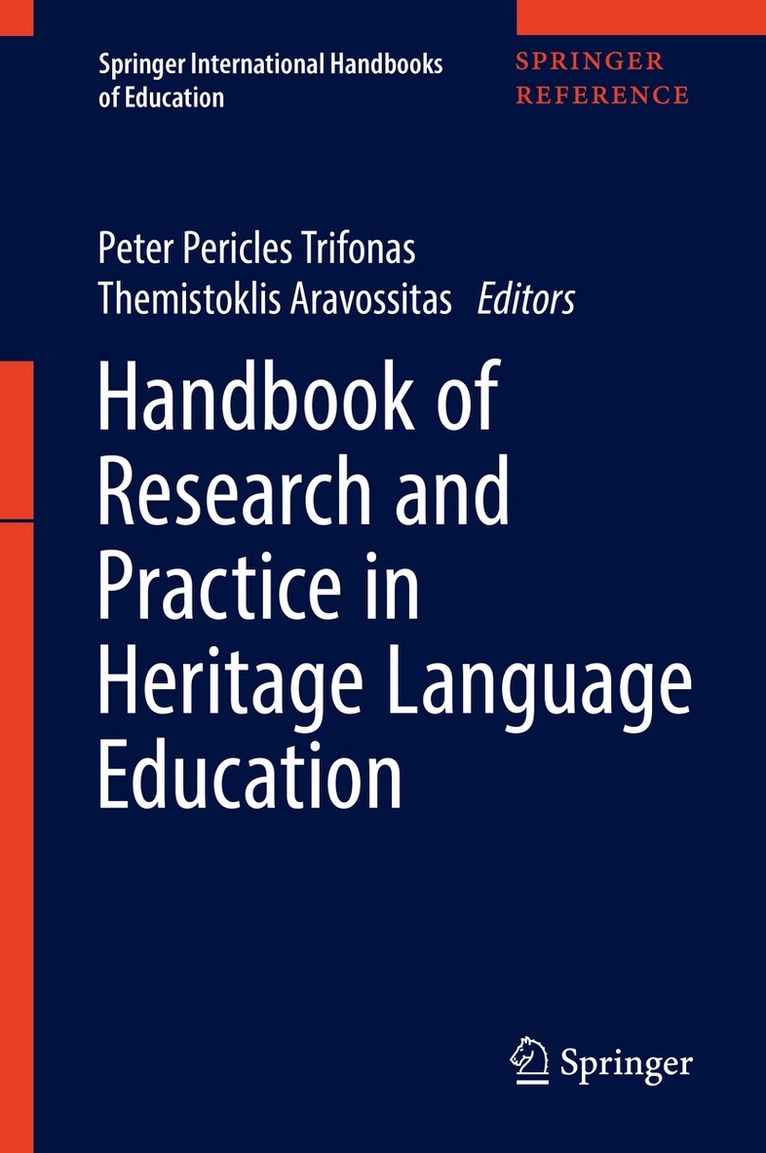
This volume covers the multidimensional and international field of Heritage Language Education, including concepts, practices, and the correlation between culture and language from the perspectives of pedagogy and research. Heritage Language Learning is a new dimension in both the linguistic and pedagogic sciences, and is linked to processes of identity negotiation and cultural inheritance. It is a distinct pedagogical and curricular domain that is not exhausted within the domains of bilingualism and second or foreign language education. A heritage language is not a second or foreign language, it is the vehicle whereby cultural memory is transmitted over time, across distances, communities, and generations. Heritage languages play an important role ensuring the balance between coherence and pluralism in contemporary societies that have come to realize that diversity is an advantage for social, cultural, and economic reasons.
The volume includes topics like First Nation indigenous languages, languages in diaspora, immigrant and minority languages, and contributions from North, central and South America, Europe, Africa, Asia, and Australia. It addresses the social, linguistic, and cultural issues in educational contexts in a new way by taking up questions of globalization, difference, community, identity, democracy, ethics, politics, technology, language rights and cultural policies through the evolving field of Heritage Language Education.