Thierry Mayer - Böcker
Visar alla böcker från författaren Thierry Mayer. Handla med fri frakt och snabb leverans.
3 produkter
3 produkter
1 268 kr
Skickas inom 7-10 vardagar
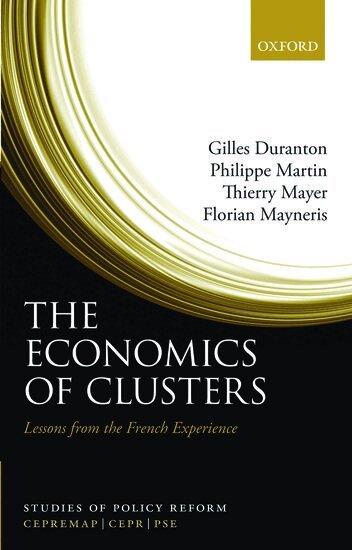
The development of clusters of economic activity is an important feature of industrial policy. Industry clusters have long fascinated economists and geographers alike, the most renowned being Silicon Valley which is seen by many as the blueprint for regional development, innovation, and growth. Several clusters have also developed across Europe, including SiliconFen in Cambridge and Minalogic in Grenoble, and in recent years cluster policies have become popular among policy makers as a useful tool for informing decisions on industrial, regional, and public policy. This book looks at the mechanisms at work behind cluster dynamics, the gains that can be expected from increased clustering, and the determinants of cluster policies. Focusing on France, it provides a theoretical and empirical study of clusters, their success and failures, and the policy lessons that can be applied to the wider international community. France is particularly interesting because there is a long tradition of strong government intervention regarding the location of economic activity, and cluster initiatives are relatively unified across the country. This book shows that, whilst gains from clusters do exist, some firms tend to cluster too much and that spatial agglomeration is only successful to a point, after which congestion effects can offset these gains. It questions the need and the feasibility of cluster policies aimed at interfering directly in the concentration process of firms, and thus looks beyond the general enthusiasm for clusters.
876 kr
Skickas inom 7-10 vardagar
Economic Geography is the most complete, up-to-date textbook available on the important new field of spatial economics. This book fills a gap by providing advanced undergraduate and graduate students with the latest research and methodologies in an accessible and comprehensive way. It is an indispensable reference for researchers in economic geography, regional and urban economics, international trade, and applied econometrics, and can serve as a resource for economists in government. Economic Geography presents advances in economic theory that explain why, despite the increasing mobility of commodities, ideas, and people, the diffusion of economic activity is very unequal and remains agglomerated in a limited number of spatial entities. The book complements theoretical analysis with detailed discussions of the empirics of the economics of agglomeration, offering a mix of theoretical and empirical research that gives a unique perspective on spatial disparities.It reveals how location continues to matter for trade and economic development, yet how economic integration is transforming the global economy into an economic space in which activities are performed within large metropolitan areas exchanging goods, skills, and information. Economic Geography examines the future implications of this evolution in the spatial economy and relates them to other major social and economic trends. * Provides a complete introduction to economic geography * Explains the latest theory and methodologies * Covers the empirics of agglomeration, from spatial concentration measurement to structural estimations of economic geography models * Includes history and background of the field * Serves as a textbook for students and a resource for professionals
1 915 kr
Skickas inom 7-10 vardagar
The choice of location for the production plants of multinational firms is an important issue, not least because this decision is accompanied by so many fears brought into public debate. This book analyses how foreign direct investors choose their locations, whilst exploring the forces which shape international economic geography. Although these two issues are, to some extent, inter-related, researchers have only recently acknowledged the similarity of economic geography and international business approaches to the empirical assessment of likely causes of the degree of spatial concentration observed in many modern industries. Giving insight into the direction that future research should take, this book contains state-of-the-art papers on both theoretical and empirical levels. This original collection makes a particularly important contribution to our understanding of the existence and impact of home market effects.Introducing a welcome synthesis between two related and yet rarely integrated areas of study using case studies of firms in Europe, US MNEs and the Mexican automobile industry, this book will be welcomed by both academic and practising economists. Regional scientists and economists, and those with a specific interest in international trade issues will also find the book enlightening.