Thomas A. Dutton - Böcker
Visar alla böcker från författaren Thomas A. Dutton. Handla med fri frakt och snabb leverans.
2 produkter
2 produkter
641 kr
Skickas inom 10-15 vardagar
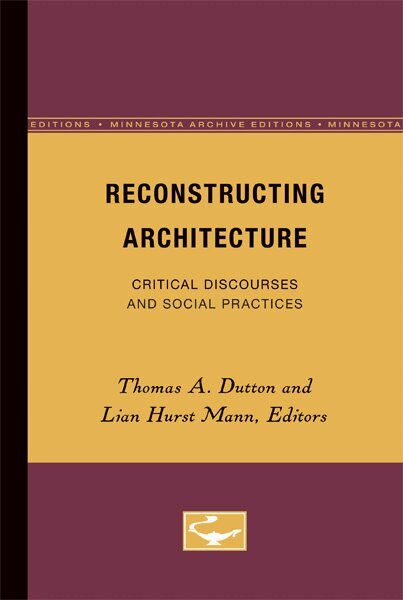
Reconstructing Architecture was first published in 1996. Minnesota Archive Editions uses digital technology to make long-unavailable books once again accessible, and are published unaltered from the original University of Minnesota Press editions.To create architecture is an inherently political act, yet its nature as a social practice is often obscured beneath layers of wealth and privilege. The contributors to this volume question architecture's complicity with the status quo, moving beyond critique to outline the part architects are playing in building radical social movements and challenging dominant forms of power.The making of architecture is instrumental in the construction of our identities, our differences, the world around us-much of what we know of institutions, the distribution of power, social relations, and cultural values is mediated by the built environment. Historically, architecture has constructed the environments that house the dominant culture. Yet, as the essays in Reconstructing Architecture demonstrate, there exists a strong tradition of critical practice in the field, one that attempts to alter existing social power relations. Engaging the gap between modernism and postmodernism, each chapter addresses an oppositional discourse that has developed within the field and then reconstructs it in terms of a new social project: feminism, social theory, environmentalism, cultural studies, race and ethnic studies, and critical theory.The activists and scholars writing here provide a clarion call to architects and other producers of culture, challenging them to renegotiate their political allegiances and to help reconstruct a viable democratic life in the face of inexorable forces driving economic growth, destroying global ecology, homogenizing culture, and privatizing the public realm. Reconstructing Architecture reformulates the role of architecture in society as well as its capacity to further a progressive social transformation.Contributors: Sherry Ahrentzen, U of Wisconsin, Milwaukee; Bradford C. Grant, California Polytechnic State U, San Luis Obispo; Richard Ingersoll, Rice U; Margaret Soltan, George Washington U; Anthony Ward, U of Auckland, New Zealand.Thomas A. Dutton is an architect and professor of architecture at Miami University, Ohio. He is editor of Voices in Architectural Education (1991) and is associate editor of the Journal of Architectural Education.Lian Hurst Mann is an architect and editor of Architecture California. A founding member of the Labor/Community Strategy Center in Los Angeles, she is editor of its bilingual quarterly Ahora Now and a coauthor of Reconstructing Los Angeles from the Bottom Up (1993).
1 039 kr
Skickas inom 10-15 vardagar
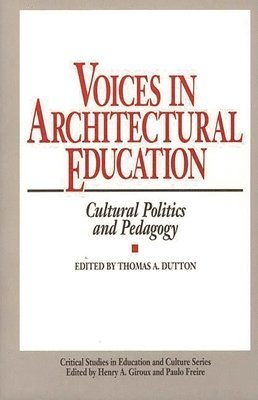
This book is a unique collection of new and existing articles about progressive architectural teaching and learning. It is about restructuring architectural education--a project that defines itself within a transformative definition of society. Dialectically linking architectural education and society, the book presents authors who conceptualize architectural pedagogy within a critical analysis of the larger society, and who construct forms of teaching and learning experiences that reveal and contest professional and societal directions. The authors present a multiplicity of voices, including women, people of color, and students; voices often marginalized but crucial to a remapping of the cultural-political terrain in their struggle to make issues of gender, race, class, etc. central to a reconceptualization of architectural education and pedagogy. This anthology, then, is more than a mere list of projects and pedagogies--it is a theoretical investigation of critical practices in architectural education that engage the world in order to change it.This book will challenge architectural educators to think consciously of their work and experiences in political and cultural terms. Insofar as architectural teachers plan instruction, determine readings, and select programs and building types for studio investigations, they are implementing a theory. The question, of course, is whether teachers are fully aware of the theoretical base of their actions. Since theory usually embodies interests grounded in societal forms of power, it has political consequences. This book sees education and pedagogy as forms of cultural politics--constructing a new terrain that will invigorate architectural pedagogy and focus discussion toward a needed architectural/educational/political project. Voices in Architectural Education will be invaluable to professors and students of architecture in both graduate and undergraduate education, as well as to practitioners of the architecture profession.