Thomas Ihn - Böcker
Visar alla böcker från författaren Thomas Ihn. Handla med fri frakt och snabb leverans.
4 produkter
4 produkter
2 106 kr
Skickas inom 5-8 vardagar
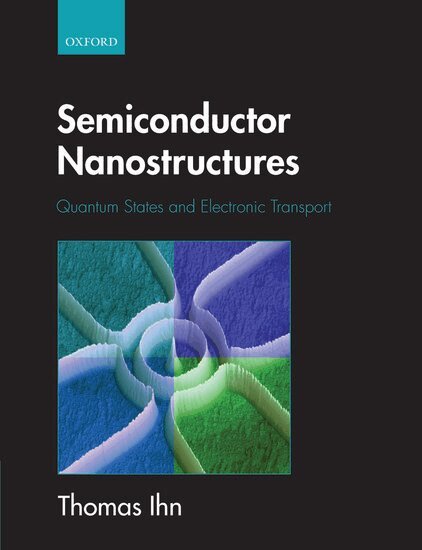
This textbook describes the physics of semiconductor nanostructures with emphasis on their electronic transport properties. At its heart are five fundamental transport phenomena: quantized conductance, tunnelling transport, the Aharonov-Bohm effect, the quantum Hall effect, and the Coulomb blockade effect. The book starts out with the basics of solid state and semiconductor physics, such as crystal structure, band structure, and effective mass approximation, including spin-orbit interaction effects important for research in semiconductor spintronics. It contains material aspects such as band engineering, doping, gating, and a selection of nanostructure fabrication techniques. The book discusses the Drude-Boltzmann-Sommerfeld transport theory as well as conductance quantization and the Landauer-Büttiker theory. These concepts are extended to mesoscopic interference phenomena and decoherence, magnetotransport, and interaction effects in quantum-confined systems, guiding the reader from fundamental effects to specialized state-of-the-art experiments.The book will provide a thorough introduction into the topic for graduate and PhD students, and will be a useful reference for lecturers and researchers working in the field.
726 kr
Skickas inom 7-10 vardagar
This textbook describes the physics of semiconductor nanostructures with emphasis on their electronic transport properties. At its heart are five fundamental transport phenomena: quantized conductance, tunnelling transport, the Aharonov-Bohm effect, the quantum Hall effect, and the Coulomb blockade effect. The book starts out with the basics of solid state and semiconductor physics, such as crystal structure, band structure, and effective mass approximation, including spin-orbit interaction effects important for research in semiconductor spintronics. It contains material aspects such as band engineering, doping, gating, and a selection of nanostructure fabrication techniques. The book discusses the Drude-Boltzmann-Sommerfeld transport theory as well as conductance quantization and the Landauer-Büttiker theory. These concepts are extended to mesoscopic interference phenomena and decoherence, magnetotransport, and interaction effects in quantum-confined systems, guiding the reader from fundamental effects to specialized state-of-the-art experiments.The book will provide a thorough introduction into the topic for graduate and PhD students, and will be a useful reference for lecturers and researchers working in the field.
852 kr
Skickas inom 10-15 vardagar
The physics of semiconductors has seen an enormous evolution within the last ?fty years. Countless achievements have been made in scienti?c research and device applications have revolutionized everyday life. We have learned how to customize materials in order to tailor their optical as well as electronic properties. The on- ing trend toward device miniaturization has been the driving force on the appli- tion side and it has fertilized fundamental research. Nowadays, advanced processing techniques allow the fabrication of sub-micron semiconductor structures in many university research laboratories. At the same time, experiments down to millikelvin temperatures allow researchers to anticipate the observation of quantum phenomena, so far hidden at room temperature by the large thermal energy and strong dephasing. The ?eld of mesoscopic physics deals with systems under experimental con- tions where several quantum length scales for electrons such as system size and phase coherence length, or phase coherence length and elastic mean free path, are compa- ble. Intense research over the last twenty years has revealed an enormous richness of quantum effects in mesoscopic semiconductor physics, which is typically charact- ized by an interplay of quantum interference and many-body interactions. The most famous phenomena are probably the integer and fractional quantum Hall effects, the quantization of conductance through a quantum point contact, the Aharonov–Bohm effect, and single-electron charging of quantum dots.
Del 192 - Springer Tracts in Modern Physics
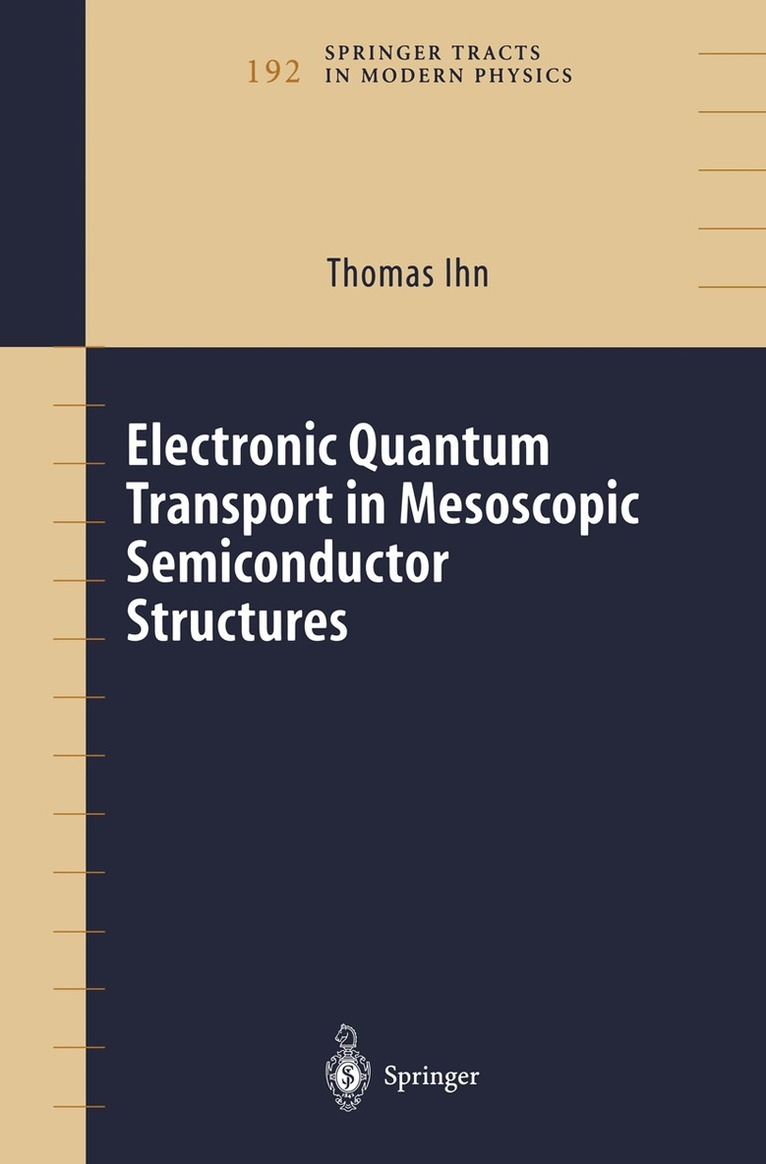
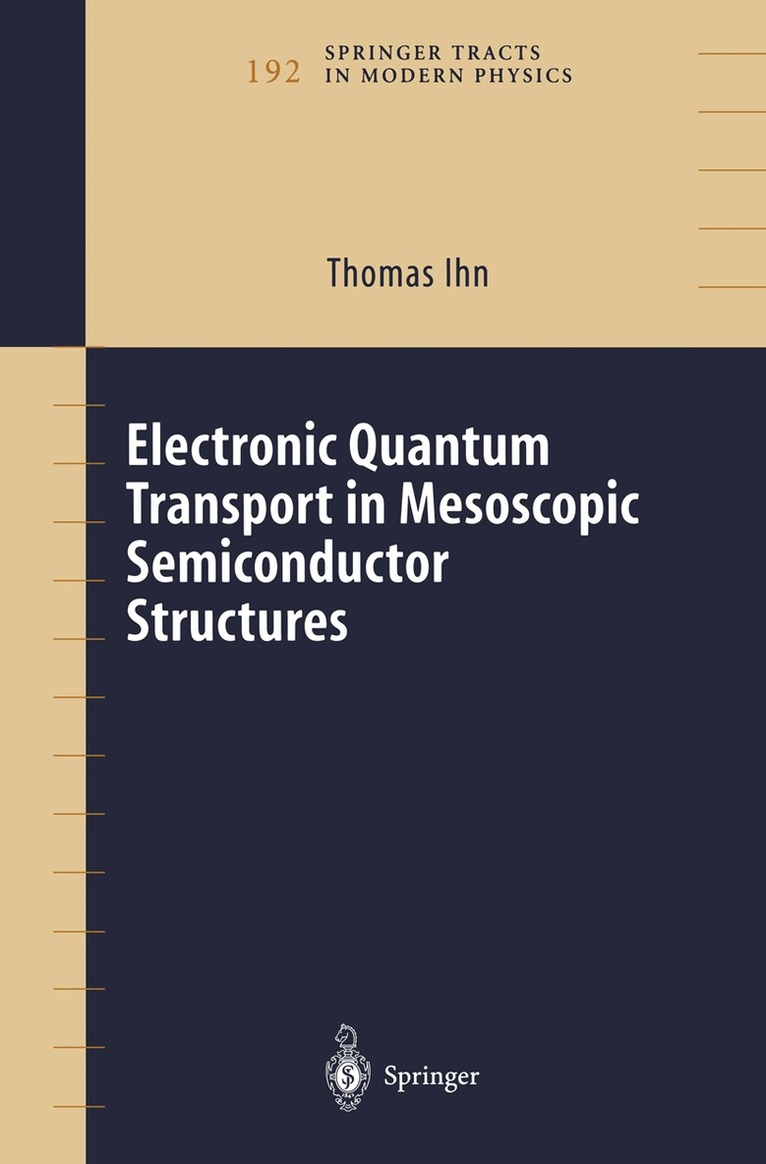
Electronic Quantum Transport in Mesoscopic Semiconductor Structures
Häftad, Engelska, 2011
852 kr
Skickas inom 10-15 vardagar
The physics of semiconductors has seen an enormous evolution within the last ?fty years. Countless achievements have been made in scienti?c research and device applications have revolutionized everyday life. We have learned how to customize materials in order to tailor their optical as well as electronic properties. The on- ing trend toward device miniaturization has been the driving force on the appli- tion side and it has fertilized fundamental research. Nowadays, advanced processing techniques allow the fabrication of sub-micron semiconductor structures in many university research laboratories. At the same time, experiments down to millikelvin temperatures allow researchers to anticipate the observation of quantum phenomena, so far hidden at room temperature by the large thermal energy and strong dephasing. The ?eld of mesoscopic physics deals with systems under experimental con- tions where several quantum length scales for electrons such as system size and phase coherence length, or phase coherence length and elastic mean free path, are compa- ble. Intense research over the last twenty years has revealed an enormous richness of quantum effects in mesoscopic semiconductor physics, which is typically charact- ized by an interplay of quantum interference and many-body interactions. The most famous phenomena are probably the integer and fractional quantum Hall effects, the quantization of conductance through a quantum point contact, the Aharonov–Bohm effect, and single-electron charging of quantum dots.