Thomas J. Curry – författare
Visar alla böcker från författaren Thomas J. Curry. Handla med fri frakt och snabb leverans.
5 produkter
5 produkter
E-bok
Engelska, 2001458 kr
Läs direkt efter köp
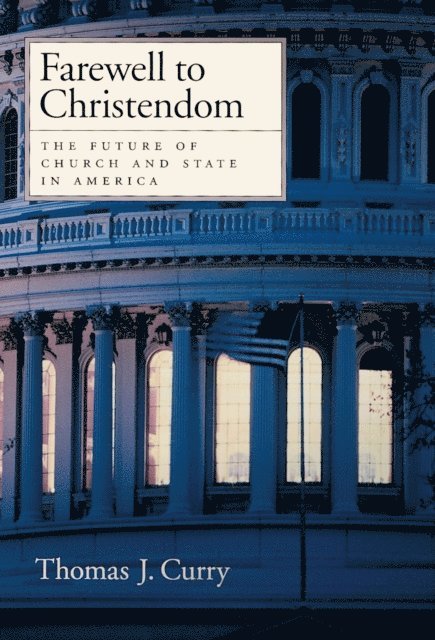
Thomas Curry argues that discussion and interpretation of the First Amendment have reached a point of deep crisis. Historical scholarship dealing with the background and interpretation of the Amendment are at an impasse, and judicial interpretation is in a state of disarray. Here, Curry provides a new paradigm for the understanding and exploration of religious liberty, contending that much of the present confusion can be traced to habits of mind that persist from Christendom and inevitably draw government into religious matters. The First Amendment, however, was meant to be a departure from the thinking that had preceded it for nearly fifteen hundred years. Curry traces much of the current difficulty to the largely unexamined assumption on the part of judges and scholars that the amendment created a right--the right to free exercise of religion--and that the courts are the guardians of that right. The First Amendment is, in fact, a limitation on government and a guarantee that the government will not impinge on the religious liberty that citizens already possess by natural right. Here, Curry shows that the key to finding more coherence between Church-State decisions and the historical meaning and purpose of the First Amendment lies in embracing this understanding of the Amendment as a limitation on government.
Häftad, Engelska, 1987
480 kr
Skickas inom 5-8 vardagar
Is government forbidden to assist all religions equally, as the Supreme Court has held? Or does the First Amendment merely ban exclusive aid to one religion, as critics of the Court assert? The First Freedoms studies the church-state context of colonial and revolutionary America to present a bold new reading of the historical meaning of the religion clauses of the First Amendment. Synthesizing and interpreting a wealth of evidence from the founding of Virginia to the passage of the Bill of Rights, including everything published in America before 1791, Thomas Curry traces America's developing ideas on religious liberty and offers the most extensive investigation ever of the historical origins and background of the First Amendment's religion clauses.
Inbunden, Engelska, 2001
534 kr
Skickas inom 5-8 vardagar
In this volume, Curry argues that discussion and interpretation of the First Amendment have reached a point of deep crisis. Historical scholarship dealing with the background and interpretation of the Amendment are at an impasse and judicial interpretation is in a state of disarray.
E-bok
PDF, Engelska, 1987464 kr
Läs direkt efter köp
Is government forbidden to assist all religions equally, as the Supreme Court has held? Or does the First Amendment merely ban exclusive aid to one religion, as critics of the Court assert? The First Freedoms studies the church-state context of colonial and revolutionary America to present a bold new reading of the historical meaning of the religion clauses of the First Amendment. Synthesizing and interpreting a wealth of evidence from the founding of Virginia to the passage of the Bill of Rights, including everything published in America before 1791, Thomas Curry traces America''s developing ideas on religious liberty and offers the most extensive investigation ever of the historical origins and background of the First Amendment''s religion clauses.
E-bok
PDF, Engelska, 2001458 kr
Läs direkt efter köp
Thomas Curry argues that discussion and interpretation of the First Amendment have reached a point of deep crisis. Historical scholarship dealing with the background and interpretation of the Amendment are at an impasse, and judicial interpretation is in a state of disarray. Here, Curry provides a new paradigm for the understanding and exploration of religious liberty, contending that much of the present confusion can be traced to habits of mind that persist from Christendom and inevitably draw government into religious matters. The First Amendment, however, was meant to be a departure from the thinking that had preceded it for nearly fifteen hundred years. Curry traces much of the current difficulty to the largely unexamined assumption on the part of judges and scholars that the amendment created a right--the right to free exercise of religion--and that the courts are the guardians of that right. The First Amendment is, in fact, a limitation on government and a guarantee that the government will not impinge on the religious liberty that citizens already possess by natural right. Here, Curry shows that the key to finding more coherence between Church-State decisions and the historical meaning and purpose of the First Amendment lies in embracing this understanding of the Amendment as a limitation on government.