Thomas J. Mueller – författare
Visar alla böcker från författaren . Handla med fri frakt och snabb leverans.
5 produkter
5 produkter
Inbunden, Engelska, 2002
2 373 kr
Skickas inom 10-15 vardagar
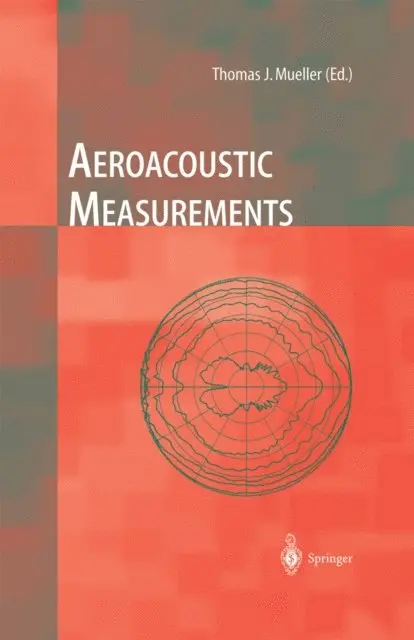
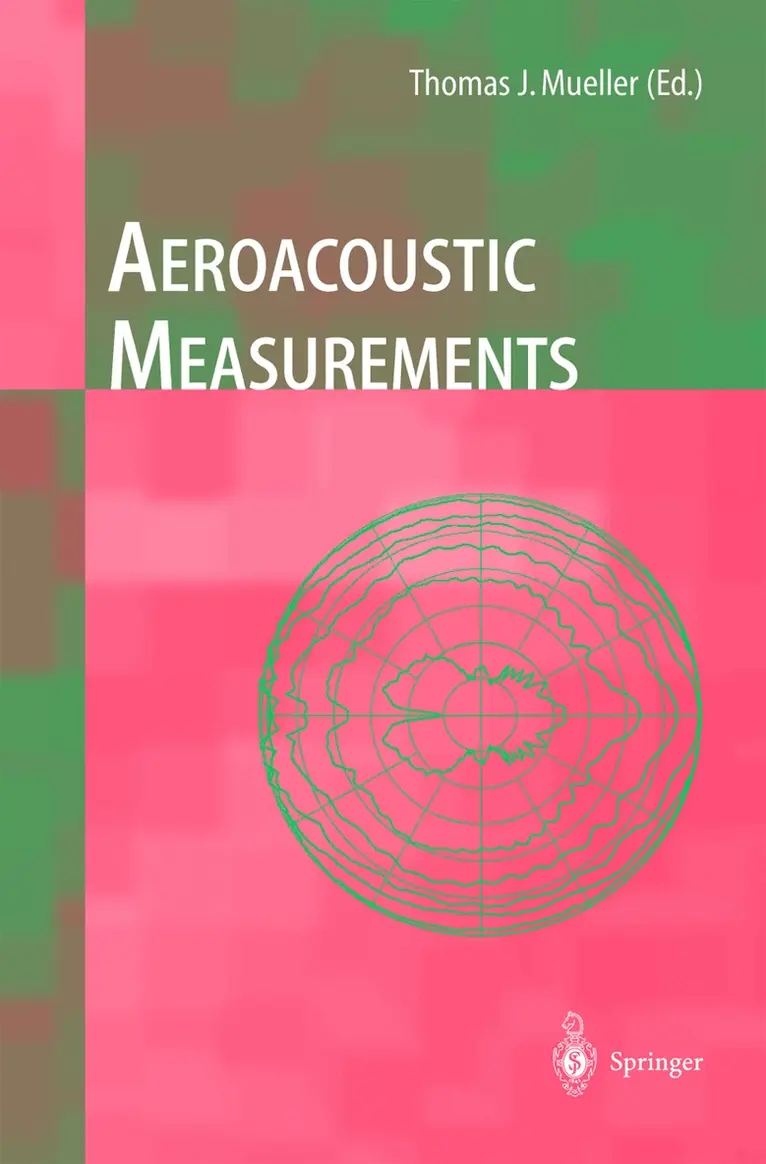
During the past three decades, there has been a growing concern over the in crease in noise pollution that comes as a direct result of the increased volume of automobile traffic, high-speed trains, and larger aircraft. Additional sources of noise are commonly found in air handling equipment (such as fans and pro pellers) and a variety of machinery used in construction and manufacturing. A vast majority of these noise sources are the result of a given system's aero acoustic response, or sound generated by the interaction of a flow field with the given structure. While barriers are commonly used to shield communities from highway and train noise, and absorption materials are used to shield machinery noise, there is no way to shield communities near major airports from the noise gen erated by low-flying aircraft. Tens of millions of people worldwide are affected by this airport noise problem. In densely populated Europe, up to 15 % of the total population is strongly influenced by airport noise. Since the volume of air traffic will continue to grow, so too will the problem and the number of people involved. It is not surprising that many countries and communities have taken legal action to preserve the quality of life in these areas. As a result, the airlines, airports, manufacturers and governments are working together to set new standards for aircraft noise reduction. In order to establish realistic goals, the generation and propagation of acoustic sources must be better understood.
Del 54 - Lecture Notes in Engineering
Low Reynolds Number Aerodynamics
Proceedings of the Conference Notre Dame, Indiana, USA, 5–7 June 1989
Häftad, Engelska, 1989
1 082 kr
Skickas inom 10-15 vardagar
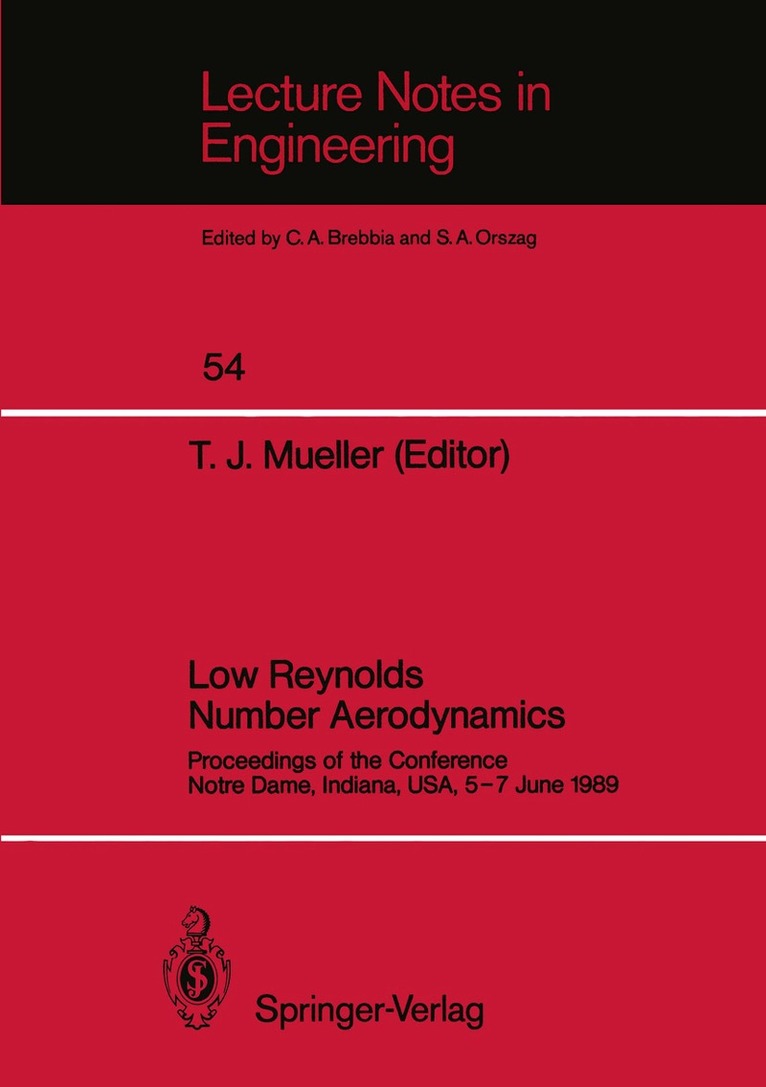
Current interest in a variety of low Reynolds number applications has focused attention on the design and evaluation of efficient airfoil sections at chord Reynolds numbers from about 100,000 to about 1,000,000. These applications include remotely piloted vehicles (RPVs) at high altitudes, sailplanes, ultra-light man-carrying/man powered aircraft, mini-RPVs at low altitudes and wind turbines/propellers. The purpose of this conference was to bring together those researchers who have been active in areas closely related to this subject. All of the papers presented are research type papers. Main topics are: Airfoil Design and Analysis, Computational Studies, Stability and Transition, Laminar Separation Bubble, Steady and Unsteady Wind Tunnel Experiments and Flight Experiments.
Häftad, Engelska, 2010
2 373 kr
Skickas inom 10-15 vardagar
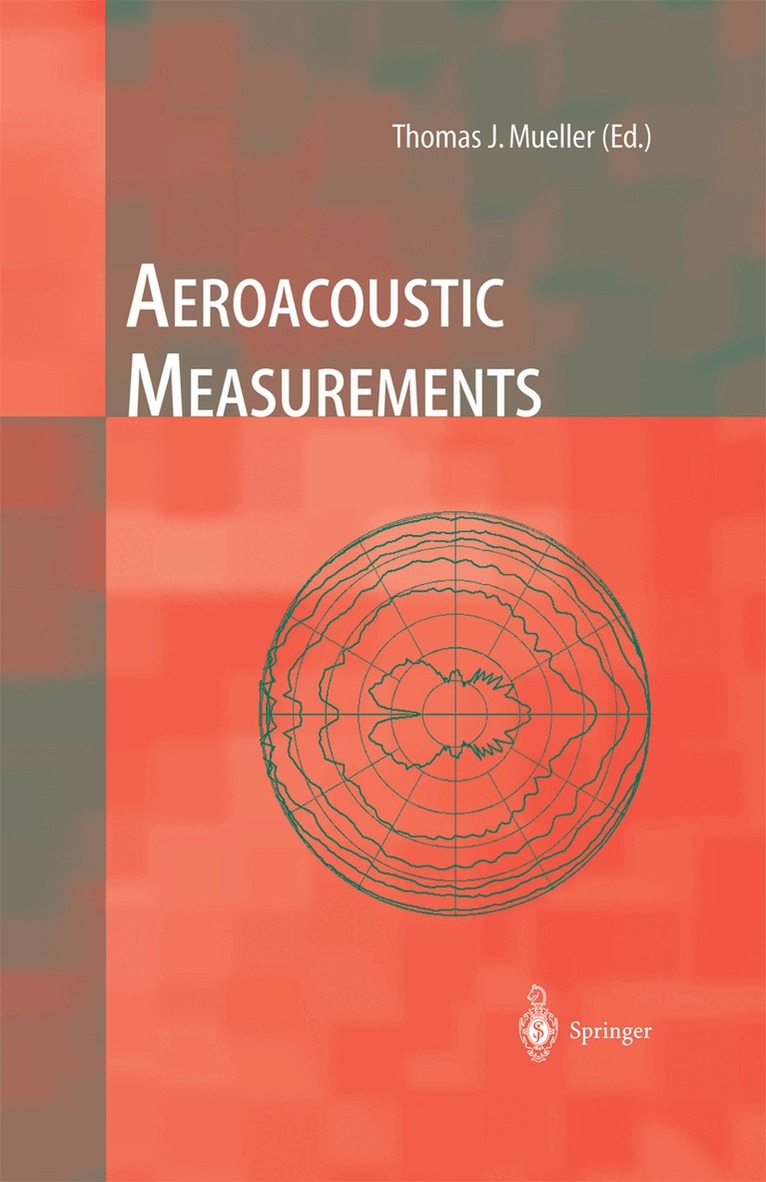
During the past three decades, there has been a growing concern over the in crease in noise pollution that comes as a direct result of the increased volume of automobile traffic, high-speed trains, and larger aircraft. Additional sources of noise are commonly found in air handling equipment (such as fans and pro pellers) and a variety of machinery used in construction and manufacturing. A vast majority of these noise sources are the result of a given system's aero acoustic response, or sound generated by the interaction of a flow field with the given structure. While barriers are commonly used to shield communities from highway and train noise, and absorption materials are used to shield machinery noise, there is no way to shield communities near major airports from the noise gen erated by low-flying aircraft. Tens of millions of people worldwide are affected by this airport noise problem. In densely populated Europe, up to 15 % of the total population is strongly influenced by airport noise. Since the volume of air traffic will continue to grow, so too will the problem and the number of people involved. It is not surprising that many countries and communities have taken legal action to preserve the quality of life in these areas. As a result, the airlines, airports, manufacturers and governments are working together to set new standards for aircraft noise reduction. In order to establish realistic goals, the generation and propagation of acoustic sources must be better understood.
E-bok
PDF, Engelska, 20131 416 kr
Läs direkt efter köp
Current interest in a variety of low Reynolds number applications has focused attention on the design and evaluation of efficient airfoil sections at chord Reynolds numbers from about 100,000 to about 1,000,000. These applications include remotely piloted vehicles (RPVs) at high altitudes, sailplanes, ultra-light man-carrying/man powered aircraft, mini-RPVs at low altitudes and wind turbines/propellers. The purpose of this conference was to bring together those researchers who have been active in areas closely related to this subject. All of the papers presented are research type papers. Main topics are: Airfoil Design and Analysis, Computational Studies, Stability and Transition, Laminar Separation Bubble, Steady and Unsteady Wind Tunnel Experiments and Flight Experiments.
E-bok
PDF, Engelska, 20133 054 kr
Läs direkt efter köp
During the past three decades, there has been a growing concern over the in crease in noise pollution that comes as a direct result of the increased volume of automobile traffic, high-speed trains, and larger aircraft. Additional sources of noise are commonly found in air handling equipment (such as fans and pro pellers) and a variety of machinery used in construction and manufacturing. A vast majority of these noise sources are the result of a given system''s aero acoustic response, or sound generated by the interaction of a flow field with the given structure. While barriers are commonly used to shield communities from highway and train noise, and absorption materials are used to shield machinery noise, there is no way to shield communities near major airports from the noise gen erated by low-flying aircraft. Tens of millions of people worldwide are affected by this airport noise problem. In densely populated Europe, up to 15 % of the total population is strongly influenced by airport noise. Since the volume of air traffic will continue to grow, so too will the problem and the number of people involved. It is not surprising that many countries and communities have taken legal action to preserve the quality of life in these areas. As a result, the airlines, airports, manufacturers and governments are working together to set new standards for aircraft noise reduction. In order to establish realistic goals, the generation and propagation of acoustic sources must be better understood.