Thomas M. Klapotke – författare
695 kr
Läs direkt efter köp
Dieses Buch ist Teil unserer neuen Datenbank Anorganik Online.
Diese Einführung behandelt die Grundlagen der Chemie hochenergetischer Materialien - primäre und sekundäre Explosivstoffe, Treibladungspulver, Raketentreibstoffe sowie Pyrotechnika - und bietet einen Einblick in aktuelle Forschungsgebiete. Die für energetische Materialien wichtige Thermodynamik wird in ihren Grundlagen vorgestellt und durch moderne Computer-Rechenverfahren ergänzt. Leistungsparameter wie Explosionswärme, Detonationsgeschwindigkeit und Detonationsdruck für Explosivstoffe sowie spezifischer Impuls und Schub für Treibstoffe werden ebenso behandelt wie wichtige Sensitivitätsdaten, z.B. die Schlag-, Reibe-, thermische und elektrostatische Empfindlichkeit. Aktuelle Entwicklungen, wie die Synthese neuer stickstoffreicher Verbindungen und neue Anforderungen an die Umweltverträglichkeit von energetischen Materialien für die Zukunft sind ebenfalls Bestandteil dieses Buches. Eingegangen wird auf zivile Anwendungen (z.B. als Treibstoffe für Trägerraketen- und Satellitentriebwerke) sowie auf vielseitige Aspekten im militärischen Bereich. Es richtet sich in erster Linie an Studierende der Chemie sowie der Material- und Ingenieurwissenschaften, aber auch an alle, die in den verschiedensten Bereichen der Wehrtechnik tätig sind.
701 kr
Läs direkt efter köp
630 kr
Läs direkt efter köp
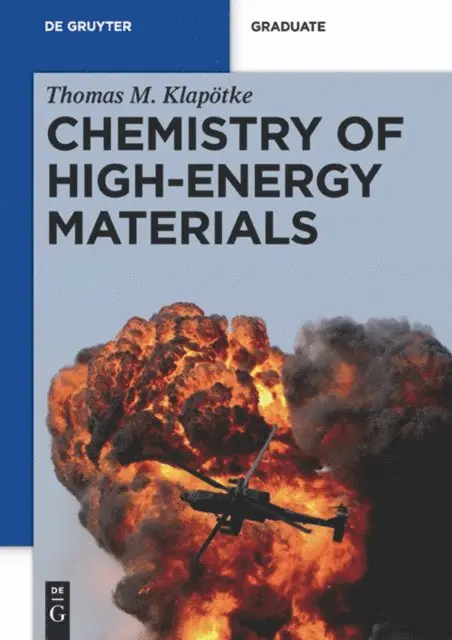
This graduate-level textbook in a new revised edition treats the basic chemistry of high energy materials - primary and secondary explosives, propellants, rocket fuel and pyrotechnics - and provides a review of new research developments. Applications in both military and civil fields are discussed. The book also offers new insights into "green" chemistry requirements and strategies for military applications. This work should be of interest to advanced students in chemistry, materials science and engineering, as well as all those working in defense technology.
755 kr
Läs direkt efter köp
Chemistry of High-Energy Materials continues in this new and revised 3rd edition to provide fundamental scientific insights into primary and secondary explosives, propellants, rocket fuel and pyrotechnics. The contents of the previous edition were meticulously updated and recent research developments added to this graduate-level textbook. Applications in military and civil fields are discussed. Especially environmental issues caused by lead-based primary explosives, perchlorates in pyrotechnic formulations and modern signal flare compositions are discussed and current research presented. Further additions include the understanding of the mechanism and continuing development of laser ignition methods, techniques for the characterization of detonators and their output as well as principles and effects of underwater explosions.
New in the 3rd Edition:
• Revised and updated content, new study problems and questions.
• Extended examination of the application of ionic liquids in the field and hydrodynamics.
• Intended for advanced students in chemistry, materials science and engineering, as well as to all those working in defense technology.
"This book makes a nice addition to the shelf of everyone involved with energetic materials. As such it is recommended as a very useful reference for both students and experienced readers."Ernst-Christian Koch on the 2nd Edition in: Propellants Explosive Pyrotechnics 16/2011
Upcoming titles by Thomas M. Klapötke:
Energetic Materials Encyclopedia (January 2018)Thomas M. Klapötke
CSci CChem FRSC was from 1995 until 1997 Ramsay Professor of Chemistry at the University of Glasgow in Scotland. Since 1997 he has held the Chair of Inorganic Chemistry at LMU Munich.
695 kr
Läs direkt efter köp
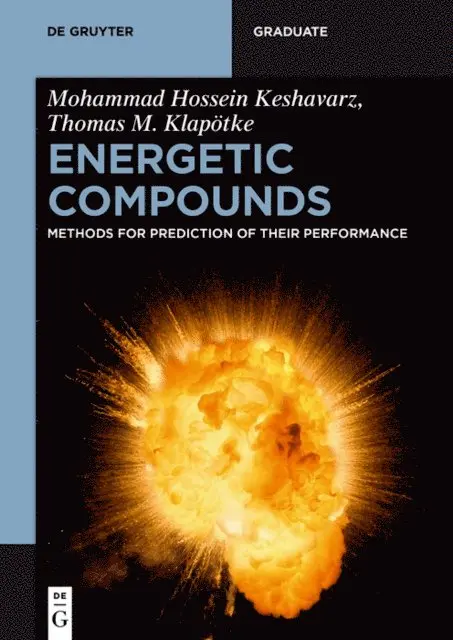
Since the synthesis and development of new energetic materials require identification of promising candidates for additional study and elimination of poor candidates from further consideration, it is important for engineers, scientists and industries to assess the performance of the new compounds for reducing costs associated with synthesis, testing and evaluation of these materials. Nowadays different approaches have been used to predict the performance of energetic compounds, which can be recognized to be cost-effective, environmentally-desirable and time-saving capabilities. This book reviews different methods for the assessment of the performance of an energetic compound through its heat of detonation, detonation pressure, detonation velocity, detonation temperature, Gurney energy and power (strength). The book also focuses on the detonation pressure and detonation velocity of non-ideal aluminized energetic compounds. Simple and reliable methods are demonstrated in detail where they can be easily used for the design, synthesis and development of novel energetic compounds.
1 004 kr
Läs direkt efter köp
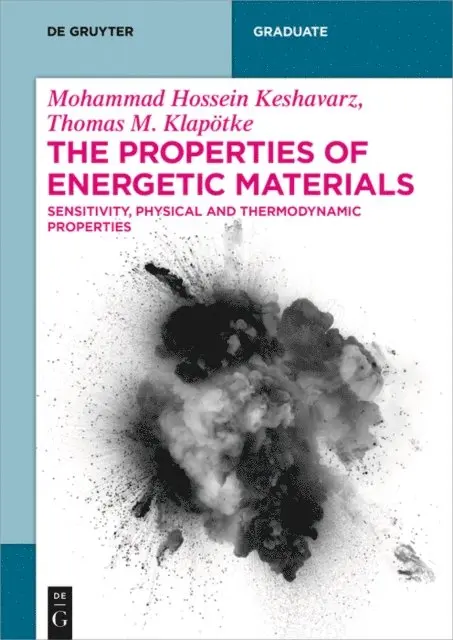
For a chemist who is concerned with the synthesis of new energetic compounds, it is essential to be able to assess physical and thermodynamic properties, as well as the sensitivity, of possible new energetic compounds before synthesis is attempted. Various approaches have been developed to predict important aspects of the physical and thermodynamic properties of energetic materials including (but not limited to): crystal density, heat of formation, melting point, enthalpy of fusion and enthalpy of sublimation of an organic energetic compound. Since an organic energetic material consists of metastable molecules capable of undergoing very rapid and highly exothermic reactions, many methods have been developed to estimate the sensitivity of an energetic compound with respect to detonationcausing external stimuli such as heat, friction, impact, shock and electrostatic discharge. This book introduces these methods and demonstrates those methods which can be easily applied.
1 004 kr
Läs direkt efter köp
For a chemist who is concerned with the synthesis of new energetic compounds, it is essential to be able to assess physical and thermodynamic properties, as well as the sensitivity, of possible new energetic compounds before synthesis is attempted. Various approaches have been developed to predict important aspects of the physical and thermodynamic properties of energetic materials including (but not limited to): crystal density, heat of formation, melting point, enthalpy of fusion and enthalpy of sublimation of an organic energetic compound. Since an organic energetic material consists of metastable molecules capable of undergoing very rapid and highly exothermic reactions, many methods have been developed to estimate the sensitivity of an energetic compound with respect to detonationcausing external stimuli such as heat, friction, impact, shock and electrostatic discharge. This book introduces these methods and demonstrates those methods which can be easily applied.
695 kr
Läs direkt efter köp
Since the synthesis and development of new energetic materials require identification of promising candidates for additional study and elimination of poor candidates from further consideration, it is important for engineers, scientists and industries to assess the performance of the new compounds for reducing costs associated with synthesis, testing and evaluation of these materials. Nowadays different approaches have been used to predict the performance of energetic compounds, which can be recognized to be cost-effective, environmentally-desirable and time-saving capabilities. This book reviews different methods for the assessment of the performance of an energetic compound through its heat of detonation, detonation pressure, detonation velocity, detonation temperature, Gurney energy and power (strength). The book also focuses on the detonation pressure and detonation velocity of non-ideal aluminized energetic compounds. Simple and reliable methods are demonstrated in detail where they can be easily used for the design, synthesis and development of novel energetic compounds.
963 kr
Läs direkt efter köp
1 069 kr
Läs direkt efter köp
The 5th revised edition expands on the basic chemistry of high-energy materials of the previous editions and examines new research developments, including plastic bonded explosives and melt-castable dinitrate esters. Applications in military and civil fields are discussed. This work is of interest to advanced students in chemistry, materials science and engineering, as well as to all those working in defense technology.
1 069 kr
Läs direkt efter köp
The 5th revised edition expands on the basic chemistry of high-energy materials of the previous editions and examines new research developments, including plastic bonded explosives and melt-castable dinitrate esters. Applications in military and civil fields are discussed. This work is of interest to advanced students in chemistry, materials science and engineering, as well as to all those working in defense technology.
3 316 kr
Läs direkt efter köp
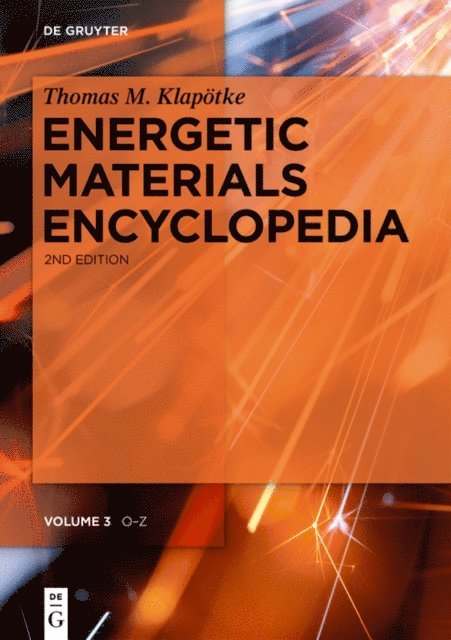
The Energetic Materials Encyclopedia is a compendium of pure energetic materials (i.e., not formulations) which summarizes the most important parameters of these compounds. The impact, friction and electrostatic discharge (ESD) sensitivity parameters are reported. Thermal parameters such as the melting points and decomposition temperatures are also given together with the thermodynamic enthalpies of formation. The density values that govern the detonation performance are given for the theoretical maximum density (TMD) and, where appropriate, also for lower densities. The most important performance parameters such as the detonation pressure, the detonation velocity as well as the temperature of explosion and the heat of explosion are also stated.
Wherever possible experimental values are given together with calculated parameters. If multiple values for one property were available from the literature, these are also stated, e.g. 20 different detonation velocities for RDX. For all literature values, the original references have been included.
This revised and updated edition of the Energetic Materials Encyclopedia will be of interest to professionals, advanced students and educators in chemistry, materials science, engineering and military technology. All data have been updated and additional compounds not listed in the first edition have been included.
3 316 kr
Läs direkt efter köp
The Energetic Materials Encyclopedia is a compendium of pure energetic materials (i.e., not formulations) which summarizes the most important parameters of these compounds. The impact, friction and electrostatic discharge (ESD) sensitivity parameters are reported. Thermal parameters such as the melting points and decomposition temperatures are also given together with the thermodynamic enthalpies of formation. The density values that govern the detonation performance are given for the theoretical maximum density (TMD) and, where appropriate, also for lower densities. The most important performance parameters such as the detonation pressure, the detonation velocity as well as the temperature of explosion and the heat of explosion are also stated.
Wherever possible experimental values are given together with calculated parameters. If multiple values for one property were available from the literature, these are also stated, e.g. 20 different detonation velocities for RDX. For all literature values, the original references have been included.
This revised and updated edition of the Energetic Materials Encyclopedia will be of interest to professionals, advanced students and educators in chemistry, materials science, engineering and military technology. All data have been updated and additional compounds not listed in the first edition have been included.
3 316 kr
Läs direkt efter köp
The Energetic Materials Encyclopedia is a compendium of pure energetic materials (i.e., not formulations) which summarizes the most important parameters of these compounds. The impact, friction and electrostatic discharge (ESD) sensitivity parameters are reported. Thermal parameters such as the melting points and decomposition temperatures are also given together with the thermodynamic enthalpies of formation. The density values that govern the detonation performance are given for the theoretical maximum density (TMD) and, where appropriate, also for lower densities. The most important performance parameters such as the detonation pressure, the detonation velocity as well as the temperature of explosion and the heat of explosion are also stated.
Wherever possible experimental values are given together with calculated parameters. If multiple values for one property were available from the literature, these are also stated, e.g. 20 different detonation velocities for RDX. For all literature values, the original references have been included.
This revised and updated edition of the Energetic Materials Encyclopedia will be of interest to professionals, advanced students and educators in chemistry, materials science, engineering and military technology. All data have been updated and additional compounds not listed in the first edition have been included.
992 kr
Läs direkt efter köp
This book discusses methods for the assessment of energetic compounds through heat of detonation, detonation pressure, velocity and temperature, Gurney energy and power. The authors focus on the detonation pressure and detonation velocity of non-ideal aluminized energetic compounds. This 2nd Edition includes an updated and improved presentation of simple, reliable methods for the design, synthesis and development of novel energetic compounds.
949 kr
Läs direkt efter köp
This book discusses methods for the assessment of energetic compounds through heat of detonation, detonation pressure, velocity and temperature, Gurney energy and power. The authors focus on the detonation pressure and detonation velocity of non-ideal aluminized energetic compounds. This 2nd Edition includes an updated and improved presentation of simple, reliable methods for the design, synthesis and development of novel energetic compounds.
1 115 kr
Läs direkt efter köp
Chemistry of High-Energy Materials continues in this new and revised 6th edition to provide fundamental scientifi c insights into primary and secondary explosives, propellants, rocket fuels and pyrotechnics. It expands with new research developments, including new melt casts, reactive structure materials, a computational study on the detonation velocity of mixtures of solid explosives with non-explosive liquids, calculation of craters after explosions. This work is of interest to advanced students in chemistry, materials science and engineering, as well as to all those working in military and defense technology.
1 076 kr
Läs direkt efter köp
Chemistry of High-Energy Materials continues in this new and revised 6th edition to provide fundamental scientifi c insights into primary and secondary explosives, propellants, rocket fuels and pyrotechnics. It expands with new research developments, including new melt casts, reactive structure materials, a computational study on the detonation velocity of mixtures of solid explosives with non-explosive liquids, calculation of craters after explosions. This work is of interest to advanced students in chemistry, materials science and engineering, as well as to all those working in military and defense technology.
1 115 kr
Läs direkt efter köp
For a chemist who is concerned with the synthesis of new energetic compounds, it is essential to be able to assess physical and thermodynamic properties, as well as the sensitivity, of possible new energetic compounds before synthesis is attempted. Various approaches have been developed to predict important aspects of the physical and thermodynamic properties of energetic materials including (but not limited to): crystal density, heat of formation, melting point, enthalpy of fusion and enthalpy of sublimation of an organic energetic compound. Since an organic energetic material consists of metastable molecules capable of undergoing very rapid and highly exothermic reactions, many methods have been developed to estimate the sensitivity of an energetic compound with respect to detonationcausing external stimuli such as heat, friction, impact, shock and electrostatic discharge. This book introduces these methods and demonstrates those methods which can be easily applied.
1 085 kr
Läs direkt efter köp
For a chemist who is concerned with the synthesis of new energetic compounds, it is essential to be able to assess physical and thermodynamic properties, as well as the sensitivity, of possible new energetic compounds before synthesis is attempted. Various approaches have been developed to predict important aspects of the physical and thermodynamic properties of energetic materials including (but not limited to): crystal density, heat of formation, melting point, enthalpy of fusion and enthalpy of sublimation of an organic energetic compound. Since an organic energetic material consists of metastable molecules capable of undergoing very rapid and highly exothermic reactions, many methods have been developed to estimate the sensitivity of an energetic compound with respect to detonationcausing external stimuli such as heat, friction, impact, shock and electrostatic discharge. This book introduces these methods and demonstrates those methods which can be easily applied.
2 741 kr
Läs direkt efter köp
172 kr
Läs direkt efter köp
Für viele Menschen ist die Chemie eine schwer verständliche Wissenschaft, und die Hemmschwelle, sich mit ihr auseinanderzusetzen, ist entsprechend groß. Insbesondere der Einstieg wird erschwert durch physikalische und mathematische Modelle und Grundlagen, die eher abschrecken als erklären. Wie gut wäre es, ein Buch zu haben, welches auf die detaillierte Beschreibung dieser komplexen Modelle zu Beginn verzichtet und diese erst ins Spiel bringt, wenn sie zum weiteren Verständnis notwendig werden?
Das vorliegende Buch besticht nicht nur durch den klaren und leicht verständlichen Schreibstil der Autoren, der auch junge Menschen anspricht, sondern durch einen ganz neuen didaktischen Ansatz. Der Einstieg in die spannende Welt der Chemie erfolgt über die anorganische Stoffchemie, und die andernorts meist schwer verständlichen physikalischen und mathematischen Grundlagen werden erst behandelt, wo sie in direktem Zusammenhang zum Thema stehen. So kann der Leser nach und nach in die Materie "hineinwachsen" - Aha-Erlebnisse nicht ausgeschlossen! -, ohne gleich zu Beginn abgeschreckt oder gar frustriert zu werden. Dadurch wird dieses Buch der ideale Begleiter für Studierende der Chemie im Bachelor- und Lehramtsstudiengang, aber auch für Studierende mit Nebenfach Chemie und für all diejenigen, die sich gezwungenermaßen mit Chemie auseinandersetzen müssen. Lehrer der gymnasialen Oberstufe können Anregungen für ihre Unterrichtsgestaltung gewinnen, und Schülern kann das Werk eine Entscheidungshilfe bei der Suche nach dem richtigen Studienfach sein. Vielleicht ist es ja doch Chemie?