Thomas Micklich – författare
Visar alla böcker från författaren Thomas Micklich. Handla med fri frakt och snabb leverans.
4 produkter
4 produkter
Inbunden, Engelska, 2018
1 471 kr
Skickas inom 5-8 vardagar
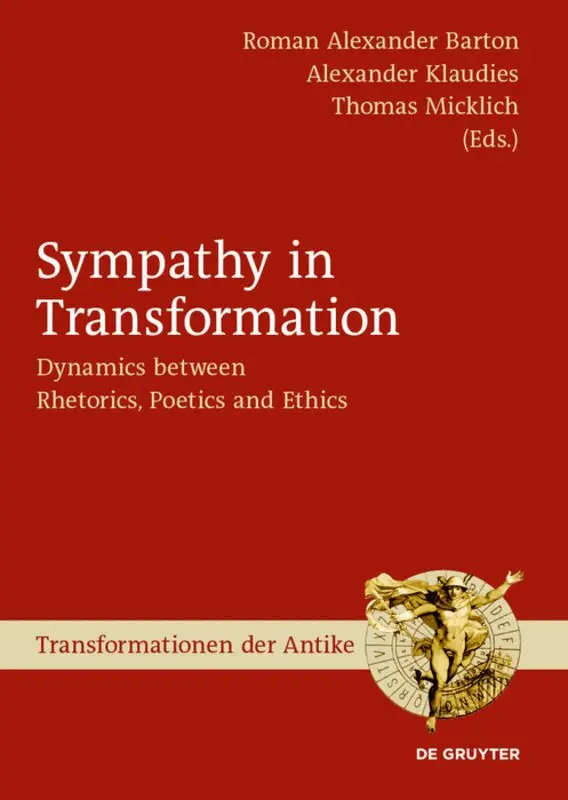
There is little doubt that sympathy plays a pivotal role in aesthetic as well as moral experience, yet also little agreement on how to describe this connection and its long history. This volume investigates the changes in the concept of sympathy as well as its rhetorical, poetical and ethical functions from antiquity to the threshold of Romanticism. The focus is on sympathy's development from a cosmological principle expressing the coherence, correspondence, and unity of all things into a theoretical key concept of intersubjectivity informing moral philosophy, criticism and literature. Thus, Sympathy in Transformation offers important insights into the many ways in which, when sympathy migrates into diverse discourses in Early Modernity, its ancient origins dwindle out of sight, while some of its central elements re-emerge in a surprising manner.
E-bok
Engelska, 20181 397 kr
Läs direkt efter köp
There is little doubt that sympathy plays a pivotal role in aesthetic as well as moral experience, yet also little agreement on how to describe this connection and its long history. This volume investigates the changes in the concept of sympathy as well as its rhetorical, poetical and ethical functions from antiquity to the threshold of Romanticism. The focus is on sympathy''s development from a cosmological principle expressing the coherence, correspondence, and unity of all things into a theoretical key concept of intersubjectivity informing moral philosophy, criticism and literature. Thus, Sympathy in Transformation offers important insights into the many ways in which, when sympathy migrates into diverse discourses in Early Modernity, its ancient origins dwindle out of sight, while some of its central elements re-emerge in a surprising manner.
E-bok
PDF, Engelska, 20181 447 kr
Läs direkt efter köp
There is little doubt that sympathy plays a pivotal role in aesthetic as well as moral experience, yet also little agreement on how to describe this connection and its long history. This volume investigates the changes in the concept of sympathy as well as its rhetorical, poetical and ethical functions from antiquity to the threshold of Romanticism. The focus is on sympathy''s development from a cosmological principle expressing the coherence, correspondence, and unity of all things into a theoretical key concept of intersubjectivity informing moral philosophy, criticism and literature. Thus, Sympathy in Transformation offers important insights into the many ways in which, when sympathy migrates into diverse discourses in Early Modernity, its ancient origins dwindle out of sight, while some of its central elements re-emerge in a surprising manner.
E-bok
PDF, Tyska, 2009895 kr
Läs direkt efter köp
Thomas Micklich geht es um die Gottesbeziehung des Menschen. Der Denkbarkeit dieser Voraussetzung des Glaubens stellen sich aber rationalitätslogische Probleme in den Weg. Die Studie verfolgt eine doppelte Strategie. Einerseits sollen implizite Voraussetzungen theologischen Denkens expliziert sowie innere Widersprüchlichkeiten offen geleget, andererseits einzelne Konstellationen des Glaubens in den Blick genommen werden. Die Hauptthese der Studie ist, dass die »Gottesbeziehung« in der Regel als eine zweistellige Relation gedacht wird. Diese Konzeption ist jedoch aporetisch, aber nicht als Aporie des Glaubens, sondern der zugrunde liegenden rationalitätslogischen Struktur. Die Perspektive, die die Studie zu eröffnen sucht, ist, die Gottesbeziehung als eine genuin dreistellige Relation zu denken. Dieser formalen Pointe entspricht ihre materiale Fassung als soziale Beziehung der Intersubjektivität. Intersubjektivität besteht dabei nicht zwischen »Gott« und »Mensch«, sondern zwischen Mensch und Mensch, derart, dass »Gott« als die Beziehung der Bezogenen zu denken ist. Nur so kann vermieden werden, dass der Mitmensch zur bloßen Randbedingung der Gottesbeziehung des Anderen wird, für die er vielmehr mitkonstitutiv ist. Dies ist denkbar auf der Basis einer transitiven – triadischen – Relation. Die Kommunikation des Glaubens kann nun als eine spezifische Geschichte Gottes mit dem Menschen, als seine sozial für uns wirkliche Mitmenschlichkeit, begriffen werden, deren Transzendenz sich inmitten unserer Welt erfahrbar realisiert.