Thomas S. Ferguson – författare
Visar alla böcker från författaren Thomas S. Ferguson. Handla med fri frakt och snabb leverans.
10 produkter
10 produkter
Häftad, Engelska, 1996
2 151 kr
Skickas inom 10-15 vardagar
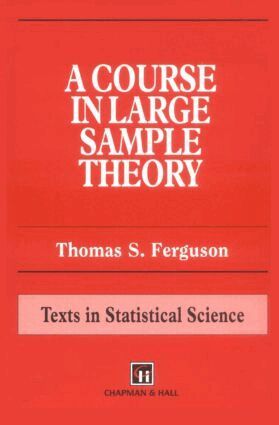
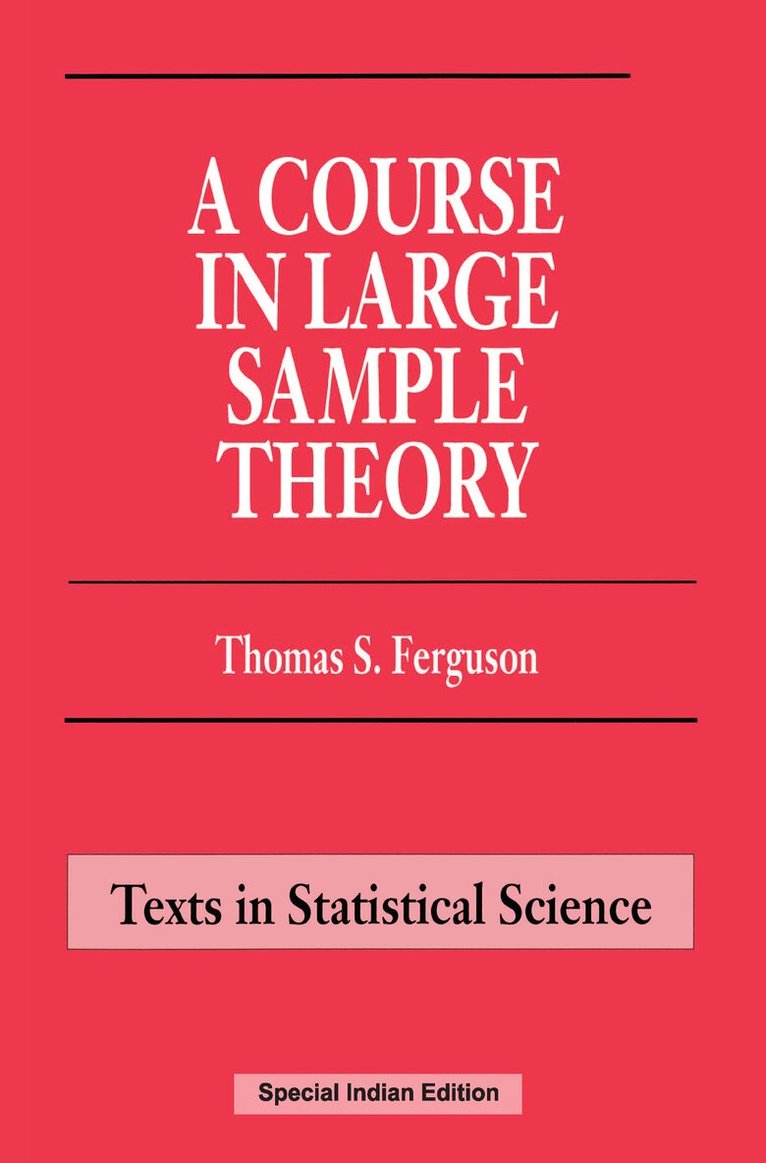
A Course in Large Sample Theory is presented in four parts. The first treats basic probabilistic notions, the second features the basic statistical tools for expanding the theory, the third contains special topics as applications of the general theory, and the fourth covers more standard statistical topics. Nearly all topics are covered in their multivariate setting.The book is intended as a first year graduate course in large sample theory for statisticians. It has been used by graduate students in statistics, biostatistics, mathematics, and related fields. Throughout the book there are many examples and exercises with solutions. It is an ideal text for self study.
Del 7 - Theory and Decision Library C
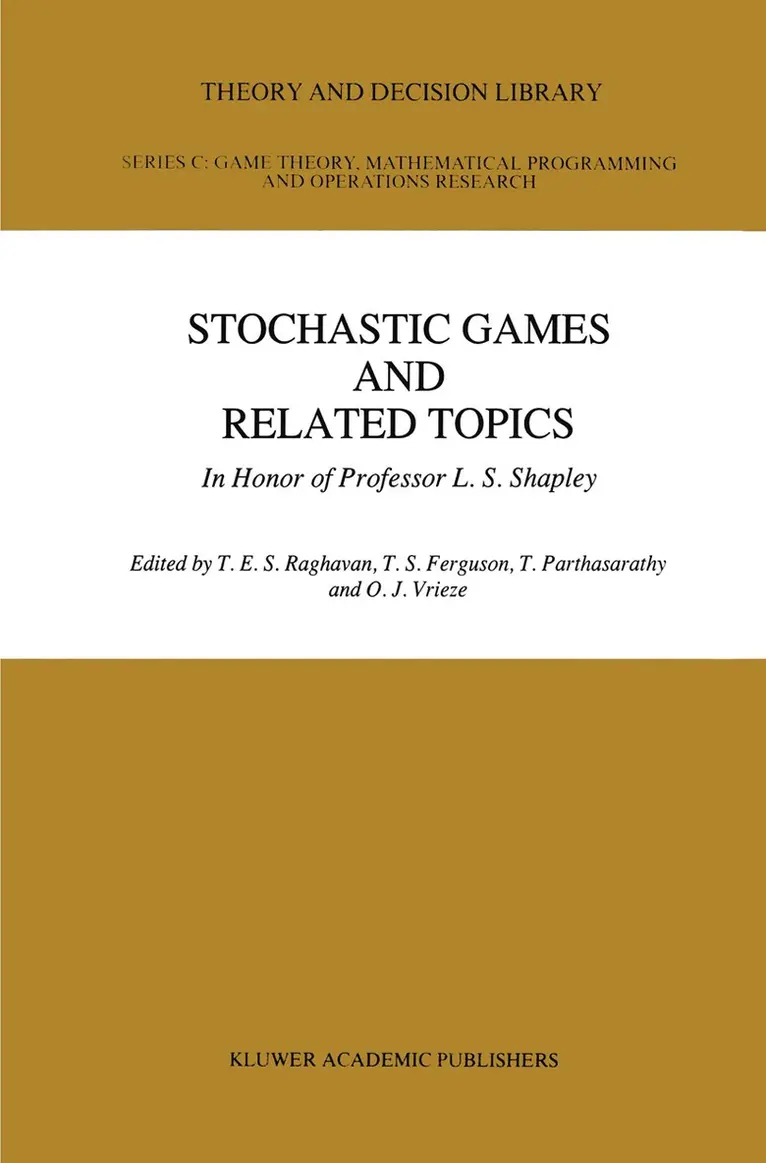
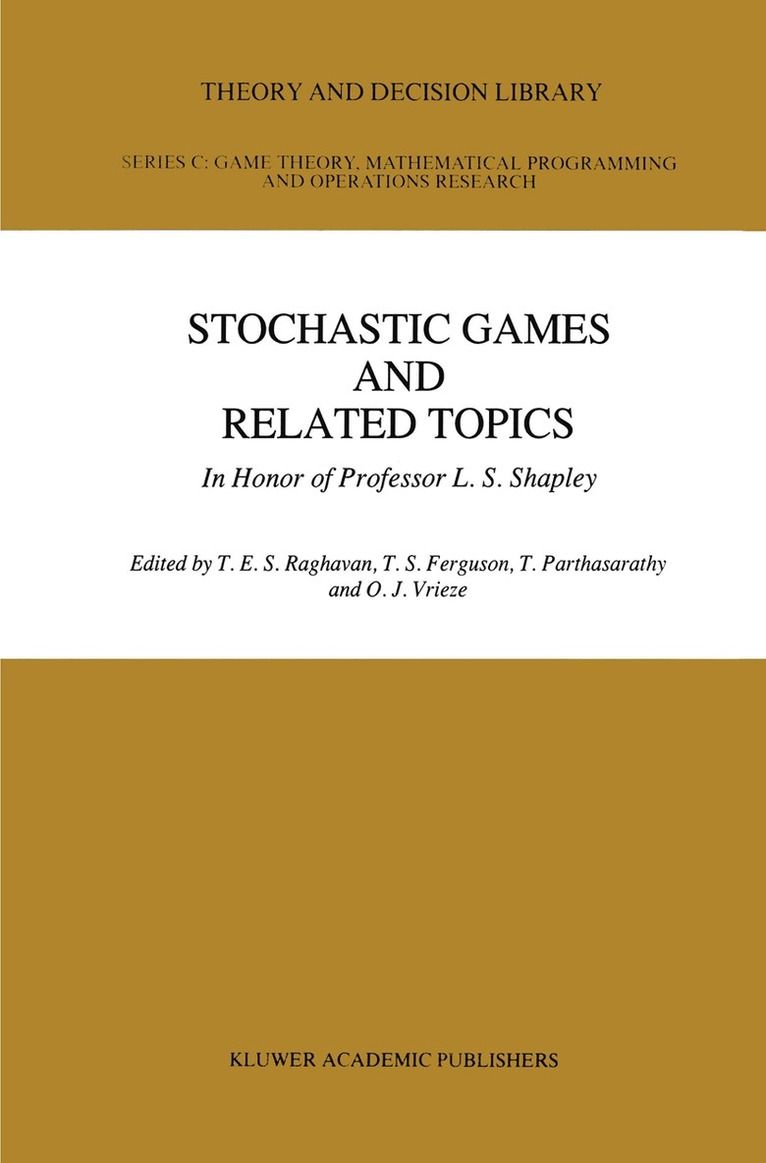
Stochastic Games And Related Topics
In Honor of Professor L. S. Shapley
Inbunden, Engelska, 1990
1 619 kr
Skickas inom 10-15 vardagar
Inbunden, Engelska, 2017
2 927 kr
Skickas inom 10-15 vardagar
A Course in Large Sample Theory is presented in four parts. The first treats basic probabilistic notions, the second features the basic statistical tools for expanding the theory, the third contains special topics as applications of the general theory, and the fourth covers more standard statistical topics. Nearly all topics are covered in their multivariate setting.The book is intended as a first year graduate course in large sample theory for statisticians. It has been used by graduate students in statistics, biostatistics, mathematics, and related fields. Throughout the book there are many examples and exercises with solutions. It is an ideal text for self study.
E-bok
Engelska, 20172 590 kr
Läs direkt efter köp
A Course in Large Sample Theory is presented in four parts. The first treats basic probabilistic notions, the second features the basic statistical tools for expanding the theory, the third contains special topics as applications of the general theory, and the fourth covers more standard statistical topics. Nearly all topics are covered in their multivariate setting.The book is intended as a first year graduate course in large sample theory for statisticians. It has been used by graduate students in statistics, biostatistics, mathematics, and related fields. Throughout the book there are many examples and exercises with solutions. It is an ideal text for self study.
E-bok
PDF, Engelska, 20172 515 kr
Läs direkt efter köp
A Course in Large Sample Theory is presented in four parts. The first treats basic probabilistic notions, the second features the basic statistical tools for expanding the theory, the third contains special topics as applications of the general theory, and the fourth covers more standard statistical topics. Nearly all topics are covered in their multivariate setting.The book is intended as a first year graduate course in large sample theory for statisticians. It has been used by graduate students in statistics, biostatistics, mathematics, and related fields. Throughout the book there are many examples and exercises with solutions. It is an ideal text for self study.
E-bok
PDF, Engelska, 2014756 kr
Läs direkt efter köp
Mathematical Statistics: A Decision Theoretic Approach presents an investigation of the extent to which problems of mathematical statistics may be treated by decision theory approach. This book deals with statistical theory that could be justified from a decision-theoretic viewpoint. Organized into seven chapters, this book begins with an overview of the elements of decision theory that are similar to those of the theory of games. This text then examines the main theorems of decision theory that involve two more notions, namely the admissibility of a decision rule and the completeness of a class of decision rules. Other chapters consider the development of theorems in decision theory that are valid in general situations. This book discusses as well the invariance principle that involves groups of transformations over the three spaces around which decision theory is built. The final chapter deals with sequential decision problems. This book is a valuable resource for first-year graduate students in mathematics.
Häftad, Engelska, 2012
1 605 kr
Skickas inom 10-15 vardagar
E-bok
PDF, Engelska, 20121 977 kr
Läs direkt efter köp
Inbunden, Engelska, 2020
1 206 kr
Skickas inom 3-6 vardagar
Game theory is a fascinating subject. We all know many entertaining games, such as chess, poker, tic-tac-toe, bridge, baseball, computer games — the list is quite varied and almost endless. In addition, there is a vast area of economic games, discussed in Myerson (1991) and Kreps (1990), and the related political games [Ordeshook (1986), Shubik (1982), and Taylor (1995)]. The competition between firms, the conflict between management and labor, the fight to get bills through congress, the power of the judiciary, war and peace negotiations between countries, and so on, all provide examples of games in action. There are also psychological games played on a personal level, where the weapons are words, and the payoffs are good or bad feelings [Berne (1964)]. There are biological games, the competition between species, where natural selection can be modeled as a game played between genes [Smith (1982)]. There is a connection between game theory and the mathematical areas of logic and computer science. One may view theoretical statistics as a two-person game in which nature takes the role of one of the players, as in Blackwell and Girshick (1954) and Ferguson (1968).Games are characterized by a number of players or decision makers who interact, possibly threaten each other and form coalitions, take actions under uncertain conditions, and finally receive some benefit or reward or possibly some punishment or monetary loss. In this text, we present various mathematical models of games and study the phenomena that arise. In some cases, we will be able to suggest what courses of action should be taken by the players. In others, we hope simply to be able to understand what is happening in order to make better predictions about the future.
Häftad, Engelska, 2020
950 kr
Skickas inom 3-6 vardagar
Game theory is a fascinating subject. We all know many entertaining games, such as chess, poker, tic-tac-toe, bridge, baseball, computer games — the list is quite varied and almost endless. In addition, there is a vast area of economic games, discussed in Myerson (1991) and Kreps (1990), and the related political games [Ordeshook (1986), Shubik (1982), and Taylor (1995)]. The competition between firms, the conflict between management and labor, the fight to get bills through congress, the power of the judiciary, war and peace negotiations between countries, and so on, all provide examples of games in action. There are also psychological games played on a personal level, where the weapons are words, and the payoffs are good or bad feelings [Berne (1964)]. There are biological games, the competition between species, where natural selection can be modeled as a game played between genes [Smith (1982)]. There is a connection between game theory and the mathematical areas of logic and computer science. One may view theoretical statistics as a two-person game in which nature takes the role of one of the players, as in Blackwell and Girshick (1954) and Ferguson (1968).Games are characterized by a number of players or decision makers who interact, possibly threaten each other and form coalitions, take actions under uncertain conditions, and finally receive some benefit or reward or possibly some punishment or monetary loss. In this text, we present various mathematical models of games and study the phenomena that arise. In some cases, we will be able to suggest what courses of action should be taken by the players. In others, we hope simply to be able to understand what is happening in order to make better predictions about the future.