Thomas Viehmann – författare
Visar alla böcker från författaren Thomas Viehmann. Handla med fri frakt och snabb leverans.
2 produkter
2 produkter
E-bok
Engelska, 2020406 kr
Läs direkt efter köp
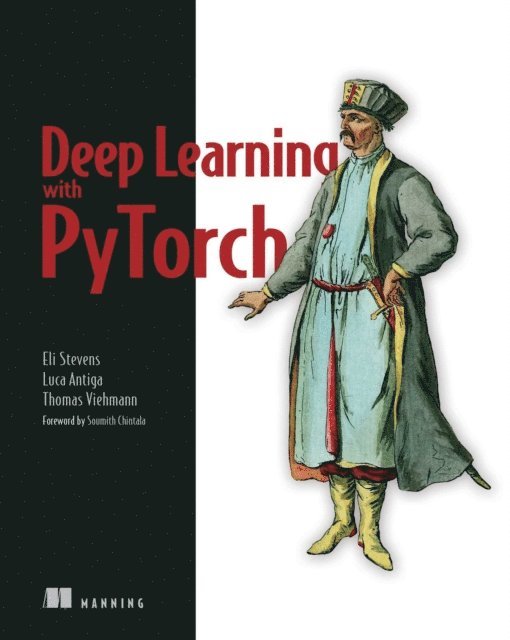
“We finally have the definitive treatise on PyTorch! It covers the basics and abstractions in great detail. I hope this book becomes your extended reference document.” —Soumith Chintala, co-creator of PyTorch Key Features Written by PyTorch’s creator and key contributors Develop deep learning models in a familiar Pythonic way Use PyTorch to build an image classifier for cancer detection Diagnose problems with your neural network and improve training with data augmentation Purchase of the print book includes a free eBook in PDF, Kindle, and ePub formats from Manning Publications.About The Book Every other day we hear about new ways to put deep learning to good use: improved medical imaging, accurate credit card fraud detection, long range weather forecasting, and more. PyTorch puts these superpowers in your hands. Instantly familiar to anyone who knows Python data tools like NumPy and Scikit-learn, PyTorch simplifies deep learning without sacrificing advanced features. It’s great for building quick models, and it scales smoothly from laptop to enterprise. Deep Learning with PyTorch teaches you to create deep learning and neural network systems with PyTorch. This practical book gets you to work right away building a tumor image classifier from scratch. After covering the basics, you’ll learn best practices for the entire deep learning pipeline, tackling advanced projects as your PyTorch skills become more sophisticated. All code samples are easy to explore in downloadable Jupyter notebooks. What You Will Learn Understanding deep learning data structures such as tensors and neural networks Best practices for the PyTorch Tensor API, loading data in Python, and visualizing results Implementing modules and loss functions Utilizing pretrained models from PyTorch Hub Methods for training networks with limited inputs Sifting through unreliable results to diagnose and fix problems in your neural network Improve your results with augmented data, better model architecture, and fine tuning This Book Is Written For For Python programmers with an interest in machine learning. No experience with PyTorch or other deep learning frameworks is required. About The Authors Eli Stevens has worked in Silicon Valley for the past 15 years as a software engineer, and the past 7 years as Chief Technical Officer of a startup making medical device software. Luca Antiga is co-founder and CEO of an AI engineering company located in Bergamo, Italy, and a regular contributor to PyTorch. Thomas Viehmann is a Machine Learning and PyTorch speciality trainer and consultant based in Munich, Germany and a PyTorch core developer. Table of Contents PART 1 - CORE PYTORCH 1 Introducing deep learning and the PyTorch Library 2 Pretrained networks 3 It starts with a tensor 4 Real-world data representation using tensors 5 The mechanics of learning 6 Using a neural network to fit the data 7 Telling birds from airplanes: Learning from images 8 Using convolutions to generalize PART 2 - LEARNING FROM IMAGES IN THE REAL WORLD: EARLY DETECTION OF LUNG CANCER 9 Using PyTorch to fight cancer 10 Combining data sources into a unified dataset 11 Training a classification model to detect suspected tumors 12 Improving training with metrics and augmentation 13 Using segmentation to find suspected nodules 14 End-to-end nodule analysis, and where to go next PART 3 - DEPLOYMENT 15 Deploying to production
E-bok
Engelska, 2026453 kr
Läs direkt efter köp
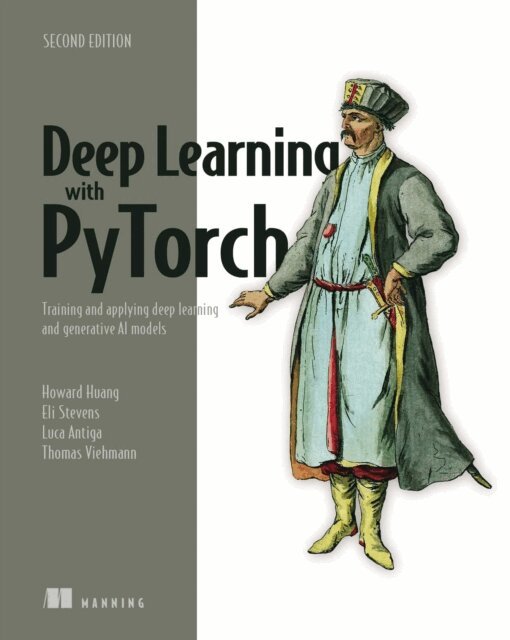
PyTorch core developer Howard Huang updates the bestselling original Deep Learning with PyTorch with new insights into the transformers architecture and generative AI models. Instantly familiar to anyone who knows PyData tools like NumPy, PyTorch simplifies deep learning without sacrificing advanced features. In this book youll learn how to create your own neural network and deep learning systems and take full advantage of PyTorchs built-in tools for automatic differentiation, hardware acceleration, distributed training, and more. Youll discover how easy PyTorch makes it to build your entire DL pipeline, including using the PyTorch Tensor API, loading data in Python, monitoring training, and visualizing results. Each new technique you learn is put into action with practical code examples in each chapter, culminating into you building your own convolution neural networks, transformers, and even a real-world medical image classifier. In Deep Learning with PyTorch, Second Edition youll find: Deep learning fundamentals reinforced with hands-on projects Mastering PyTorch's flexible APIs for neural network development Implementing CNNs, transformers, and diffusion models Optimizing models for training and deployment Generative AI models to create images and text About the technology The powerful PyTorch library makes deep learning simplewithout sacrificing the features you need to create efficient neural networks, LLMs, and other ML models. Pythonic by design, its instantly familiar to users of NumPy, Scikit-learn, and other ML frameworks. This thoroughly-revised second edition covers the latest PyTorch innovations, including how to create and refine generative AI models. About the book Deep Learning with PyTorch, Second Edition shows you how to build neural network models using the latest version of PyTorch. Clear explanations and practical projects help you master the fundamentals and explore advanced architectures including transformers and LLMs. Along the way youll learn techniques for training using augmented data, improving model architecture, and fine tuning. What's inside PyTorch APIs for neural network development LLMs, transformers, and diffusion models Model training and deployment About the reader For Python programmers with a background in machine learning. About the author Howard Huang is a software engineer and developer on the PyTorch library focusing on large scale, distributed training. Eli Stevens, Luca Antiga, and Thomas Viehmann authored the first edition of Deep Learning with PyTorch. Table of Contents Part 1 1 Introducing deep learning and the PyTorch library 2 Pretrained networks 3 It starts with a tensor 4 Real-world data representation using tensors 5 The mechanics of learning 6 Using a neural network to fit the data 7 Telling birds from airplanes: Learning from images 8 Using convolutions to generalize Part 2 9 How transformers work 10 Diffusion models for images 11 Using PyTorch to fight cancer 12 Combining data sources into a unified dataset 13 Training a classification model to detect suspected tumors 14 Improving training with metrics and augmentation 15 Using segmentation to find suspected nodules 16 Training models on multiple GPU 17 Deploying to production