Thorsten A. Kern – författare
1 214 kr
Läs direkt efter köp
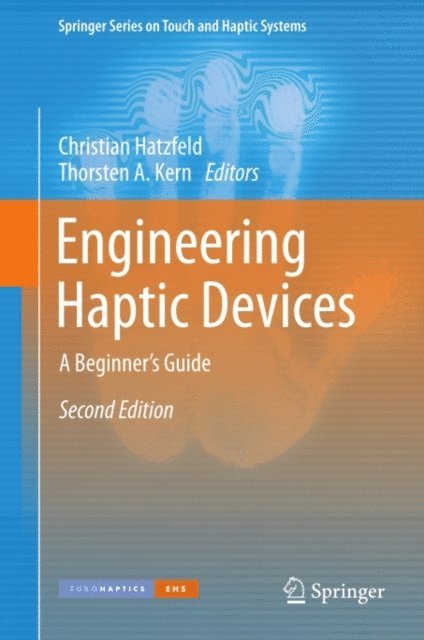
In this greatly reworked second edition of Engineering Haptic Devices the psychophysic content has been thoroughly revised and updated. Chapters on haptic interaction, system structures and design methodology were rewritten from scratch to include further basic principles and recent findings. New chapters on the evaluation of haptic systems and the design of three exemplary haptic systems from science and industry have been added.
This book was written for students and engineers that are faced with the development of a task-specific haptic system. It is a reference book for the basics of haptic interaction and existing haptic systems and methods as well as an excellent source of information for technical questions arising in the design process of systems and components.
Divided into two parts, part 1 contains typical application areas of haptic systems and a thorough analysis of haptics as an interaction modality. The role of the user in the design of haptic systems is discussed and relevant design and development stages are outlined. Part II presents all relevant problems in the design of haptic systems including general system and control structures, kinematic structures, actuator principles and sensors for force and kinematic measures. Further chapters examine interfaces and software development for virtual reality simulations.
974 kr
Skickas inom 10-15 vardagar
544 kr
Skickas inom 10-15 vardagar
437 kr
Skickas inom 10-15 vardagar
Haptics: Science, Technology, Applications
13th International Conference on Human Haptic Sensing and Touch Enabled Computer Applications, EuroHaptics 2022, Hamburg, Germany, May 22–25, 2022, Proceedings
450 kr
Skickas inom 10-15 vardagar
1 404 kr
Skickas inom 10-15 vardagar
1 147 kr
Läs direkt efter köp
„Entwicklung Haptischer Geräte“ legt den Schwerpunkt auf die technologischen Aspekte der Geräte, die unsere haptische Wahrnehmung beeinflussen und ermöglicht Ingenieuren und Naturwissenschaftlern eine umfassende Einführung in dieses weite und interdisziplinäre Themenfeld.
Den Einstieg erleichtert ein Einblick in die Definition der Haptik aus psychologischer Sicht, gefolgt von einem Blick auf die Haptik im Alltag um ihre Bedeutung besser verstehen zu können, aber auch um ihren Verlust zu bemerken. Über die Definition einer einheitlichen Terminologie werden mit anschaulichen Beispielen aus den biologischen Kenndaten haptischer Wahrnehmung die Parameter abgeleitet, deren Verständnis für die spätere Produktentwicklung notwendig ist. Basierend darauf werden grundlegende Gerätekonzepte vorgestellt und die wesentlichen Komponenten eines haptischen Gerätes eingeführt und in Beziehung zueinander gesetzt. Daraus ergeben sich empfohlene Entscheidungswege für die Entwicklung, die ausführlich beschrieben werden. Anschließend werden sehr konkrete technische Betrachtungen aller relevanten Komponenten und Strukturen durchgeführt. Begonnen wird dies über die übergeordneten Themen der Regelungstechnik sowie den Kinematikentwurf. Anschließend werden Aktortechnologien von elektrodynamischen Systemen bis hin zu Ultraschall- und Polymeraktoren in Entwurf und Auslegung sowie für deren Einsatz in haptischen Systemen diskutiert. Im Bereich Sensortechnik bildet die für rückgekoppelte Systeme besonders relevante Kraftsensorik einen Schwerpunkt. Die Schnittstellen zur Anbindung der Geräte zu umgebenden Systemen sowie die Positionsmesstechnik runden den Hardware-Geräteentwurf ab. Ein Kapitel zu den Grundzügen des Softwareentwurfs für die haptische Interaktion bei der Simulation virtueller Welten gibt einen Einblick in die informationstechnischen Fragestellungen haptischer Entwicklungen.
Die Summe dieser Abschnitte in dem Fokus eines technischenEntwicklungsprozesses stellt die wichtigsten Inhalte der Technologie und Methodik zu ihrer Nutzung klar dar, so dass vom Leser eine Einschätzung der Relevanz bezogen auf das eigene Problem getroffen werden kann.
Das Buch dient also sowohl als Nachschlagewerk für Haptik-relevante Technologien, sowie als Lehrbuch, um Methodiken im Umgang mit ingenieurtechnischen Fragestellung in der Haptik zu definieren und deren Anwendung zu zeigen.
966 kr
Skickas inom 10-15 vardagar
840 kr
Läs direkt efter köp
In this book, we aim to give a thorough introduction to machine dynamics. It covers the theoretical basis of dynamics, modelling, mechanical design, practical applications, kinematics and kinetics, principles of mechanics, equations of motion for multibody systems, applications to mechanisms, vehicle dynamics, and static and dynamic balancing. It covers a complete range of mechanisms and concepts, from the determination of degrees of freedom to the design of complex cams. This progression is explained at a reasonable pace so that by the end the reader is able to design and analyze mechanical systems. Throughout the book, we also try to introduce conceptual examples and exercises to make the text more practical and understandable for the reader and also useful as a reference for lectures in universities. In addition, most books in this field are too voluminous and therefore are not suitable as a reference for a lecture. In this book, we have reduced the unnecessary theory part and put more emphasis on practical examples. Moreover, it is written in such a way that it will guide the readers even if they have forgotten the dynamics and basic concept and provide enough information. So this book can be used as a self-study book.
700 kr
Skickas inom 10-15 vardagar