Till Weber - Böcker
Visar alla böcker från författaren Till Weber. Handla med fri frakt och snabb leverans.
5 produkter
5 produkter
240 kr
Skickas inom 3-6 vardagar
273 kr
Skickas inom 3-6 vardagar
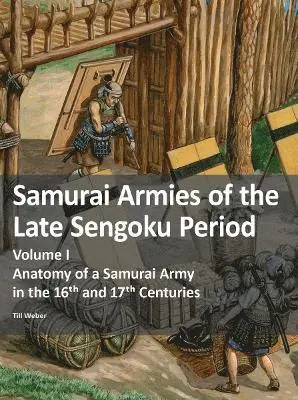
Samurai Armies of the Late Sengoku Period
Volume I: Anatomy of a Samurai Army in the 16th and 17th Centuries
Häftad, 2022
343 kr
Skickas
The "Anatomy of a samurai army" details its composition, hierarchies, strengths and weaknesses as well as examining how it fought. Other aspects include:- the differences between samurai and European warfare;- the roles assigned to samurai and ashigaru in different armies;- how these armies, some of which were over 100,000 strong, functioned;- marching orders and camp facilities of the armies and;- where each individual samurai stood in the order of battle.The reader will discover what may seem to be abstract or strange ideas by way of the most detailed examples possible, in both word and picture, that are based on a variety of Japanese sources.
Samurai Armies of the Late Sengoku Period
Volume II: Castles and Sieges, Artillery, Heraldry & Clothing
Häftad, Engelska, 2022
343 kr
Skickas
The elegant, multi-storey main towers of Japanese castles, surrounded by massive fortifications, are widely known as symbols of samurai rule. However, the first of these tenshukaku were built only at the very end of the Sengoku period. Most fortifications were built of wood with eart- hen ramparts and ditches exploiting the natural environment.The second volume of this series details these constructions as well as the fortifications that were affected by major sieges: Fushimi, Tanabe, Otsu and Ueda in 1600, and Osaka in 1614/15. The author explains the sophisticated siege techniques and countermeasures employed by samurai armies of the period, and the Japanese artillery of the time.
443 kr
Skickas
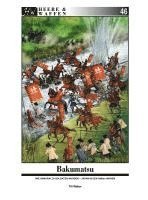
From the early 17th century until the 1860s, Japan was ruled by samurai led by the Shoguns of the powerful Tokugawa dynasty. The long period of peace following almost incessant civil war had negative effects on the proficiency of these feudal warriors. When industrialized Western powers whose armies and navies were equipped with the most modern weapons began to take interest in Japan in the 1850s, a tumultuous period of reforms and radical changes ensued - Bakumatsu. From this time emerged a country which had thoroughly albeit painfully rid itself of former taboos: modern rifles and artillery produced new tactics, while modern uniforms replaced the samurai's former splendour in arms. Now even non-samurai could become fighting men. By the 1870s, the Emperor Meiji ruled over a new Japan which no longer had any use for its ancient warrior elite.The Zeughaus Verlag's third volume of the history of the samurai provides a detailed overview of the opposing parties as well as their respective military reforms. The reader is introduced to the various modern and traditional-minded combatants, from lowly but efficient regular infantry to the gallant desperadoes filling the ranks of the Shinsengumi. Rag-tag militias replaced proud and resplendently attired samurai fighting for a lost cause. Tactics, arms, clothing and equipment are presented in detail. The author describes the campaigns and battles which changed the country's face between 1866 and 1869, and introduces the protagonists of the struggle which culminated in modern Japan's entrance onto the world stage.