Tim Shallice - Böcker
Visar alla böcker från författaren Tim Shallice. Handla med fri frakt och snabb leverans.
11 produkter
11 produkter
1 653 kr
Skickas inom 5-8 vardagar
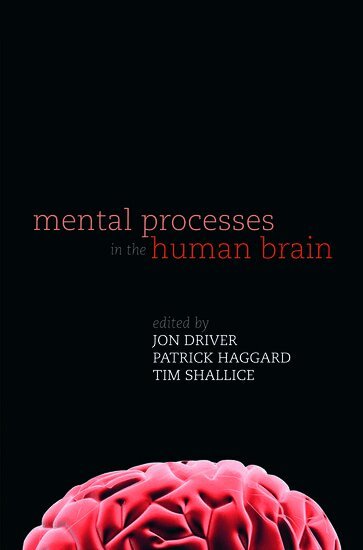
The scientific study of the human mind and brain has come of age with the advent of technologically advanced methods for imaging brain structure and activity in health and disease, plus computational theories of cognition. These advances are leading to sophisticated new accounts for how mental processes are implemented in the human brain, but they also raise new challenges.Mental Processes in the Human Brain provides an integrative overview of the rapid advances and future challenges in understanding the neurobiological basis of mental processes that are characteristically (and in some cases, perhaps uniquely) human, including: language; thought; understanding of others; attention; planning and decision-making; emotion; memory; prediction; and awareness itself. The book also presents the latest insights into how these various processes can break down after brain injury. With chapters from some of leading figures in the brain sciences, this book will be essential for all those in the cognitive and brain sciences.
1 107 kr
Skickas inom 5-8 vardagar
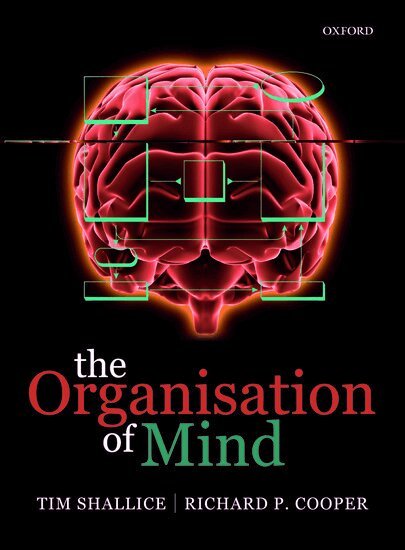
Brain imaging has been immensely valuable in showing us how the mind works. However, many of our ideas about how the mind works come from disciplines like experimental psychology, artificial intelligence and linguistics, which in their modern form date back to the computer revolution of the 1940s, and are not strongly linked to the subdisciplines of biomedicine. Cognitive science and neuroscience thus have very separate intellectual roots, and very different styles. Unfortunately, these two areas of knowledge have not been well integrated as far as higher mental processes are concerned. So how can these two be reconciled in order to develop a full understanding of the mind and brain?This is the focus of this landmark book from leaders in the field. Coming more than two decades after Shallice's classic 'From neuropsychology to mental structure', 'The Organisation of Mind' establishes a strong historical, empirical, and theoretical basis for cognitive neuroscience.The book starts by reviewing the history and intellectual roots of the field, looking at some of the researchers who guided and influenced it. The basic principles - theoretical and empirical and the inferential relation between them - are then considered with particular emphasis being placed on inferences to the organisation of the cognitive system from two empirical methodologies - neuropsychology and functional imaging. The core skeleton of the cognitive system is then analysed for the areas most critical for understanding rational thought. In the third section the components of simple cognitive acts are described, namely semantic processing, working memory, and cognitive operations. In the final section, more complex higher-level modulating processes are considered, including, supervisory processing, episodic memory, consciousness and problem-solving.This will be a seminal publication on the interface between the brain sciences and the cognitive sciences and essential reading for all students and researchers in related fields.
1 096 kr
Skickas inom 7-10 vardagar
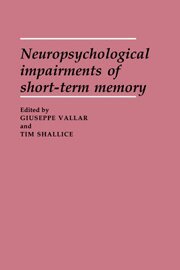
This work summarizes the empirical and theoretical work on impairments of short-term memory (often caused by damage in the left cerebral hemisphere) and contains chapters from virtually every scientist in Europe and North America working on the problem. The chapters present evidence from both normal and brain-damaged patients. Two neuropsychological issues are discussed in detail: first, the specific patterns of immediate memory impairment resulting from brain damage with reference to both multistore and the interactive-activation theoretical frameworks. Also considered is the relation between verbal STM and sentence comprehension disorders in patients with a defective immediate auditory memory: an area of major controversy in more recent years.
1 890 kr
Skickas inom 7-10 vardagar
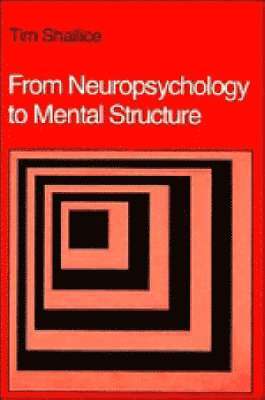
As a cognitive neuropsychologist, Tim Shallice considers the general question of what can be learned about the operation of the normal cognitive system from the study of the cognitive difficulties arising from neurological damage and disease. He distinguishes two types of theories of normal function - primarily modular and primary non-modular - and argues that the problems of making valid inferences about normal function from studies of brain-damaged subjects are more severe for the latter. He first analyzes five well-researched areas in which some modularity can be assumed: short-term memory, reading, writing, visual perception, and the relation between input and output language processing. His aim is to introduce the methods about normal function mirror ones derived directly from studies of normal subjects and indeed at times preceded them. He then more theoretically examines these inferences, from group studies and individual case studies to modular and non-modular systems. Finally, he considers five areas where theories of normal function are relatively undeveloped and neuropsychology provides counterintuitive phenomena and guides to theory-building: the organization of semantic systems, visual attention, concentration and will, episodic memory, and consciousness.
851 kr
Skickas inom 7-10 vardagar
As a cognitive neuropsychologist, Tim Shallice considers the general question of what can be learned about the operation of the normal cognitive system from the study of the cognitive difficulties arising from neurological damage and disease. He distinguishes two types of theories of normal function - primarily modular and primary non-modular - and argues that the problems of making valid inferences about normal function from studies of brain-damaged subjects are more severe for the latter. He first analyzes five well-researched areas in which some modularity can be assumed: short-term memory, reading, writing, visual perception, and the relation between input and output language processing. His aim is to introduce the methods about normal function mirror ones derived directly from studies of normal subjects and indeed at times preceded them. He then more theoretically examines these inferences, from group studies and individual case studies to modular and non-modular systems. Finally, he considers five areas where theories of normal function are relatively undeveloped and neuropsychology provides counterintuitive phenomena and guides to theory-building: the organization of semantic systems, visual attention, concentration and will, episodic memory, and consciousness.
2 448 kr
Skickas inom 7-10 vardagar
This work summarizes the empirical and theoretical work on impairments of short-term memory (often caused by damage in the left cerebral hemisphere) and contains chapters from virtually every scientist in Europe and North America working on the problem. The chapters present evidence from both normal and brain-damaged patients. Two neuropsychological issues are discussed in detail: first, the specific patterns of immediate memory impairment resulting from brain damage with reference to both multistore and the interactive-activation theoretical frameworks. Also considered is the relation between verbal STM and sentence comprehension disorders in patients with a defective immediate auditory memory: an area of major controversy in more recent years.
866 kr
Skickas inom 7-10 vardagar
1 569 kr
Skickas inom 7-10 vardagar
3 569 kr
Skickas inom 7-10 vardagar
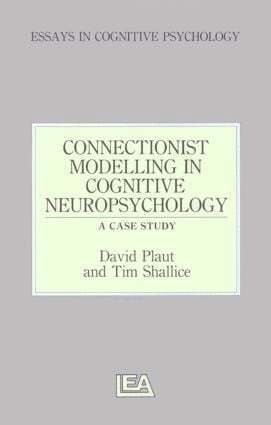
Connectionist Modelling in Cognitive Neuropsychology: A Case Study
A Special Issue of Cognitive Neuropsychology
Inbunden, Engelska, 1994
1 258 kr
Skickas inom 10-15 vardagar
Computational models offer tools for exploring the nature of human cognitive processes. In connectionist, neural network, or parallel distributed processing models, information processing takes the form of cooperative and competitive interactions among many simple, neuron-like processing units. These models provide new ways of thinking about the neural basis of cognitive processes, and how disorders of brain function lead to disorders of cognition. This monograph is an expanded version of a recent issue of the journal Cognitive Neuropsychology. It presents the most comprehensive existing "case study" of how the effects of damage in connectionist models can replicate the detailed and diverse patterns of cognitive impairments that can arise in humans as a result of brain damage.It begins with a review of the basic methodology of cognitive neuropsychology and of other attempts at modeling neuropsychological phenomena. It then focuses on a particular form of acquired reading disorder, "deep dyslexia," in which previously literate adults with brain damage exhibit a wide range of symptoms in pronouncing written words, the most striking of which is the production of semantic errors (e.g. reading RIVER as "ocean").A series of simulations investigate the effects of damage in connectionist models that pronounce written words via their meaning. The work systematically explores each main aspect of the design of the models, identifying the basic computational properties that are responsible for the occurrence of deep dyslexia when the models are damaged.Although the investigation concerns a specific form of reading impairment, the computational principles that emerge as critical are very general ones: representation of concepts as distributed patterns of activity, encoding of knowledge in terms of weights on connections between units, interactivity between units to form stable attractors for familiar activity patterns, and greater richness of concrete vs. abstract semantics. The fact that damage to models embodying these principles and damage to the brain can produce strikingly similar behaviour supports the view that the human cognitive system operates according to similar principles.
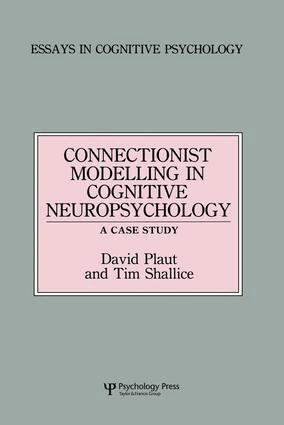
Connectionist Modelling in Cognitive Neuropsychology: A Case Study
A Special Issue of Cognitive Neuropsychology
Häftad, Engelska, 2015
481 kr
Skickas inom 10-15 vardagar
Computational models offer tools for exploring the nature of human cognitive processes. In connectionist, neural network, or parallel distributed processing models, information processing takes the form of cooperative and competitive interactions among many simple, neuron-like processing units. These models provide new ways of thinking about the neural basis of cognitive processes, and how disorders of brain function lead to disorders of cognition. This monograph is an expanded version of a recent issue of the journal Cognitive Neuropsychology. It presents the most comprehensive existing "case study" of how the effects of damage in connectionist models can replicate the detailed and diverse patterns of cognitive impairments that can arise in humans as a result of brain damage.It begins with a review of the basic methodology of cognitive neuropsychology and of other attempts at modeling neuropsychological phenomena. It then focuses on a particular form of acquired reading disorder, "deep dyslexia," in which previously literate adults with brain damage exhibit a wide range of symptoms in pronouncing written words, the most striking of which is the production of semantic errors (e.g. reading RIVER as "ocean").A series of simulations investigate the effects of damage in connectionist models that pronounce written words via their meaning. The work systematically explores each main aspect of the design of the models, identifying the basic computational properties that are responsible for the occurrence of deep dyslexia when the models are damaged.Although the investigation concerns a specific form of reading impairment, the computational principles that emerge as critical are very general ones: representation of concepts as distributed patterns of activity, encoding of knowledge in terms of weights on connections between units, interactivity between units to form stable attractors for familiar activity patterns, and greater richness of concrete vs. abstract semantics. The fact that damage to models embodying these principles and damage to the brain can produce strikingly similar behaviour supports the view that the human cognitive system operates according to similar principles.