Timo Kivimäki - Böcker
Visar alla böcker från författaren Timo Kivimäki. Handla med fri frakt och snabb leverans.
10 produkter
10 produkter
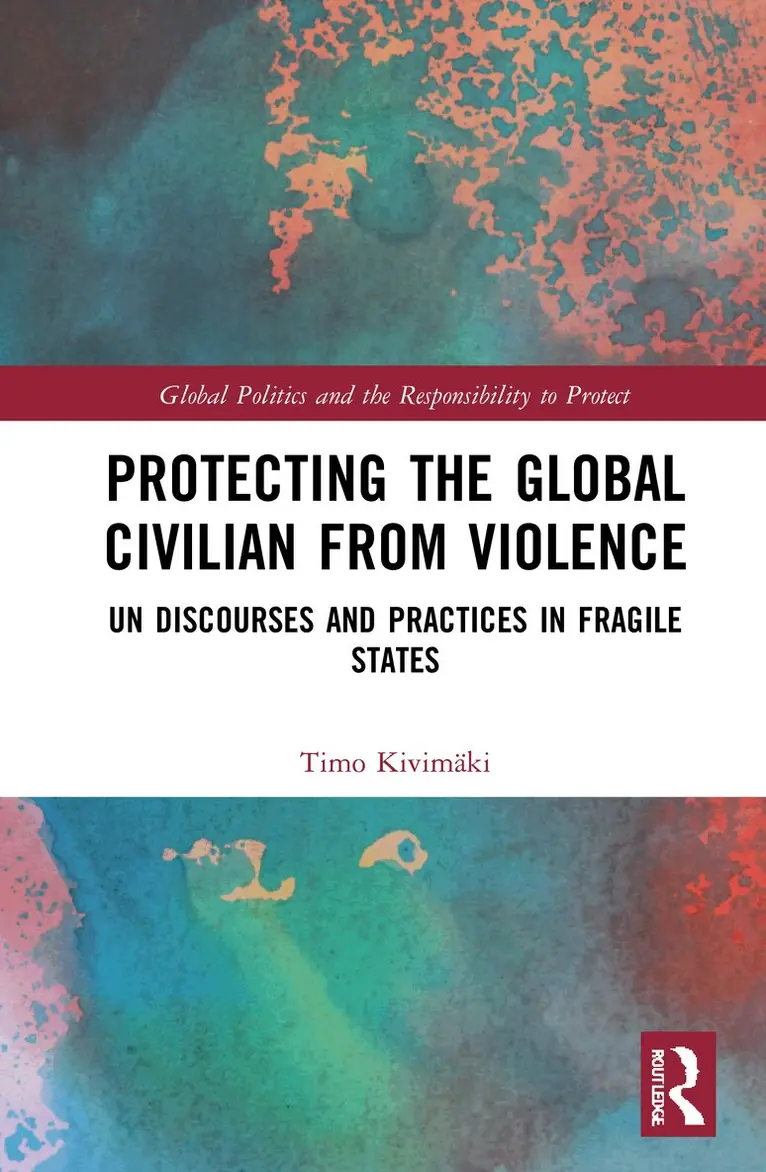
Protecting the Global Civilian from Violence
UN Discourses and Practices in Fragile States
Inbunden, Engelska, 2021
2 113 kr
Skickas inom 10-15 vardagar
This book reveals why the UN is more successful than unilateral great powers in protecting civilians from violence, and focuses on the discourse, development and consequences of UN peacekeeping. Analysing statistics of state fragility and fatalities of violence, it reveals that the UN has managed to save tens of thousands of lives with its peacekeeping: a surprising statistic given the media consensus about the UN’s powerlessness and inefficiency. Using computer-assisted discourse analysis of resolutions from the UN Security Council, 1993-2019, the book offers data that describe the character and development of UN approach to the protection of civilians from violence. It then links the data to the statistics of conflict fatalities and state fragility to reveal, by means of qualitative and quantitative analysis, when, where, how and why the UN has been successful at protecting civilians. Two reasons for the UN’s success are highlighted in the book as being statistically most significant. First, the organization offers local ownership to peaceful solutions by considering conflicting parties as the primary agents of protection. Second, the UN approach is much less power-oriented than unilateral approaches by the great powers: protection for the UN does not mean deterrence or destruction, but rather, support for local protectors of civilians. However, strong great power influence on such operations tends to weaken UN’s ability to save lives.This book will be of much interest to students of humanitarian intervention, peacekeeping, human rights and International Relations in general.
Protecting the Global Civilian from Violence
UN Discourses and Practices in Fragile States
Häftad, Engelska, 2023
578 kr
Skickas inom 10-15 vardagar
This book reveals why the UN is more successful than unilateral great powers in protecting civilians from violence, and focuses on the discourse, development and consequences of UN peacekeeping. Analysing statistics of state fragility and fatalities of violence, it reveals that the UN has managed to save tens of thousands of lives with its peacekeeping: a surprising statistic given the media consensus about the UN’s powerlessness and inefficiency. Using computer-assisted discourse analysis of resolutions from the UN Security Council, 1993-2019, the book offers data that describe the character and development of UN approach to the protection of civilians from violence. It then links the data to the statistics of conflict fatalities and state fragility to reveal, by means of qualitative and quantitative analysis, when, where, how and why the UN has been successful at protecting civilians. Two reasons for the UN’s success are highlighted in the book as being statistically most significant. First, the organization offers local ownership to peaceful solutions by considering conflicting parties as the primary agents of protection. Second, the UN approach is much less power-oriented than unilateral approaches by the great powers: protection for the UN does not mean deterrence or destruction, but rather, support for local protectors of civilians. However, strong great power influence on such operations tends to weaken UN’s ability to save lives.This book will be of much interest to students of humanitarian intervention, peacekeeping, human rights and International Relations in general.
442 kr
Skickas inom 10-15 vardagar
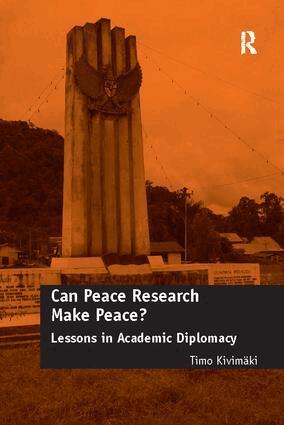
This book is about the process and, more generally, about the opportunities that peace research and the teaching of conflict resolution can offer academic diplomacy. As such the book is both an empirical and a theoretical project. While it aims at being the most comprehensive analysis of the conflict in West Kalimantan, it also launches a new theoretical approach, neo-pragmatism, and offers lessons for the prevention of conflicts elsewhere. While being based on the classical pragmatist theories of truth and explanation, the approach developed in this book incorporates the complications to social science theory caused by the 'discovery' of socially constructed realities, and concepts such as speech acts. Yet, instead of just theorizing speech acts and social constructs, the theoretical mission is to offer pragmatic, detailed, concrete prescriptions of what to do to deconstruct realities that threaten peace by the means available for research and scholars of peace.
777 kr
Skickas inom 10-15 vardagar
The annual number of battle deaths from interstate and intra-state conflicts in East Asia has declined by 95% since 1979. During the past three decades, East Asia has been more peaceful than Europe, the Americas or any continent, in terms of battle deaths per capita. When generating theories on peace and war, studies almost never look at the experiences of East Asia. Yet the region by focusing on a commitment to development, is a social reality that is less paranoid, less militaristic and more cooperative. Since 1979 there has been a commonly accepted rule to keep domestic issues domestic so that external military interference, that often caused the majority of battle deaths, was not needed. Thus the emergence of the long peace of East Asia is historically specific, and cannot be generalized by studying objective, material conditions independent of common perceptions and common interpretations. This does not mean that the East Asian experience is not relevant for other regions in the world, but that generalizations should not be attempted to be drawn from the material conditions, but rather from the lived experience and socially constructed realities of East Asia. Since East Asia is a spectacular case of pacification, and since it has not contributed much to our theories of peace and conflict, The Long Peace of East Asia is an important book for studies on peace and war.
550 kr
Skickas inom 10-15 vardagar
Title first published in 2003. Following the terrorist attacks of September 11, 2001 and October 12, 2002 in the United States and on Bali, we may be witnessing the most sweeping shift in US foreign policy since the beginning of the cold war. America is again committed to leading the world in a battle against a global enemy. The US relationship with Indonesia - the country with the world’s largest Islamic population - could prove to be of decisive importance for the success of its new global mission. Timo Kivimäki’s analysis of the dynamics and background of the US-Indonesian relationship will be essential reading for all concerned with American Foreign Policy, Asian studies, peace studies and conflict resolution and negotiation.
1 298 kr
Skickas inom 10-15 vardagar
Title first published in 2003. Following the terrorist attacks of September 11, 2001 and October 12, 2002 in the United States and on Bali, we may be witnessing the most sweeping shift in US foreign policy since the beginning of the cold war. America is again committed to leading the world in a battle against a global enemy. The US relationship with Indonesia - the country with the world’s largest Islamic population - could prove to be of decisive importance for the success of its new global mission. Timo Kivimäki’s analysis of the dynamics and background of the US-Indonesian relationship will be essential reading for all concerned with American Foreign Policy, Asian studies, peace studies and conflict resolution and negotiation.
1 298 kr
Skickas inom 10-15 vardagar
This book is about the process and, more generally, about the opportunities that peace research and the teaching of conflict resolution can offer academic diplomacy. As such the book is both an empirical and a theoretical project. While it aims at being the most comprehensive analysis of the conflict in West Kalimantan, it also launches a new theoretical approach, neo-pragmatism, and offers lessons for the prevention of conflicts elsewhere. While being based on the classical pragmatist theories of truth and explanation, the approach developed in this book incorporates the complications to social science theory caused by the 'discovery' of socially constructed realities, and concepts such as speech acts. Yet, instead of just theorizing speech acts and social constructs, the theoretical mission is to offer pragmatic, detailed, concrete prescriptions of what to do to deconstruct realities that threaten peace by the means available for research and scholars of peace.
2 246 kr
Skickas inom 10-15 vardagar
The annual number of battle deaths from interstate and intra-state conflicts in East Asia has declined by 95% since 1979. During the past three decades, East Asia has been more peaceful than Europe, the Americas or any continent, in terms of battle deaths per capita. When generating theories on peace and war, studies almost never look at the experiences of East Asia. Yet the region by focusing on a commitment to development, is a social reality that is less paranoid, less militaristic and more cooperative. Since 1979 there has been a commonly accepted rule to keep domestic issues domestic so that external military interference, that often caused the majority of battle deaths, was not needed. Thus the emergence of the long peace of East Asia is historically specific, and cannot be generalized by studying objective, material conditions independent of common perceptions and common interpretations. This does not mean that the East Asian experience is not relevant for other regions in the world, but that generalizations should not be attempted to be drawn from the material conditions, but rather from the lived experience and socially constructed realities of East Asia. Since East Asia is a spectacular case of pacification, and since it has not contributed much to our theories of peace and conflict, The Long Peace of East Asia is an important book for studies on peace and war.
Failure to Protect
The Path to and Consequences of Humanitarian Interventionism
Inbunden, Engelska, 2019
1 646 kr
Skickas inom 7-10 vardagar
This book investigates the reasons behind, and consequences of, military operations by Western powers. It focuses on those humanitarian interventions aimed at protecting civilians from terror, dictators and criminals in fragile states. Contributing to the cosmopolitan, feminist and post-colonial literature on interventions, 12 case studies from across the globe are explored, including military interventions in: Afghanistan, the Central African Republic, Iraq, Kosovo, Libya, Mali, Mauritania, Pakistan, Sierra Leone, Somalia, Syria and Yemen.The interventionist era post 1999 has been associated with an increase in conflict fatalities, while the non-interventionist era 1989-1999 is associated with declining conflict violence. This book analyses both quantitatively and qualitatively the interactive discourses of the proponents and opponents of humanitarian protection. Timo Kivimäki explores the need for a representative global agency and legitimate institutions to avoid accusations of partisanship, and calls for the removal of the masculine gender bias in protection to create 'democratic matriotism'.A timely read for advanced international relations scholars, this book analyses the data surrounding military interventions, providing a thorough insight into the last two decades of humanitarian conflict work. Politicians and practitioners of wartime humanitarian protection will also greatly benefit from this book.
3 398 kr
Skickas inom 7-10 vardagar
The Research Handbook on Conflict Prevention is a cohesive and comparative analysis of the ways in which organised violence is combatted. Renowned experts dissect the complex problem of conflict prevention by investigating its three main aspects: agency, methods and timing.This incisive Research Handbook both reviews the current literature on conflict prevention and introduces new theoretical and empirical findings. Contributors compare the different roles played by women’s groups, academics, military forces, and local and international agents such as the UN. They also explore resolution methods such as prenegotiation, negotiation, mediation and conflict transformation. In doing so, they illustrate the various ways in which hegemonic masculine approaches, peace journalism, and robust non-military and military approaches manage to reduce organised violence. Finally, the Research Handbook tracks the different phases of the conflict process, from the onset and escalation of conflict to conflict relapse. Confronting the vicious cycle of organised violence, this rigorous and multi-faceted study of conflict prevention provides an impetus towards understanding the field and inspiring solutions.In-depth and comprehensive, this Research Handbook will be of great benefit to scholars of conflict and international relations, human rights, terrorism, and security, as well as practitioners and policymakers in the field.