Timothy C. Urdan - Böcker
Visar alla böcker från författaren Timothy C. Urdan. Handla med fri frakt och snabb leverans.
4 produkter
4 produkter
2 625 kr
Skickas inom 10-15 vardagar
Statistics in Plain English is a straightforward, conversational introduction to statistics that delivers exactly what its title promises. Each chapter begins with a brief overview of a statistic (or set of statistics) that describes what the statistic does and when to use it, followed by a detailed step-by-step explanation of how the statistic works and exactly what information it provides. Chapters also include an example of the statistic (or statistics) used in real-world research, "Worked Examples," "Writing It Up" sections that demonstrate how to write about each statistic, "Wrapping Up and Looking Forward" sections, and practice work problems.Thoroughly updated throughout, this edition features several key additions and changes. First, a new chapter on person-centered analyses, including cluster analysis and latent class analysis (LCA) has been added, providing an important alternative to the more commonly used variable-centered analyses (e.g., t tests, ANOVA, regression). Next, the chapter on non-parametric statistics has been enhanced with in-depth descriptions of Mann-Whitney U, Kruskal-Wallis, and Wilcoxon Signed-Rank analyses, in addition to the detailed discussion of the Chi-square statistic found in the previous edition. These nonparametric statistics are widely used when dealing with nonnormally distributed data. This edition also includes more information about the assumptions of various statistics, including a detailed explanation of the assumptions and consequences of violating the assumptions of regression, as well as more coverage of the normal distribution in statistics. Finally, the book features a multitude of real-world examples throughout to aid student understanding and provides them with a solid understanding of how several statistics techniques commonly used by researchers in the social sciences work.Statistics in Plain English is suitable for a wide range of readers, including students taking their first statistics course, professionals who want to refresh their statistical memory, and undergraduate or graduate students who need a concise companion to a more complicated text used in their class. The text works as a standalone or as a supplement and covers a range of statistical concepts from descriptive statistics to factor analysis and person-centered analyses.
522 kr
Skickas inom 10-15 vardagar
Statistics in Plain English is a straightforward, conversational introduction to statistics that delivers exactly what its title promises. Each chapter begins with a brief overview of a statistic (or set of statistics) that describes what the statistic does and when to use it, followed by a detailed step-by-step explanation of how the statistic works and exactly what information it provides. Chapters also include an example of the statistic (or statistics) used in real-world research, "Worked Examples," "Writing It Up" sections that demonstrate how to write about each statistic, "Wrapping Up and Looking Forward" sections, and practice work problems.Thoroughly updated throughout, this edition features several key additions and changes. First, a new chapter on person-centered analyses, including cluster analysis and latent class analysis (LCA) has been added, providing an important alternative to the more commonly used variable-centered analyses (e.g., t tests, ANOVA, regression). Next, the chapter on non-parametric statistics has been enhanced with in-depth descriptions of Mann-Whitney U, Kruskal-Wallis, and Wilcoxon Signed-Rank analyses, in addition to the detailed discussion of the Chi-square statistic found in the previous edition. These nonparametric statistics are widely used when dealing with nonnormally distributed data. This edition also includes more information about the assumptions of various statistics, including a detailed explanation of the assumptions and consequences of violating the assumptions of regression, as well as more coverage of the normal distribution in statistics. Finally, the book features a multitude of real-world examples throughout to aid student understanding and provides them with a solid understanding of how several statistics techniques commonly used by researchers in the social sciences work.Statistics in Plain English is suitable for a wide range of readers, including students taking their first statistics course, professionals who want to refresh their statistical memory, and undergraduate or graduate students who need a concise companion to a more complicated text used in their class. The text works as a standalone or as a supplement and covers a range of statistical concepts from descriptive statistics to factor analysis and person-centered analyses.
646 kr
Skickas inom 7-10 vardagar
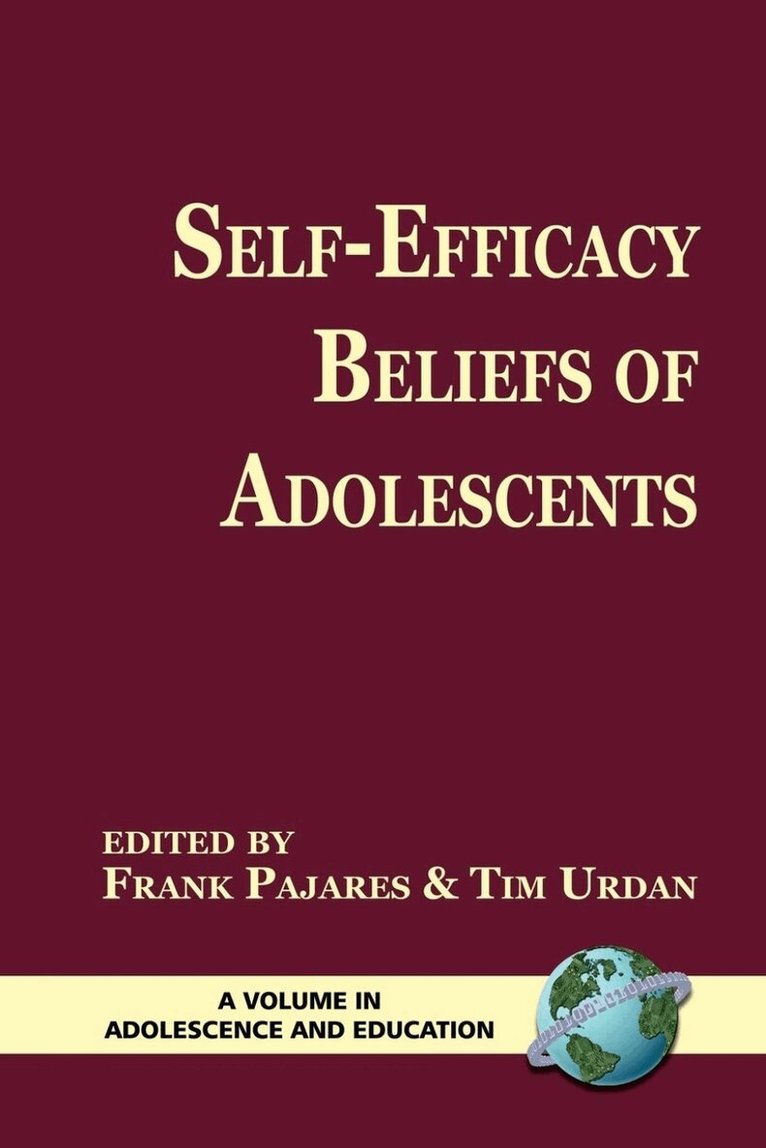
The introduction of the psychological construct of self-efficacy is widely acknowledged as one of the most important developments in the history of psychology. Today, it is simply not possible to explain phenomena such as human motivation, learning, self-regulation, and accomplishment without discussing the role played by self-efficacy beliefs. In this, the fifth volume of our series on adolescence and education, we focus on the self-efficacy beliefs of adolescents. We are proud and fortunate to be able to bring together the most prominent voices in the study of self-efficacy, including that of the Father of Social Cognitive Theory and of self-efficacy, Professor Albert Bandura. It is our hope, and our expectation, that this volume will become required reading for all students and scholars in the areas of adolescence and of motivation and, of course, for all who play a pivotal role in the education and care of youth.
1 093 kr
Skickas inom 7-10 vardagar
The introduction of the psychological construct of self-efficacy is widely acknowledged as one of the most important developments in the history of psychology. Today, it is simply not possible to explain phenomena such as human motivation, learning, self-regulation, and accomplishment without discussing the role played by self-efficacy beliefs. In this, the fifth volume of our series on adolescence and education, we focus on the self-efficacy beliefs of adolescents. We are proud and fortunate to be able to bring together the most prominent voices in the study of self-efficacy, including that of the Father of Social Cognitive Theory and of self-efficacy, Professor Albert Bandura. It is our hope, and our expectation, that this volume will become required reading for all students and scholars in the areas of adolescence and of motivation and, of course, for all who play a pivotal role in the education and care of youth.