Timothy R. Scully – författare
Visar alla böcker från författaren Timothy R. Scully. Handla med fri frakt och snabb leverans.
7 produkter
7 produkter
Inbunden, Engelska, 2003
1 776 kr
Skickas inom 10-15 vardagar
Christian Democracy swept across parts of Latin America, gaining influence in Venezuela in the 1940s, Chile in the 1950s, El Salvador and Guatemala in the 1960s, and Costa Rica and Mexico in the 1980s. This book offers an overview of Christian Democracy in the region— underscoring its remarkable diversity—and examines the Christian Democratic organizations of Chile and Mexico, which are still major parties today. The concluding section analyzes the demise of formerly significant Christian Democratic parties in El Salvador, Guatemala, Peru, and Venezuela.Christian Democracy in Latin America provides the definitive stufy of the nature, rise, and decline of Christian Democracy in Latin America. The book enriches the broader theoretical literature on political parties by highlighting the distinctive strategic dilemmas parties face, and the distinctive objectives they pursue, in contexts of fragile democracy or of authoritarian regimes.
Häftad, Engelska, 2003
430 kr
Skickas inom 5-8 vardagar
Christian Democracy swept across parts of Latin America, gaining influence in Venezuela in the 1940s, Chile in the 1950s, El Salvador and Guatemala in the 1960s, and Costa Rica and Mexico in the 1980s. This book offers an overview of Christian Democracy in the region— underscoring its remarkable diversity—and examines the Christian Democratic organizations of Chile and Mexico, which are still major parties today. The concluding section analyzes the demise of formerly significant Christian Democratic parties in El Salvador, Guatemala, Peru, and Venezuela.Christian Democracy in Latin America provides the definitive stufy of the nature, rise, and decline of Christian Democracy in Latin America. The book enriches the broader theoretical literature on political parties by highlighting the distinctive strategic dilemmas parties face, and the distinctive objectives they pursue, in contexts of fragile democracy or of authoritarian regimes.
Inbunden, Engelska, 2009
1 666 kr
Skickas inom 10-15 vardagar
Producing more effective governance is the greatest challenge that faces most Latin American democracies today—a challenge that involves not only strengthening democratic institutions but also increasing governmental effectiveness. Focusing on the post-1990 period, this volume addresses why some policies and some countries have been more successful than others in meeting this dual challenge.Two features of the volume stand out. First, whereas some analysts tend to generalize for Latin America as a whole, this group of authors underscores the striking differences of achievement among countries in the region and illustrates the importance of understanding these differences. The second feature is the range of expertise within the volume.In addition to the volume editors, the contributors are Alan Angell, Daniel Brinks, Fernando Henrique Cardoso, José de Gregorio, Alejandro Foxley, Evelyne Huber, José Miguel Insulza, Juliana Martínez Franzoni, Patricio Navia, Francisco Rodriguez, Mitchell Seligson, John Stephens, Jorge Vargas Cullell, and Ignacio Walker.
Häftad, Engelska, 2009
402 kr
Skickas inom 5-8 vardagar
Producing more effective governance is the greatest challenge that faces most Latin American democracies today—a challenge that involves not only strengthening democratic institutions but also increasing governmental effectiveness. Focusing on the post-1990 period, this volume addresses why some policies and some countries have been more successful than others in meeting this dual challenge.Two features of the volume stand out. First, whereas some analysts tend to generalize for Latin America as a whole, this group of authors underscores the striking differences of achievement among countries in the region and illustrates the importance of understanding these differences. The second feature is the range of expertise within the volume.In addition to the volume editors, the contributors are Alan Angell, Daniel Brinks, Fernando Henrique Cardoso, José de Gregorio, Alejandro Foxley, Evelyne Huber, José Miguel Insulza, Juliana Martínez Franzoni, Patricio Navia, Francisco Rodriguez, Mitchell Seligson, John Stephens, Jorge Vargas Cullell, and Ignacio Walker.
740 kr
Läs direkt efter köp
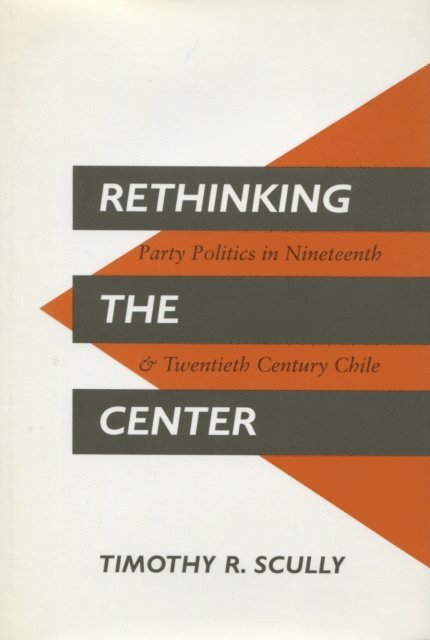
From their beginnings in the mid-nineteenth century through the 1980s, political parties in Chile have displayed three discrete ideological tendencies, with two at opposite ends of the political spectrum and at least one in the center. This tripartite distribution made Chile's party system unlike any other in Latin America. How did Chile's distinctive system evolve?This book finds the answer in how three basic social cleavages – religious, urban, and rural – became polarized at three periods of "critical juncture." Clerical-anticlerical conflict gave initial definition to the party system in the period 1857-61, and continued to shape the political arena long after specific issues had receded into the background. Then, between 1920 and 1932, class conflict in the urban and mining enclave sectors forced party elites to respond to the demands of leaders of middle-sector and working groups for increased political and social power. This was the second of what the author calls Chile's "critical junctures" for party formation. The third, occurring in the period 1952-58, saw the spread of working-class politics into the countryside. Crucial here was a shift in the position of the Catholic Church on class conflict, resulting in the emergence of an important Church-inspired center party. The book compares the behavior of the political center during the three historical periods and suggests a conceptual framework for understanding different types of center parties.The author also addresses certain questions raised by the emergence and behavior of center parties: What were the implications of the presence of a center party for the patterns of party competition? Why did the center emerge and re-emerge at each critical point in the evolution of Chile's party system? Can this be understood in terms of an underlying coalitional logic, or are factors such as leadership, political choice, and historical accident more useful explanations? Consistent with this focus on the center is a new account of the key role of the Christian Democrats in the reconstitution of party competition in the late 1980s and early 1990s. The author concludes by offering some observations on the probable shape of party politics – and the role of the political center within it – in tomorrow's Chile.
E-bok
PDF, Engelska, 2009488 kr
Läs direkt efter köp
Producing more effective governance is the greatest challenge that faces most Latin American democracies today—a challenge that involves not only strengthening democratic institutions but also increasing governmental effectiveness. Focusing on the post-1990 period, this volume addresses why some policies and some countries have been more successful than others in meeting this dual challenge.Two features of the volume stand out. First, whereas some analysts tend to generalize for Latin America as a whole, this group of authors underscores the striking differences of achievement among countries in the region and illustrates the importance of understanding these differences. The second feature is the range of expertise within the volume.In addition to the volume editors, the contributors are Alan Angell, Daniel Brinks, Fernando Henrique Cardoso, José de Gregorio, Alejandro Foxley, Evelyne Huber, José Miguel Insulza, Juliana Martínez Franzoni, Patricio Navia, Francisco Rodriguez, Mitchell Seligson, John Stephens, Jorge Vargas Cullell, and Ignacio Walker.
Inbunden, Engelska, 1995
1 161 kr
Tillfälligt slut
This volume fills the need for a comprehensive, up-to-date portrait of parties and party systems in Latin America. It includes chapters on all the large and medium-sized countries, as well as those smaller countries with older democratic traditions: Argentina, Bolivia, Brazil, Chile, Colombia, Costa Rica, Ecuador, Mexico, Paraguay, Peru, Uruguay, and Venezuela. The book is framed by an introduction that provides a theoretical and comparative conceptual map for charting Latin American party systems and a conclusion that looks ahead to the challenges and trends for party building in the 1990's. The twelve country case studies address five analytical themes. Finally, and most important, the authors characterise the nature of the party system in each country - how institutionalised it is and how it can be classified.