Todd H. Hall – författare
Visar alla böcker från författaren Todd H. Hall. Handla med fri frakt och snabb leverans.
4 produkter
4 produkter
Inbunden, Engelska, 2015
582 kr
Skickas inom 11-20 vardagar
Emotional Diplomacy explores the politics of expressed emotion on the international stage, looking at the ways state actors strategically deploy emotional behavior to manipulate the perceptions of others. By examining diverse instances of emotional behavior, Todd H. Hall reveals that official emotional displays play an integral role in the strategies and interactions of state actors. Emotional diplomacy is more than rhetoric; as this book demonstrates, its implications extend to the provision of economic and military aid, great-power cooperation, and the use of armed force. Hall investigates three strands of emotional diplomacy: those rooted in anger, sympathy, and guilt. His research, drawn on sources and interviews in five different languages, provides new insights into the 1995–1996 Taiwan Strait Crisis, the post-9/11 reactions of China and Russia, and relations between West Germany and Israel after World War II. Emotional Diplomacy offers a unique take on the intersection of strategic action and emotional display, a means for understanding why states behave emotionally. Hall provides the theoretical tools necessary for understanding the nature and significance of state-level emotional behavior through new observations of how states seek reconciliation, strategically respond to unforeseen crises, and demonstrate resolve in the face of perceived provocations.
Inbunden, Engelska, 2026
769 kr
Kommande
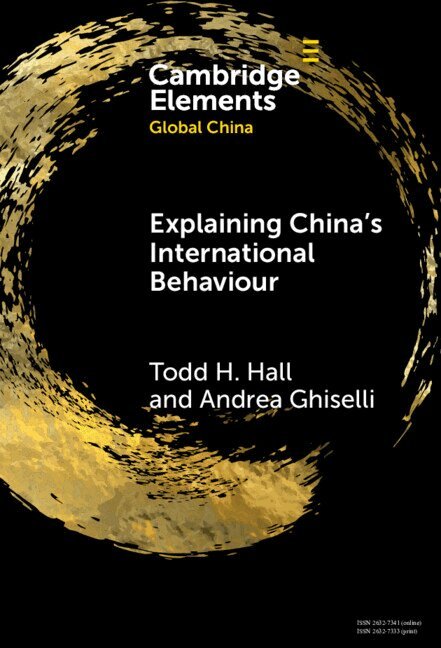
As the People's Republic of China (PRC) has become an increasingly significant global power, understanding its international behaviour has become a central question for scholars, analysts, and policymakers worldwide. Out of this profusion of competing perspectives, the authors identify four distinct ideal-typical approaches employed to explain the PRC's international behaviour: universalist, exceptionalist, political-institutionalist, and particularist. They find that at their core, the fundamental issues of disagreement between these approaches concern the degree to which they conceptualise the PRC as a unitary and/or distinctive actor. Crucially, these are not fixed attributes; they vary over time and across policy domains. Based on this, we make the case for a contextualised approach that adjusts its analysis to such variation. The authors illustrate their approach by examining PRC behaviour in the South China Sea and in relation to its Belt and Road Initiative. This title is also available as Open Access on Cambridge Core.
Häftad, Engelska, 2026
239 kr
Kommande
As the People's Republic of China (PRC) has become an increasingly significant global power, understanding its international behaviour has become a central question for scholars, analysts, and policymakers worldwide. Out of this profusion of competing perspectives, the authors identify four distinct ideal-typical approaches employed to explain the PRC's international behaviour: universalist, exceptionalist, political-institutionalist, and particularist. They find that at their core, the fundamental issues of disagreement between these approaches concern the degree to which they conceptualise the PRC as a unitary and/or distinctive actor. Crucially, these are not fixed attributes; they vary over time and across policy domains. Based on this, we make the case for a contextualised approach that adjusts its analysis to such variation. The authors illustrate their approach by examining PRC behaviour in the South China Sea and in relation to its Belt and Road Initiative. This title is also available as Open Access on Cambridge Core.
Häftad, Engelska, 2019
285 kr
Skickas inom 10-15 vardagar
Emotional Diplomacy explores the politics of expressed emotion on the international stage, looking at the ways state actors strategically deploy emotional behavior to manipulate the perceptions of others. By examining diverse instances of emotional behavior, Todd H. Hall reveals that official emotional displays play an integral role in the strategies and interactions of state actors. Emotional diplomacy is more than rhetoric; as this book demonstrates, its implications extend to the provision of economic and military aid, great-power cooperation, and the use of armed force. Hall investigates three strands of emotional diplomacy: those rooted in anger, sympathy, and guilt. His research, drawn on sources and interviews in five different languages, provides new insights into the 1995–1996 Taiwan Strait Crisis, the post-9/11 reactions of China and Russia, and relations between West Germany and Israel after World War II. Emotional Diplomacy offers a unique take on the intersection of strategic action and emotional display, a means for understanding why states behave emotionally. Hall provides the theoretical tools necessary for understanding the nature and significance of state-level emotional behavior through new observations of how states seek reconciliation, strategically respond to unforeseen crises, and demonstrate resolve in the face of perceived provocations.