Tom Hick – författare
2 009 kr
Skickas inom 10-15 vardagar
687 kr
Läs direkt efter köp
This book provides the European structure of liability for failed contract negotiations through a comparative lens, with wider lessons for an international context.
The book demonstrates that all the analysed legal systems, in Belgium, France, Germany, Italy, and the Netherlands, can be best understood through a binary structure in their approach to pre-contractual liability, or culpa in contrahendo. This structure consists of two key elements: first, a general liability framework that allows for compensation of pure economic loss based on certain qualified conduct, such as negligence; and second, an implicit obligation to contract, which, though not explicitly recognized, is presumed in most systems. The book argues that this dual framework provides valuable insights into ongoing scholarly debates and the challenges practitioners face in cases of failed contract negotiations. Drawing on these insights, it proposes a more effective approach to the obligation to contract: one that encourages parties to collaborate in reaching an agreement voluntarily rather than imposing one upon them.
This book will be of interest to researchers in the field of comparative contract and tort law, European private law, and private law theory.
687 kr
Läs direkt efter köp
This book provides the European structure of liability for failed contract negotiations through a comparative lens, with wider lessons for an international context.
The book demonstrates that all the analysed legal systems, in Belgium, France, Germany, Italy, and the Netherlands, can be best understood through a binary structure in their approach to pre-contractual liability, or culpa in contrahendo. This structure consists of two key elements: first, a general liability framework that allows for compensation of pure economic loss based on certain qualified conduct, such as negligence; and second, an implicit obligation to contract, which, though not explicitly recognized, is presumed in most systems. The book argues that this dual framework provides valuable insights into ongoing scholarly debates and the challenges practitioners face in cases of failed contract negotiations. Drawing on these insights, it proposes a more effective approach to the obligation to contract: one that encourages parties to collaborate in reaching an agreement voluntarily rather than imposing one upon them.
This book will be of interest to researchers in the field of comparative contract and tort law, European private law, and private law theory.
930 kr
Skickas inom 5-8 vardagar
785 kr
Läs direkt efter köp
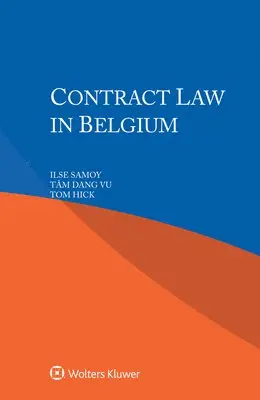
Derived from the renowned multi-volume International Encyclopaedia of Laws, this practical analysis of the law of contracts in Belgium covers every aspect of the subject – definition and classification of contracts, contractual liability, relation to the law of property, good faith, burden of proof, defects, penalty clauses, arbitration clauses, remedies in case of non-performance, damages, power of attorney, and much more. Lawyers who handle transnational contracts will appreciate the explanation of fundamental differences in terminology, application, and procedure from one legal system to another, as well as the international aspects of contract law. Throughout the book, the treatment emphasizes drafting considerations.
An introduction in which contracts are defined and contrasted to torts, quasi-contracts, and property is followed by a discussion of the concepts of ‘consideration’ or ‘cause’ and other underlying principles of the formation of contract. Subsequent chapters cover the doctrines of ‘relative effect’, termination of contract, and remedies for non-performance. The second part of the book, recognizing the need to categorize an agreement as a specific contract in order to determine the rules which apply to it, describes the nature of agency, sale, lease, building contracts, and other types of contract. Facts are presented in such a way that readers who are unfamiliar with specific terms and concepts in varying contexts will fully grasp their meaning and significance.
Its succinct yet scholarly nature, as well as the practical quality of the information it provides, make this book a valuable time-saving tool for business and legal professionals alike. Lawyers representing parties with interests in Belgium will welcome this very useful guide, and academics and researchers will appreciate its value in the study of comparative contract law.
785 kr
Läs direkt efter köp
Derived from the renowned multi-volume International Encyclopaedia of Laws, this practical analysis of the law of contracts in Belgium covers every aspect of the subject – definition and classification of contracts, contractual liability, relation to the law of property, good faith, burden of proof, defects, penalty clauses, arbitration clauses, remedies in case of non-performance, damages, power of attorney, and much more. Lawyers who handle transnational contracts will appreciate the explanation of fundamental differences in terminology, application, and procedure from one legal system to another, as well as the international aspects of contract law. Throughout the book, the treatment emphasizes drafting considerations.
An introduction in which contracts are defined and contrasted to torts, quasi-contracts, and property is followed by a discussion of the concepts of ‘consideration’ or ‘cause’ and other underlying principles of the formation of contract. Subsequent chapters cover the doctrines of ‘relative effect’, termination of contract, and remedies for non-performance. The second part of the book, recognizing the need to categorize an agreement as a specific contract in order to determine the rules which apply to it, describes the nature of agency, sale, lease, building contracts, and other types of contract. Facts are presented in such a way that readers who are unfamiliar with specific terms and concepts in varying contexts will fully grasp their meaning and significance.
Its succinct yet scholarly nature, as well as the practical quality of the information it provides, make this book a valuable time-saving tool for business and legal professionals alike. Lawyers representing parties with interests in Belgium will welcome this very useful guide, and academics and researchers will appreciate its value in the study of comparative contract law.