Tom Mens - Böcker
Visar alla böcker från författaren Tom Mens. Handla med fri frakt och snabb leverans.
6 produkter
6 produkter
1 957 kr
Skickas inom 10-15 vardagar
The ever-increasing importance of social coding platforms has made software ecosystems indispensable to software practitioners, in commercial as well as open-source settings.The book starts with an introductory chapter that provides a historical account of the origins of software ecosystems.
1 957 kr
Skickas inom 10-15 vardagar
The ever-increasing importance of social coding platforms has made software ecosystems indispensable to software practitioners, in commercial as well as open-source settings.The book starts with an introductory chapter that provides a historical account of the origins of software ecosystems.
554 kr
Skickas inom 10-15 vardagar
Software has become omnipresent and vital in our information-based society, so all software producers should assume responsibility for its reliability. While "reliable" originally assumed implementations that were effective and mainly error-free, additional issues like adaptability and maintainability have gained equal importance recently. For example, the 2004 ACM/IEEE Software Engineering Curriculum Guidelines list software evolution as one of ten key areas of software engineering education.Mens and Demeyer, both international authorities in the field of software evolution, together with the invited contributors, focus on novel trends in software evolution research and its relations with other emerging disciplines such as model-driven software engineering, service-oriented software development, and aspect-oriented software development. They do not restrict themselves to the evolution of source code but also address the evolution of other, equally important software artifacts such as databases and database schemas, design models, software architectures, and process management. The contributing authors provide broad overviews of related work, and they also contribute to a comprehensive glossary, a list of acronyms, and a list of books, journals, websites, standards and conferences that together represent the community’s body of knowledge.Combining all these features, this book is the indispensable source for researchers and professionals looking for an introduction and comprehensive overview of the state of the art. In addition, it is an ideal basis for an advanced course on software evolution.
554 kr
Skickas inom 10-15 vardagar
Software has become omnipresent and vital in our information-based society, so all software producers should assume responsibility for its reliability. While "reliable" originally assumed implementations that were effective and mainly error-free, additional issues like adaptability and maintainability have gained equal importance recently. For example, the 2004 ACM/IEEE Software Engineering Curriculum Guidelines list software evolution as one of ten key areas of software engineering education.Mens and Demeyer, both international authorities in the field of software evolution, together with the invited contributors, focus on novel trends in software evolution research and its relations with other emerging disciplines such as model-driven software engineering, service-oriented software development, and aspect-oriented software development. They do not restrict themselves to the evolution of source code but also address the evolution of other, equally important software artifacts such as databases and database schemas, design models, software architectures, and process management. The contributing authors provide broad overviews of related work, and they also contribute to a comprehensive glossary, a list of acronyms, and a list of books, journals, websites, standards and conferences that together represent the community’s body of knowledge.Combining all these features, this book is the indispensable source for researchers and professionals looking for an introduction and comprehensive overview of the state of the art. In addition, it is an ideal basis for an advanced course on software evolution.
1 101 kr
Skickas inom 10-15 vardagar
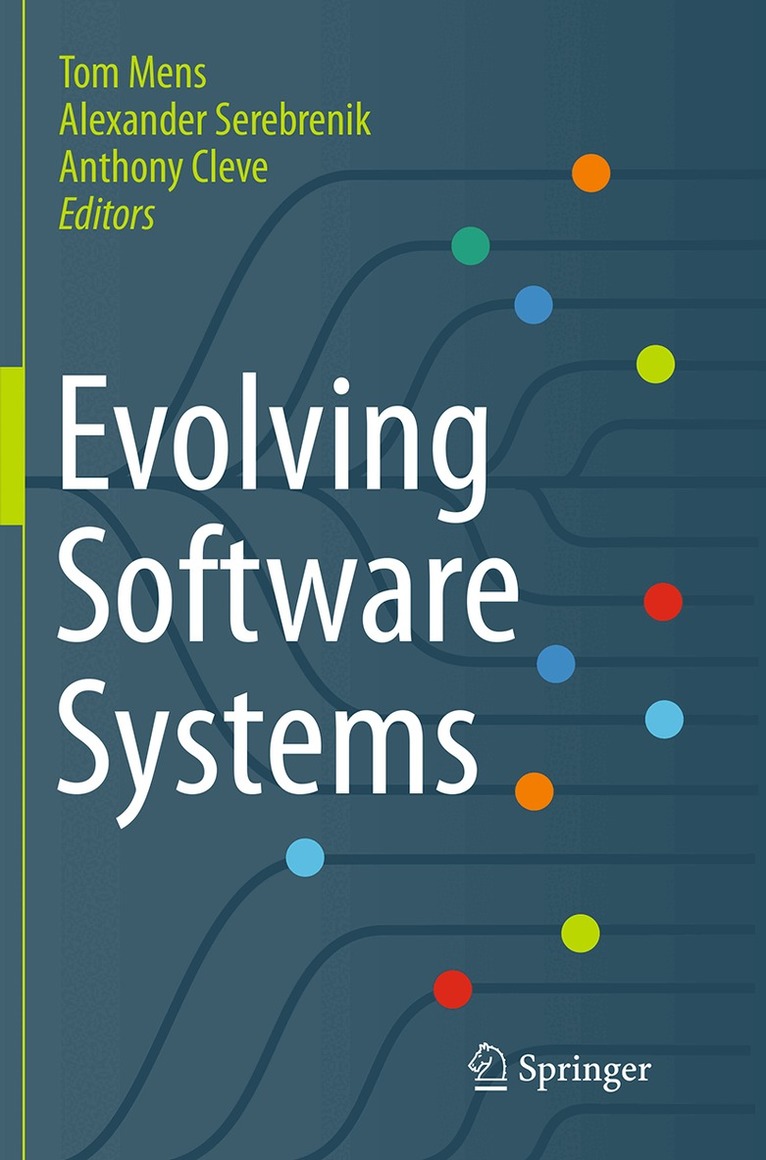
During the last few years, software evolution research has explored new domains such as the study of socio-technical aspects and collaboration between different individuals contributing to a software system, the use of search-based techniques and meta-heuristics, the mining of unstructured software repositories, the evolution of software requirements, and the dynamic adaptation of software systems at runtime. Also more and more attention is being paid to the evolution of collections of inter-related and inter-dependent software projects, be it in the form of web systems, software product families, software ecosystems or systems of systems.With this book, the editors present insightful contributions on these and other domains currently being intensively explored, written by renowned researchers in the respective fields of software evolution. Each chapter presents the state of the art in a particular topic, as well as the current research, available tool support and remaining challenges. The book is complemented by a glossary of important terms used in the community, a reference list of nearly 1,000 papers and books and tips on additional resources that may be useful to the reader (reference books, journals, standards and major scientific events in the domain of software evolution and datasets).This book is intended for all those interested in software engineering, and more particularly, software maintenance and evolution. Researchers and software practitioners alike will find in the contributed chapters an overview of the most recent findings, covering a broad spectrum of software evolution topics. In addition, it can also serve as the basis of graduate or postgraduate courses on e.g., software evolution, requirements engineering, model-driven software development or social informatics.
1 101 kr
Skickas inom 10-15 vardagar
During the last few years, software evolution research has explored new domains such as the study of socio-technical aspects and collaboration between different individuals contributing to a software system, the use of search-based techniques and meta-heuristics, the mining of unstructured software repositories, the evolution of software requirements, and the dynamic adaptation of software systems at runtime. Also more and more attention is being paid to the evolution of collections of inter-related and inter-dependent software projects, be it in the form of web systems, software product families, software ecosystems or systems of systems.With this book, the editors present insightful contributions on these and other domains currently being intensively explored, written by renowned researchers in the respective fields of software evolution. Each chapter presents the state of the art in a particular topic, as well as the current research, available tool support and remaining challenges. The book is complemented by a glossary of important terms used in the community, a reference list of nearly 1,000 papers and books and tips on additional resources that may be useful to the reader (reference books, journals, standards and major scientific events in the domain of software evolution and datasets).This book is intended for all those interested in software engineering, and more particularly, software maintenance and evolution. Researchers and software practitioners alike will find in the contributed chapters an overview of the most recent findings, covering a broad spectrum of software evolution topics. In addition, it can also serve as the basis of graduate or postgraduate courses on e.g., software evolution, requirements engineering, model-driven software development or social informatics.