Tomàs – författare
Visar alla böcker från författaren Tomàs. Handla med fri frakt och snabb leverans.
8 produkter
8 produkter
Häftad, Spanska, 2023
321 kr
Skickas inom 5-8 vardagar
Häftad, Spanska, 2011
229 kr
Skickas inom 5-8 vardagar
Inbunden, Spanska, 2011
366 kr
Skickas inom 5-8 vardagar
E-bok
PDF, Engelska, 20143 381 kr
Läs direkt efter köp
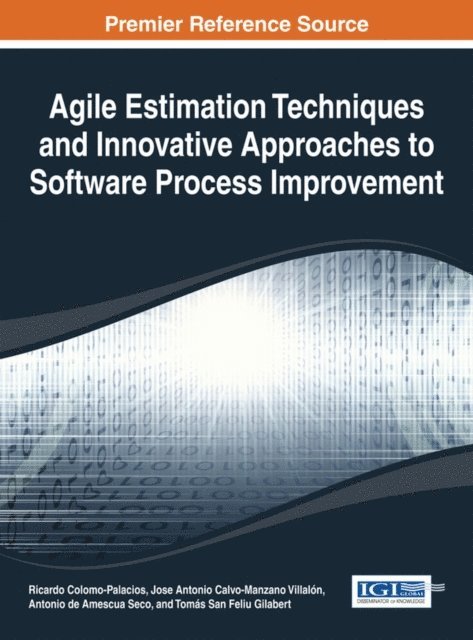
Applying methodologies of Software Process Improvement (SPI) is an effective way for businesses to remain competitive in the software industry. However, many organizations find implementing software process initiatives challenging. Agile Estimation Techniques and Innovative Approaches to Software Process Improvement reviews current SPI techniques and applications through discussions on current and future trends as well as the presentation of case studies on SPI implementation. Ideal for use by academics, students, and policy-makers, as well as industry professionals and managers, this publication provides a complete overview of current tools and methodologies regarding Software Process Improvement.
E-bok
Engelska, 20143 381 kr
Läs direkt efter köp
Applying methodologies of Software Process Improvement (SPI) is an effective way for businesses to remain competitive in the software industry. However, many organizations find implementing software process initiatives challenging. Agile Estimation Techniques and Innovative Approaches to Software Process Improvement reviews current SPI techniques and applications through discussions on current and future trends as well as the presentation of case studies on SPI implementation. Ideal for use by academics, students, and policy-makers, as well as industry professionals and managers, this publication provides a complete overview of current tools and methodologies regarding Software Process Improvement.
Häftad, Engelska, 2015
263 kr
Skickas inom 3-6 vardagar
E-bok
Engelska, 20193 538 kr
Läs direkt efter köp
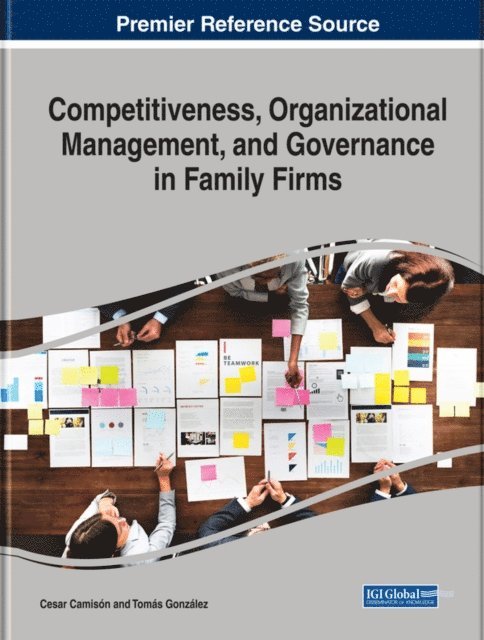
The "e;family effect"e; remains a challenge for researchers interested in both the family firm's organizational form and in the effects of familial ownership on a firm's strategy, structure, and performance. Governance mechanisms, management quality, ownership concentration, and family involvement all have relevant effects in terms of influencing monitoring costs, investment decisions, the development of the portfolio of resources and capabilities, and family firm competitiveness. Nevertheless, few studies to date have opened the black box of the "e;family effect."e; Competitiveness, Organizational Management, and Governance in Family Firms is an essential reference source that makes a clear distinction between the separation of ownership and management, on the one hand, and the institutional development of family governance instruments, on the other, to help uncover the asymmetric effects of these two choices. It also allows the examination as to which of the two strategies employed in family firms reinforce managerial capital that has a greater positive impact on the "e;family effect,"e; thus helping to achieve better managerial capabilities. Featuring research on topics such as corporate governance, private business, and successional leadership, this book is ideally designed for managers, executives, CEOs, company owners, consultants, business professionals, entrepreneurs, academicians, and researchers interested in an in-depth understanding of the keys to success and survival of family-operated organizations.
Inbunden, Engelska, 2011
1 093 kr
Tillfälligt slut
Originally developed in linguistics, the structuralist approach has been introduced as a scientific method in anthropology and other human sciences since the 1950s. In the 1960s and 1970s the double category of primary and secondary structure (langue and parole), essential to structuralism, in which the primary structure's system of rules determines how the secondary elements are placed in relation to one another, also advanced to a leading Ideology in the field of architecture and urban planning. From its development in the Netherlands and within the Team 10 circle of architects, structuralism in architecture quickly spread world-wide. Since the 1990s we have been witnessing a revival of structuralist tendencies in architecture. Whereas the structuralism of the 1970s encountered limits in complexity that were insurmountable at the time, today there is much to suggest that the return to structural thinking is causally connected to information technology, which has opened up new possibilities for dealing with complexity. In the field of digital architecture there is talk of neo-Structuralism. The question arises as to whether primary and secondary structures of the 1960s should be understood today as being in a state of complex interactions with one another that could be described through algorithms. The current interest in design methods based on rules makes the structuralist approach one of the most productive and comprehensive methods for the organisation, design, and production of the built environment. At the same time, it provides the systemic and meta-theoretical background for all disciplines involved in the production of space. This book is a collection of 47 articles by renowned authors including, among others, Roland Barthes, Koos Bosma, Jörg Gleiter, Herman Hertzberger, Arnulf Lüchinger, Winy Maas, Sylvain Malfroy, Hasim Sarkis, Fabian Scheurer, and Georges Teyssot. Through well-founded theoretical contributions, the book provides the first comprehensive representation of historical and contemporary digital structural thinking in architecture and urban planning.