Torsten Söderström - Böcker
Visar alla böcker från författaren Torsten Söderström. Handla med fri frakt och snabb leverans.
3 produkter
3 produkter
800 kr
Skickas inom 10-15 vardagar
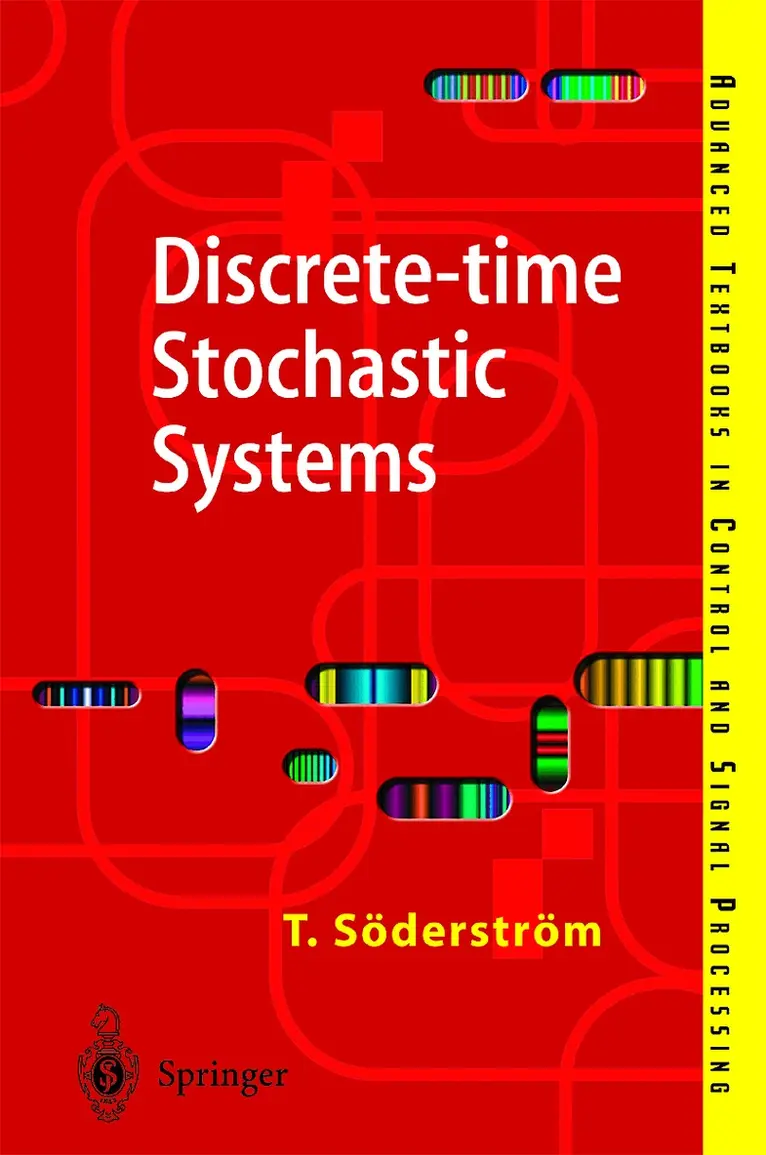
Discrete-time Stochastic Systems gives a comprehensive introduction to the estimation and control of dynamic stochastic systems and provides complete derivations of key results such as the basic relations for Wiener filtering. The book covers both state-space methods and those based on the polynomial approach. Similarities and differences between these approaches are highlighted. Some non-linear aspects of stochastic systems (such as the bispectrum and extended Kalman filter) are also introduced and analysed.The books chief features are as follows: inclusion of the polynomial approach provides alternative and simpler computational methods than simple reliance on state-space methods; algorithms for analysis and design of stochastic systems allow for ease of implementation and experimentation by the reader; the highlighting of spectral factorization gives appropriate emphasis to this key concept often overlooked in the literature; explicit solutions of Wiener problems are handy schemes, well suited for computations compared with more commonly available but abstract formulations; complex-valued models that are directly applicable to many problems in signal processing and communications. Changes in the second edition include: additional information covering spectral factorisation and the innovations form; the chapter on optimal estimation being completely rewritten to focus on a posterior estimates rather than maximum likelihood; new material on fixed lag smoothing and algorithms for solving Riccati equations are improved and more up to date; new presentation of polynomial control and new derivation of linear-quadratic-Gaussian control.Discrete-time Stochastic Systems is primarily of benefit to students taking M.Sc. courses in stochastic estimation and control, electronic engineering and signal processing but may also be of assistance for self study and as a reference.
1 804 kr
Skickas inom 10-15 vardagar
This book presents an overview of the different errors-in-variables (EIV) methods that can be used for system identification.
1 804 kr
Skickas inom 10-15 vardagar
This book presents an overview of the different errors-in-variables (EIV) methods that can be used for system identification. Readers will explore the properties of an EIV problem. Such problems play an important role when the purpose is the determination of the physical laws that describe the process, rather than the prediction or control of its future behaviour. EIV problems typically occur when the purpose of the modelling is to get physical insight into a process. Identifiability of the model parameters for EIV problems is a non-trivial issue, and sufficient conditions for identifiability are given. The author covers various modelling aspects which, taken together, can find a solution, including the characterization of noise properties, extension to multivariable systems, and continuous-time models. The book finds solutions that are constituted of methods that are compatible with a set of noisy data, which traditional approaches to solutions, such as (total) least squares, do not find.A number of identification methods for the EIV problem are presented. Each method is accompanied with a detailed analysis based on statistical theory, and the relationship between the different methods is explained. A multitude of methods are covered, including:instrumental variables methods;methods based on bias-compensation;covariance matching methods; and prediction error and maximum-likelihood methods.The book shows how many of the methods can be applied in either the time or the frequency domain and provides special methods adapted to the case of periodic excitation. It concludes with a chapter specifically devoted to practical aspects and user perspectives that will facilitate the transfer of the theoretical material to application in real systems. Errors-in-Variables Methods in System Identification gives readers the possibility of recovering true system dynamics from noisy measurements, while solving over-determined systems of equations, making it suitable for statisticians and mathematicians alike. The book also acts as a reference for researchers and computer engineers because of its detailed exploration of EIV problems.