Toshihiko Izutsu - Böcker
Visar alla böcker från författaren Toshihiko Izutsu. Handla med fri frakt och snabb leverans.
4 produkter
4 produkter
590 kr
Skickas inom 7-10 vardagar
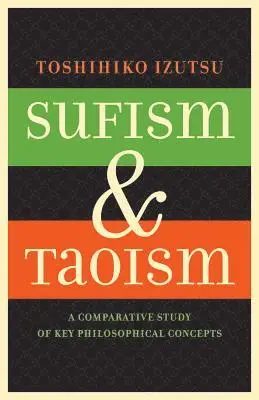
In this deeply learned work, Toshihiko Izutsu compares the metaphysical and mystical thought-systems of Sufism and Taoism and discovers that, although historically unrelated, the two share features and patterns which prove fruitful for a transhistorical dialogue. His original and suggestive approach opens new doors in the study of comparative philosophy and mysticism. Izutsu begins with Ibn 'Arabi, analyzing and isolating the major ontological concepts of this most challenging of Islamic thinkers. Then, in the second part of the book, Izutsu turns his attention to an analysis of parallel concepts of two great Taoist thinkers, Lao-tzu and Chuang-tzu. Only after laying bare the fundamental structure of each world view does Izutsu embark, in the final section of the book, upon a comparative analysis. Only thus, he argues, can he be sure to avoid easy and superficial comparisons. Izutsu maintains that both the Sufi and Taoist world views are based on two pivots - the Absolute Man and the Perfect Man - with a whole system of oncological thought being developed between these two pivots.Izutsu discusses similarities in these ontological systems and advances the hypothesis that certain patterns of mystical and metaphysical thought may be shared even by systems with no apparent historical connection. This second edition of "Sufism and Taoism" is the first published in the United States. The original edition, published in English and in Japan, was prized by the few English-speaking scholars who knew of it as a model in the field of comparative philosophy. Making available in English much new material on both sides of its comparison, "Sufism and Taoism" richly fulfills Izutsu's motivating desire 'to open a new vista in the domain of comparative philosophy.'
281 kr
Skickas inom 7-10 vardagar
In this deeply learned work, Toshihiko Izutsu compares the metaphysical and mystical thought-systems of Sufism and Taoism and discovers that, although historically unrelated, the two share features and patterns which prove fruitful for a transhistorical dialogue. His original and suggestive approach opens new doors in the study of comparative philosophy and mysticism. Izutsu begins with Ibn 'Arabi, analyzing and isolating the major ontological concepts of this most challenging of Islamic thinkers. Then, in the second part of the book, Izutsu turns his attention to an analysis of parallel concepts of two great Taoist thinkers, Lao-tzu and Chuang-tzu. Only after laying bare the fundamental structure of each world view does Izutsu embark, in the final section of the book, upon a comparative analysis. Only thus, he argues, can he be sure to avoid easy and superficial comparisons. Izutsu maintains that both the Sufi and Taoist world views are based on two pivots--the Absolute Man and the Perfect Man--with a whole system of oncological thought being developed between these two pivots.Izutsu discusses similarities in these ontological systems and advances the hypothesis that certain patterns of mystical and metaphysical thought may be shared even by systems with no apparent historical connection. This second edition of Sufism and Taoism is the first published in the United States. The original edition, published in English and in Japan, was prized by the few English-speaking scholars who knew of it as a model in the field of comparative philosophy. Making available in English much new material on both sides of its comparison, Sufism and Taoism richly fulfills Izutsu's motivating desire "to open a new vista in the domain of comparative philosophy."
365 kr
Skickas inom 10-15 vardagar
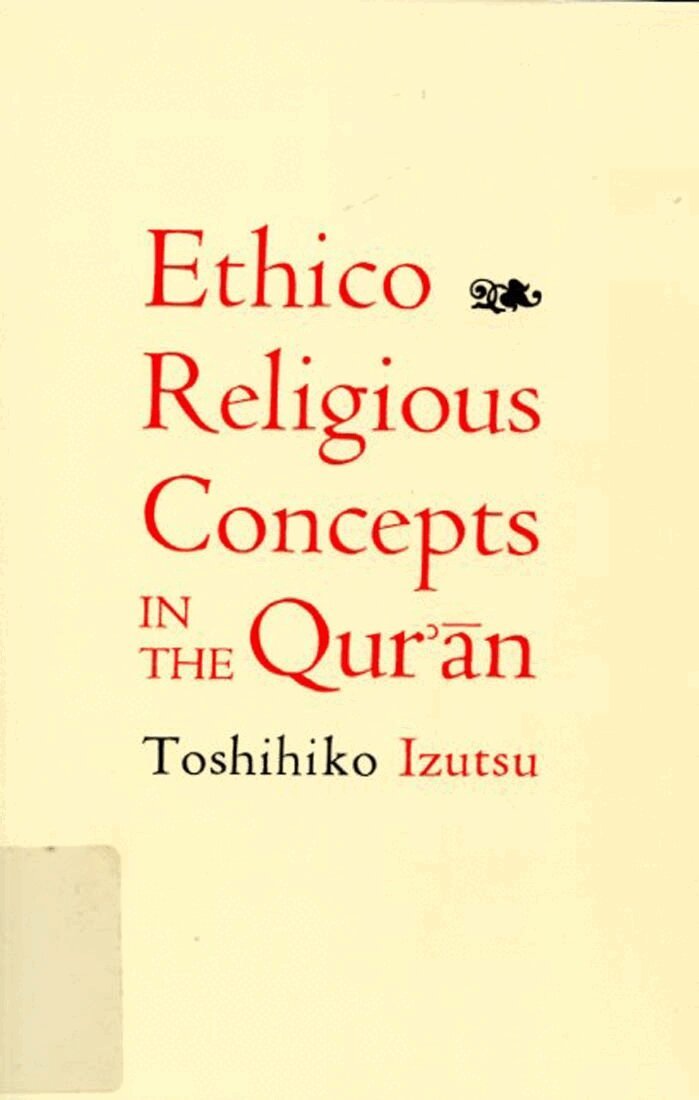
In the Ethico-Religious Concepts in the Qur'án Toshihiko Izutsu analyzes the guiding spirit of the Islamic moral code, the basic ethical relationship of man to God. Izutsu asserts that, according to the Qur'anic conception, God is of an ethical nature and acts upon man in an ethical way. The resulting implications for man are enormous, requiring devotion not merely to God but to living one's life ethically. Izutsu shows that for the Qur'an our ethical response to God's actions is religion itself; it is at the same time both ethics and religion. Izutsu explores these themes by employing ethnolinguistics, a theory of the interrelations between linguistic cultural patterns, to analyse the semantic structure of major concepts in the Quar'an. Islam, which arose in the seventh century, represents one of the most sweeping religious reforms ever to appear in the East. The Quar'an shows in vividly concrete terms how time-honoured tribal norms came into bloody conflict with new ideals of life, and finally yielded to the rising power. This transitional epoch is of particular importance in the whole of Islamic thought, a time during which the key terms of a traditionally fixed system of values were transformed in their connotative structure, modified in their combinations, and finally integrated into an entirely different system. Originally published in 1959 as The Structure of the Ethical Terms in the Koran and revised under the current title in 1966, this 2002 reprint makes this classic work of Islamic studies once again available.
241 kr
Skickas inom 5-8 vardagar