translated by Karen Desmond – författare
Visar alla böcker från författaren . Handla med fri frakt och snabb leverans.
4 produkter
4 produkter
Häftad, Engelska, 2020
705 kr
Skickas inom 10-15 vardagar
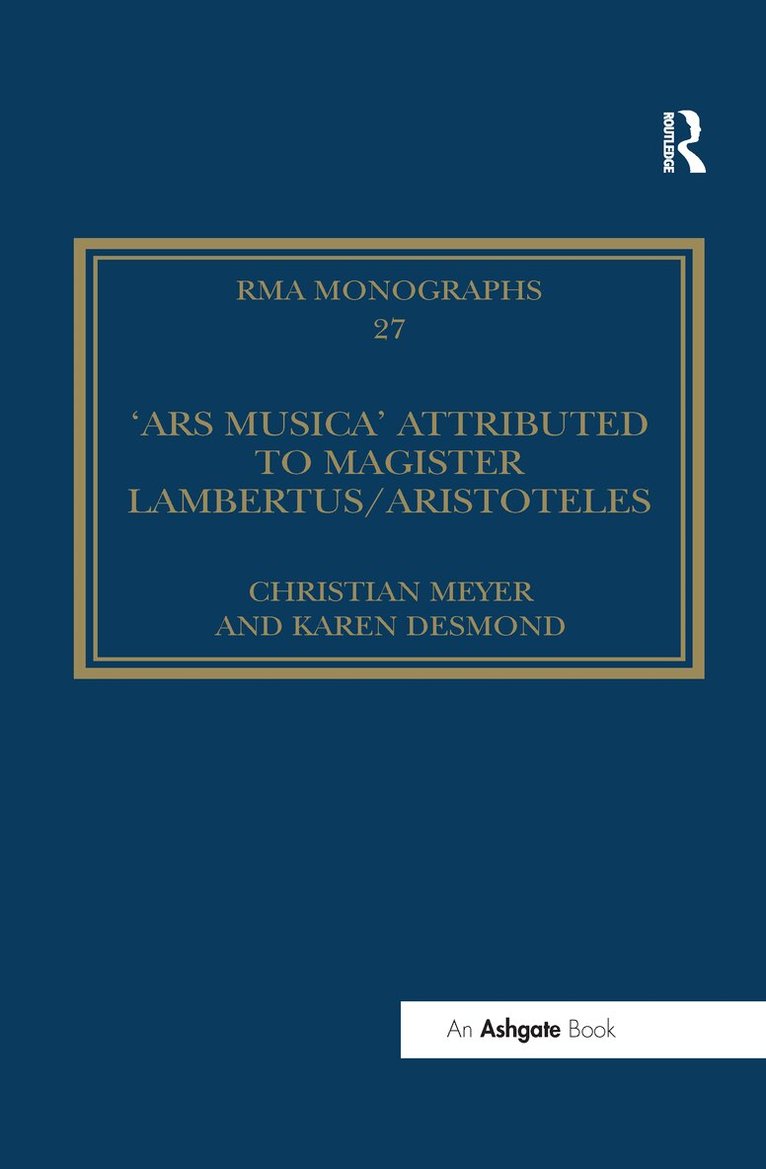
The treatise on musica plana and musica mensurabilis written by Lambertus/Aristoteles is our main witness to thirteenth-century musical thought in the decades between the treatises of Johannes de Garlandia and Franco of Cologne. Most treatises on music of this century - except for Franco’s treatise on musical notation - survive in only a single copy; Lambertus’s Ars musica, extant in five sources, is thus distinguished by a more substantial and long-lasting manuscript tradition. Unique in its ambitions, this treatise presents both the rudiments of the practice of liturgical chant and the principles of polyphonic notation in a dense and rigorous manner like few music treatises of its time - a conceptual framework characteristic of Parisian university culture in the thirteenth century. This new edition of Lambertus’s treatise is the first since Edmond de Coussemaker’s of 1864. Christian Meyer’s meticulous edition is displayed on facing pages with Karen Desmond’s English translation, and the treatise and translation are prefaced by a substantial introduction to the text and its author by Christian Meyer, translated by Barbara Haggh-Huglo.
E-bok
Engelska, 2017831 kr
Läs direkt efter köp
The treatise on musica plana and musica mensurabilis written by Lambertus/Aristoteles is our main witness to thirteenth-century musical thought in the decades between the treatises of Johannes de Garlandia and Franco of Cologne. Most treatises on music of this century - except for Franco‘s treatise on musical notation - survive in only a single copy; Lambertus‘s Ars musica, extant in five sources, is thus distinguished by a more substantial and long-lasting manuscript tradition. Unique in its ambitions, this treatise presents both the rudiments of the practice of liturgical chant and the principles of polyphonic notation in a dense and rigorous manner like few music treatises of its time - a conceptual framework characteristic of Parisian university culture in the thirteenth century. This new edition of Lambertus‘s treatise is the first since Edmond de Coussemaker‘s of 1864. Christian Meyer‘s meticulous edition is displayed on facing pages with Karen Desmonds English translation, and the treatise and translation are prefaced by a substantial introduction to the text and its author by Christian Meyer, translated by Barbara Haggh-Huglo.
E-bok
PDF, Engelska, 2017831 kr
Läs direkt efter köp
The treatise on musica plana and musica mensurabilis written by Lambertus/Aristoteles is our main witness to thirteenth-century musical thought in the decades between the treatises of Johannes de Garlandia and Franco of Cologne. Most treatises on music of this century - except for Franco‘s treatise on musical notation - survive in only a single copy; Lambertus‘s Ars musica, extant in five sources, is thus distinguished by a more substantial and long-lasting manuscript tradition. Unique in its ambitions, this treatise presents both the rudiments of the practice of liturgical chant and the principles of polyphonic notation in a dense and rigorous manner like few music treatises of its time - a conceptual framework characteristic of Parisian university culture in the thirteenth century. This new edition of Lambertus‘s treatise is the first since Edmond de Coussemaker‘s of 1864. Christian Meyer‘s meticulous edition is displayed on facing pages with Karen Desmonds English translation, and the treatise and translation are prefaced by a substantial introduction to the text and its author by Christian Meyer, translated by Barbara Haggh-Huglo.
Inbunden, Engelska, 2015
2 508 kr
Skickas inom 5-8 vardagar
The treatise on musica plana and musica mensurabilis written by Lambertus/Aristoteles is our main witness to thirteenth-century musical thought in the decades between the treatises of Johannes de Garlandia and Franco of Cologne. Most treatises on music of this century - except for Franco’s treatise on musical notation - survive in only a single copy; Lambertus’s Ars musica, extant in five sources, is thus distinguished by a more substantial and long-lasting manuscript tradition. Unique in its ambitions, this treatise presents both the rudiments of the practice of liturgical chant and the principles of polyphonic notation in a dense and rigorous manner like few music treatises of its time - a conceptual framework characteristic of Parisian university culture in the thirteenth century. This new edition of Lambertus’s treatise is the first since Edmond de Coussemaker’s of 1864. Christian Meyer’s meticulous edition is displayed on facing pages with Karen Desmond’s English translation, and the treatise and translation are prefaced by a substantial introduction to the text and its author by Christian Meyer, translated by Barbara Haggh-Huglo.