
Trish Glazebrook - Böcker
Visar alla böcker från författaren Trish Glazebrook. Handla med fri frakt och snabb leverans.
4 produkter
4 produkter
983 kr
Skickas inom 11-20 vardagar
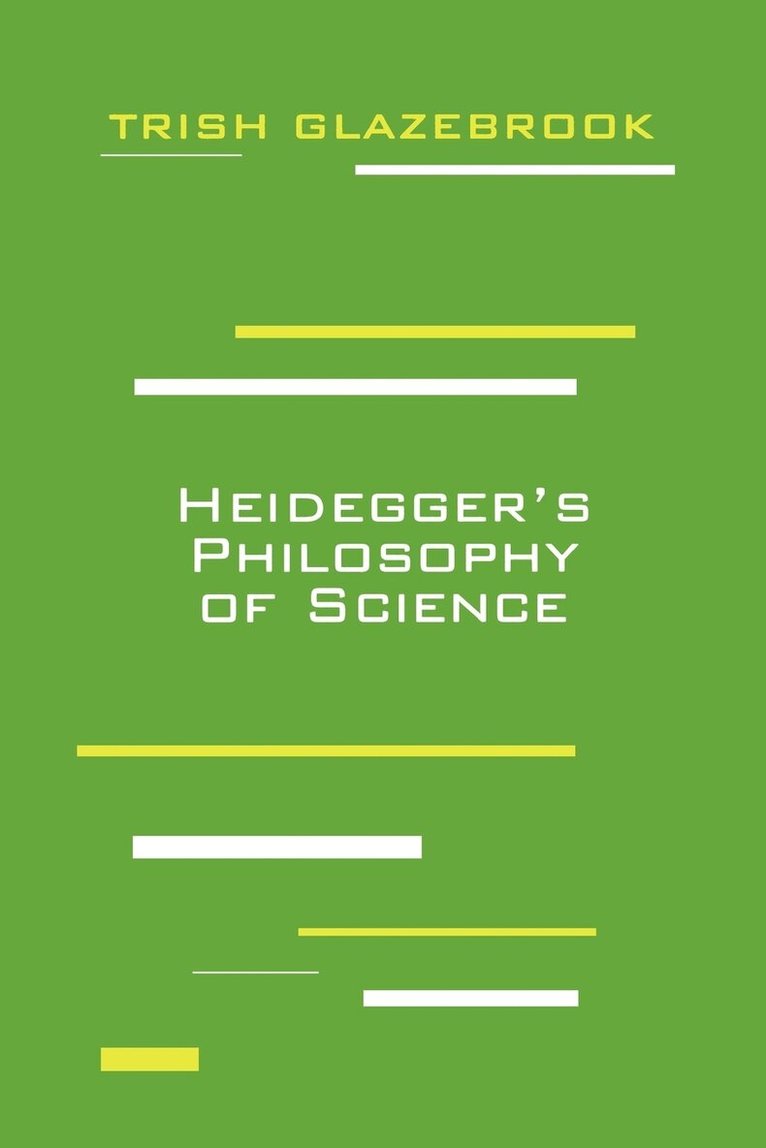
This book concerns itself with an issue that is not sufficiently addressed in the literature: Heidegger's philosophy of science. Although a great deal of attention is paid to Heidegger's later critique of technology, no one has systematically studied how he understood "science." Many readers will be surprised to learn, through this book, that Heidegger developed the essentials of a fairly sophisticated philosophy of science, one that in many ways invites comparison with that of Thomas Kuhn. Glazebrook demonstrates that Heidegger's philosophy of science is not neatly divided into "early" and "late" (or "Heidegger I" and "Heidegger II") but is, rather, an ongoing development over at least three periods, bound together as an analysis of modern science and an uncovering of other possibilities for understanding nature. Glazebrook states in her introduction, "This reading of Heidegger is radical. It cuts to the root of his thinking, for I argue that what are taken to be Heidegger's many and significant contributions to philosophy—that is, his overcoming of metaphysics, his rereading of the ancients, his critique of technology and representational thinking, his vision and revision of language, truth, and thinking—have at their core an inquiry into science that drove his thinking for sixty years. I am not arguing for a new reading of a few texts, or for adjustments and refinements of existing readings of Heideggger. Rather, I am bringing to light a new basis on which to interpret his work as a whole."
404 kr
Skickas inom 7-10 vardagar
This book concerns itself with an issue that is not sufficiently addressed in the literature: Heidegger's philosophy of science. Although a great deal of attention is paid to Heidegger's later critique of technology, no one has systematically studied how he understood "science." Many readers will be surprised to learn, through this book, that Heidegger developed the essentials of a fairly sophisticated philosophy of science, one that in many ways invites comparison with that of Thomas Kuhn. Glazebrook demonstrates that Heidegger's philosophy of science is not neatly divided into "early" and "late" (or "Heidegger I" and "Heidegger II") but is, rather, an ongoing development over at least three periods, bound together as an analysis of modern science and an uncovering of other possibilities for understanding nature. Glazebrook states in her introduction, "This reading of Heidegger is radical. It cuts to the root of his thinking, for I argue that what are taken to be Heidegger's many and significant contributions to philosophy—that is, his overcoming of metaphysics, his rereading of the ancients, his critique of technology and representational thinking, his vision and revision of language, truth, and thinking—have at their core an inquiry into science that drove his thinking for sixty years. I am not arguing for a new reading of a few texts, or for adjustments and refinements of existing readings of Heideggger. Rather, I am bringing to light a new basis on which to interpret his work as a whole."
1 057 kr
Tillfälligt slut
The first collection of essays devoted to Heidegger's contribution to understanding modern science.Although Martin Heidegger is well known for his work on technology, he is not often discussed in the context of science broadly speaking. This volume is the first to showcase diverse perspectives on Heidegger's assessments of the sciences, looking at a number of different ways that Heidegger's writings contribute to questions concerning how we understand the world through science. With particular attention to quantum theory, natural science, technoscience, and a section devoted specifically to investigating what Being and Time has to say about science, the book will be of interest to scholars in a wide range of disciplines and traditions. It closes with consideration of questions about sustainability and ethics raised by Heidegger's engagement with the sciences.
402 kr
Tillfälligt slut
The first collection of essays devoted to Heidegger's contribution to understanding modern science.Although Martin Heidegger is well known for his work on technology, he is not often discussed in the context of science broadly speaking. This volume is the first to showcase diverse perspectives on Heidegger's assessments of the sciences, looking at a number of different ways that Heidegger's writings contribute to questions concerning how we understand the world through science. With particular attention to quantum theory, natural science, technoscience, and a section devoted specifically to investigating what Being and Time has to say about science, the book will be of interest to scholars in a wide range of disciplines and traditions. It closes with consideration of questions about sustainability and ethics raised by Heidegger's engagement with the sciences.