
T.T. Kozlowski – författare
Visar alla böcker från författaren T.T. Kozlowski. Handla med fri frakt och snabb leverans.
13 produkter
13 produkter
E-bok
PDF, Engelska, 2012696 kr
Läs direkt efter köp
Water Deficits and Plant Growth, Volume VI: Woody Plant Communities focuses on the water relations of woody plants in a community context. Organized into eight chapters, this book begins with a quantitative overview of sources of water available to woody plants. Separate chapters follow that discuss the water relations of coniferous, temperate hardwood, and tropical and subtropical forests and woodlands; apple and citrus orchards; closely related woody plants; and tea plantations. For each of these plant communities, emphasis is placed on hydrological cycles; water use and transpiration; absorption of water; and effects of environmental factors on soil and plant water balance. The effects of water deficits on physiological processes; vegetative and reproductive growth; yield of harvested products; drought resistance; and cultural practices affecting plant water balance and yield are also emphasized in this book. This volume will be useful to both researchers and those involved in the practice of growing woody plants for wood and fruit crops and for esthetic values.
E-bok
PDF, Engelska, 2012696 kr
Läs direkt efter köp
Shedding of Plant Parts focuses on the anatomical, physiological, and ecological features of shedding of vegetative and reproductive parts of plants. This book encompasses both natural and induced shedding. Organized into 12 chapters, this book first outlines the extent of shedding of plant cells, tissues, and organs and summarizes the biological and economic implications of such shedding. Separate chapters follow that discuss anatomical and histochemical changes in leaf abscission; the physiological ecology and internal regulation of abscission; and the shedding of shoots, branches, bark, roots, pollen, seeds, and reproductive structures of forest trees. This book also explains the anatomical changes in abscission of reproductive structures, chemical thinning of flowers and fruits, and chemical control of fruit abscission. This book will be valuable to plant anatomists, pathologists, and physiologists, and to agronomists, arborists, biochemists, ecologists, entomologists, foresters, horticulturists, landscape architects, meteorologists, and soil scientists.

E-bok
PDF, Engelska, 2012696 kr
Läs direkt efter köp
Fire and Ecosystems focuses on a number of aspects of fire ecology. This book deals separately with both harmful and beneficial effects of fire on soils, soil organisms, animals, and plants. This reference material elucidates the effects of fire on grasslands and considers the role of fire in temperate forests and related ecosystems. Four chapters are presented on a regional basis to highlight variations in responses, especially plant succession, to fire. The use of fire in land management is also explored. This book will serve as an invaluable reference material to researchers, teachers, and land managers.
E-bok
PDF, Engelska, 2012672 kr
Läs direkt efter köp
Growth and Development of Trees, Volume I: Seed Germination, Ontogeny, and Shoot Growth is a part of a two-volume treatise, which characterizes important features of growth and development of trees and other woody plants during their life cycles. Organized into eight chapters, this book describes the important events in growth of the perennial woody plant. This volume highlights the significant changes that take place in vegetative and reproductive growth as woody plants progress from juvenility to adulthood and, finally, to a senescent state. This book also describes the effects of external and internal controls of vegetative and reproductive growth. Considerable attention is given to important spatial and temporal variations in growth. This book will be useful to academicians as well as to those involved in the practice of growing trees and other woody plants for fruit crops or wood, as well as for esthetic reasons.
E-bok
PDF, Engelska, 2012696 kr
Läs direkt efter köp
Seed Biology, Volume II: Germination Control, Metabolism, and Pathology is a part of a three-volume treatise, which aims to bring together a large body of important information on seed biology. Organized into five chapters, this book begins with a discussion on environmental control of germination and its biological significance. Separate chapters follow that discuss physiology and metabolism of seeds with specific dormancy and anomalous storage history, as well as those germinated under abnormal conditions. This work will be useful to various groups of research biologists and teachers, including agronomists, plant anatomists, biochemists, ecologists, entomologists, foresters, horticulturists, plant pathologists, and plant physiologists.

E-bok
PDF, Engelska, 2012696 kr
Läs direkt efter köp
Seed Biology: Insects, and Seed Collection, Storage, Testing, and Certification, Volume III brings together a large body of important information on seed biology. The book describes seed collection, identification, storage, testing, and certification. It also considers insects that directly affect seeds, seed-producing organs, or seed-bearing structures of plants. Organized into six chapters, this volume begins by outlining man''s dependency on seeds as source of food, fiber, spices, beverages, oils, vitamins, and drugs. Harmful effects of seeds are also mentioned. Separate chapters focus on seed development, dissemination, germination (including metabolism, environmental control, internal control, dormancy, and seed and seedling vigor), protection from diseases and insects, longevity, and deterioration. The book concludes with a discussion on the certification of field and tree seeds, the Organization for Economic Cooperation and Development certification schemes, and trends in seed certification. This book is a valuable source of information for seed producers and users as well as various groups of research biologists and teachers, including agronomists, plant anatomists, biochemists, ecologists, entomologists, foresters, horticulturists, plant pathologists, and plant physiologists.
E-bok
PDF, Engelska, 2012696 kr
Läs direkt efter köp
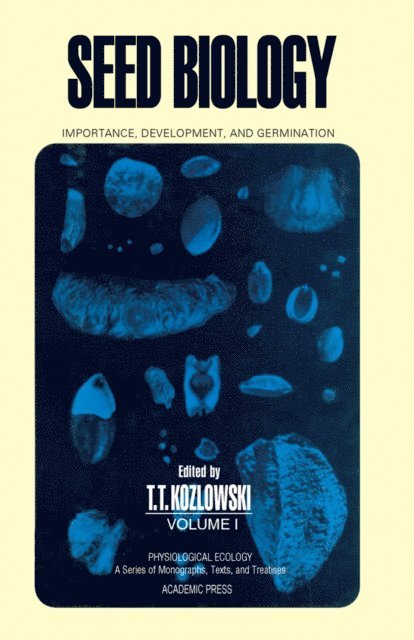
Seed Biology, Volume I: Importance, Development, and Germination is a part of a three-volume treatise, which aims to bring together a large body of important information on seed biology. Organized into six chapters, this book begins with a discussion on the importance and characteristics of seeds. Separate chapters follow that discuss the development of gymnosperm and angiosperm seeds, as well as the anatomical mechanisms of seed dispersal. Other chapters focus on the morphogenetic events involved in the germination and the scientific basis for the concept of physiological predetermination or seedling vigor, including the potential application of this concept in agriculture, forestry, and management of natural resources. This work will be useful to various groups of research biologists and teachers, including plant anatomists, pathologists, and physiologists as well as agronomists, biochemists, ecologists, entomologists, foresters, and horticulturists.
E-bok
PDF, Engelska, 2012696 kr
Läs direkt efter köp
Water Deficits and Plant Growth, Volume IV: Soil Water Measurement, Plant Responses, and Breeding for Drought Resistance explores the physiological effects of water deficits on plants and their implications on crop yield, water use, and drought resistance. This book also considers drought-resistance measurements and their application to breeding programs. This volume is organized into eight chapters and begins with an overview of measurement of soil water content and the state of water in soils. Particular emphasis is placed on methods developed from technological advances. The next two chapters focus on the structure and functioning of stomata and stomatal conductance in control of gas exchange. The discussion then shifts to the effects of water supply on photosynthesis, leaf shedding, flow of latex, and nitrogen-fixing root nodules. The final chapter is a comprehensive treatment of plant breeding for drought resistance, emphasizing breeding and testing methods as well as parameters and application to breeding programs of drought resistance. This book is a valuable resource for scientists and investigators in fields such as botany, agronomy, forestry, agriculture, and biology.
E-bok
PDF, Engelska, 2012696 kr
Läs direkt efter köp
Water Deficits and Plant Growth, Volume III: Plant Responses and Control of Water Balance focuses on the influence of water deficits on shrinkage of plant tissues, seed germination, reproductive growth, and internal plant responses such as protoplasmic resistance to desiccation, enzymatic activity, nitrogen metabolism, hormonal relations, and mineral nutrition. This book also considers alleviation and control of water deficits in plants. This volume is organized into 10 chapters and begins with an overview of shrinkage and swelling in plant tissues and their biological implications, along with some basic aspects of seed germination and environmental factors affecting germination as well as its relation to soil moisture. The discussion then shifts to the impact of water deficits on growth of fruits at different stages of development, from flowering to fruit ripening, and the ability of the protoplasm to survive a serious reduction in water content (known as protoplasmic resistance). The following chapters explore the effects of water deficits on enzyme activity, nutrient availability, nitrogen metabolism, and hormonal distribution in plants. This book also looks at transpiration in plants and how to reduce it, and then concludes with a chapter on soil water conservation as a problem of management of available water resources in the context of agriculture. This book is a valuable resource for scientists and investigators in fields such as botany, plant pathology, forestry, and agriculture.

E-bok
PDF, Engelska, 2015696 kr
Läs direkt efter köp
Water Deficits and Plant Growth, Volume II: Plant Water Consumption and Response focuses on internal water deficits in plants, the measurement for such deficits, and the identification of physiological and growth responses of herbaceous and woody plants to water deficiency. Partitioned into six chapters, the book discusses the rate of water consumption of agricultural plants. Concerns in this part include evapotranspiration, characteristics of plants, and climate. The discussions move on to the study of water consumption in forests. The methods used in the research, the theoretical considerations, and a review of the results are also discussed. The next part focuses on the relationship of water deficits and physiological processes. This part also introduces the discussions on the effect of water deficiency on the growth of herbaceous plants and trees, including the emergence of diseases related to water deficiency. The book is a valuable source of data for readers who are interested in pursuing studies on the effect of water deficiency on the growth of plants.
E-bok
PDF, Engelska, 2012696 kr
Läs direkt efter köp
Water Deficits and Plant Growth, Volume V: Water and Plant Disease presents a comprehensive treatment of the role of water deficits and excesses in the plant disease complex. This book highlights water relations of diseased plants and the effects of water stress induced by disease and environmental factors, along with water deficits related to disease and water stress as a predisposing factor in plant disease. This volume is organized into nine chapters and begins with an overview of the water relations of diseased plants, focusing on root, foliar, and shoot diseases, as well as vascular wilts. The following chapters examine the effects of water deficits on pathogen and host, the degree and duration of water deficits as predisposing factors in plant disease, and important abiotic diseases induced by water deficits and excess. The discussion then turns to water in relation to active and passive liberation of spores, as well as to the infection process. This book also explains soil moisture in relation to spread and survival of pathogens, the link between water and seed decay, field and storage fungi that affect seeds, and water in relation to wood deterioration. This volume concludes with a chapter on moisture as a factor in epidemiology and the forecasting of disease. This book is a valuable resource for scientists and investigators in fields such as botany, plant pathology, forestry, agriculture, and biology.
E-bok
PDF, Engelska, 2012696 kr
Läs direkt efter köp
Water Deficits and Plant Growth, Volume VII: Additional Woody Crop Plants is an extension of Volume VI of this treatise and deals primarily with water relations of woody crop plants in a community context. Organized into five chapters, this book begins with the important problem of predicting effects of vegetation changes on transpiration and evaporation. Separate chapters follow that discuss water relations of cotton, small fruits, grapevines, and peach trees and orchards. For each of these plant communities, emphasis is placed on hydrological cycles; water use and transpiration; absorption of water; and effects of environmental factors on soil and plant water balance. The effects of water deficits on physiological processes; vegetative and reproductive growth; yield of harvested products; drought resistance; and cultural practices affecting plant water balance and yield are also emphasized in this book. This volume will be useful to both researchers and those involved in the practice of growing woody plants for crops or for esthetic values.
E-bok
PDF, Engelska, 1971696 kr
Läs direkt efter köp
Growth and Development of Trees, Volume II: Cambial growth, Root Growth, and Reproductive Growth describes the important features of growth and development of trees and other woody plants during their life cycles. This nine-chapter book highlights the significant changes that take place in vegetative and reproductive growth as woody plants progress from juvenility to adulthood and, finally, to a senescent state. The first four chapters cover the growth of tree cambium, which is a layer of delicate meristematic tissue between the inner bark or phloem and the wood or xylem. These chapters examine the variation, control, and measurement of cambial growth. The next two chapters look into the growth mechanism of specialized and modified root systems, such as aerial, grafted, knee, and nodulated roots, root buttresses, mycorrhiza, and pneumatophores. These chapters also discuss the distribution and growth characteristics of roots of woody plants. Other chapters explore the significant changes and features during flowering and fruit, cone, and seed development. The last chapter considers some aspects of internal and external control of reproductive growth at critical stages of development. Some practical methods for stimulating fruit and seed production by trees are also provided. This book will be of great value to arborists, foresters, horticulturists, plant ecologists, plant physiologists, plant anatomists, tree breeders and geneticists, plant pathologists, entomologists, soil scientists, meteorologists, and landscape architects. It is also intended for upper level undergraduate and graduate students.