Ulrich Pfister – författare
Visar alla böcker från författaren Ulrich Pfister. Handla med fri frakt och snabb leverans.
7 produkter
Economic History of the First German Unification
State Formation and Economic Development in a European Perspective
Av Nikolaus Wolf, Ulrich Pfister
E-bok, 2023
768 kr
Lägg i varukorg
There is a striking chronological parallel between Germany’s transition from a post-Malthusian regime to modern economic growth and the formation of a modern nation-state between the late 1860s and the early 1880s, which culminated in the events of 1871.The central question of this book is whether …
Economic History of the First German Unification
State Formation and Economic Development in a European Perspective
Av Nikolaus Wolf, Ulrich Pfister
E-bok, 2023
785 kr
Lägg i varukorg
There is a striking chronological parallel between Germany’s transition from a post-Malthusian regime to modern economic growth and the formation of a modern nation-state between the late 1860s and the early 1880s, which culminated in the events of 1871.The central question of this book is whether …
Economic History of the First German Unification
State Formation and Economic Development in a European Perspective
Av Ulrich Pfister, Nikolaus Wolf
Inbunden, 2023
2209 kr
Lägg i varukorg
There is a striking chronological parallel between Germany’s transition from a post-Malthusian regime to modern economic growth and the formation of a modern nation-state between the late 1860s and the early 1880s, which culminated in the events of 1871.The central question of this book is whether …
Economic History of the First German Unification
State Formation and Economic Development in a European Perspective
Av Ulrich Pfister, Nikolaus Wolf
Häftad, 2024
671 kr
Lägg i varukorg
There is a striking chronological parallel between Germany’s transition from a post-Malthusian regime to modern economic growth and the formation of a modern nation-state between the late 1860s and the early 1880s, which culminated in the events of 1871.The central question of this book is whether …
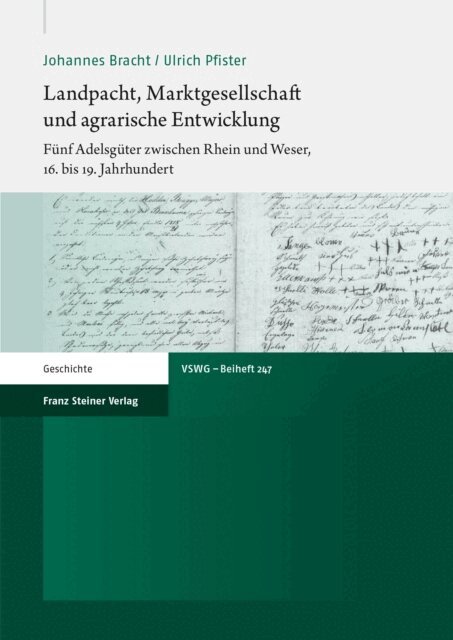
Landpacht, Marktgesellschaft und agrarische Entwicklung
Fünf Adelsgüter zwischen Rhein und Weser, 16. bis 19. Jahrhundert
Av Ulrich Pfister, Johannes Bracht
E-bok, 2020
853 kr
Lägg i varukorg
Wie hat sich die Landpacht in Deutschland langfristig entwickelt? Dieser Frage gehen Johannes Bracht und Ulrich Pfister erstmals nach. Auf Basis der Rechnungsbücher adeliger Güter in Westfalen und dem Rheinland zeigen sie, dass die Verbreitung von Pacht sowie das Niveau und die Entwicklung der …
Deutschland 1871
Die Nationalstaatsbildung und der Weg in die moderne Wirtschaft
Av Jan-Otmar Hesse, Ulrich Pfister m. fl.
Inbunden, 2021
2027 kr
Tillfälligt slut
Kurz nach der Gründung des ersten deutschen Nationalstaats 1871 trat die deutsche Wirtschaft in die Ära des modernen Wirtschaftswachstums ein. Dennoch ist bisher kaum erforscht, ob und auf welche Weise die Nationalstaatsbildung die wirtschaftliche Dynamik beeinflusst hat.In diesem Band gehen …