Umberto Cugini – författare
Visar alla böcker från författaren Umberto Cugini. Handla med fri frakt och snabb leverans.
10 produkter
10 produkter
E-bok
PDF, Engelska, 20131 977 kr
Läs direkt efter köp
IFIP Working Group 5.2 has organized a series of workshops extending the concept of intelligent CAD to the concept of "knowledge intensive engineering". The concept advocates that intensive life-cycle knowledge regarding products and design processes must be incorporated in the center of the CAD architecture. It focuses on the systematization and sharing of knowledge across the life-cycle stages and organizational boundaries. From Knowledge Intensive CAD to Knowledge Intensive Engineering comprises the Proceedings of the Fourth Workshop on Knowledge Intensive CAD, which was sponsored by the International Federation for Information Processing (IFIP) and held in Parma, Italy in May 2000. This workshop looked at the evolution of knowledge intensive design for the product life cycle moving towards knowledge intensive engineering. The 18 selected papers present an overview of the state-of-the-art in knowledge intensive engineering, discussing theoretical aspects and also practical systems and experiences gained in this area. An invited speaker paper is also included, discussing the role of knowledge in product and process innovation and technology for processing semantic knowledge. Main issues discussed in the book are: Architectures for knowledge intensive CAD; Tools for knowledge intensive CAD; Methodologies for knowledge intensive CAD; Implementation of knowledge intensive CAD; Applications of knowledge intensive CAD; Evolution of knowledge intensive design for the life-cycle; Formal methods. The volume is essential reading for researchers, graduate and postgraduate students, systems developers of advanced computer-aided design and manufacturing systems, and engineers involved in industrial applications.
E-bok
PDF, Engelska, 20131 977 kr
Läs direkt efter köp
IFIP Working Group 5.2 has organized a series of workshops aimed at presenting and discussing current issues and future perspectives of Geometric Modeling in the CAD environment. From Geometric Modeling to Shape Modeling comprises the proceedings of the seventh GEO workshop, which was sponsored by the International Federation for Information Processing (IFIP) and held in Parma, Italy in October 2000. The workshop looked at new paradigms for CAD including the evolution of geometric-centric CAD systems, modeling of non-rigid materials, shape modeling, geometric modeling and virtual prototyping, and new methods of interaction with geometric models. The seventeen included papers provide an interesting overview of the evolution of geometric centric modeling into shape modeling. Also included is an invited speaker paper, which discusses the foundation of the next generation of CAD systems, where shape and function enhance geometric descriptions. The main topics discussed in the book are: Theoretical foundation for solids and surfaces; Computational basis for geometric modeling; Methods of interaction with geometric models; Industrial and other applications of geometric modeling; New paradigms of geometric modeling for CAD; Shape modeling. From Geometric Modeling to Shape Modeling is essential reading for researchers, graduate and postgraduate students, systems developers of advanced computer-aided design and manufacturing systems, and engineers involved in industrial applications.
Inbunden, Engelska, 2001
1 669 kr
Skickas inom 10-15 vardagar
IFIP Working Group 5.2 has organized a series of workshops extending the concept of intelligent CAD to the concept of "knowledge intensive engineering". The concept advocates that intensive life-cycle knowledge regarding products and design processes must be incorporated in the center of the CAD architecture. It focuses on the systematization and sharing of knowledge across the life-cycle stages and organizational boundaries. This text comprises the proceedings of the Fourth Workshop on Knowledge Intensive CAD, which was sponsored by the International Federation for Information Processing (IFIP) and held in Parma, Italy in May 2000. This workshop looked at the evolution of knowledge-intensive design for the product life-cycle moving towards knowledge intensive engineering. The 18 selected papers present an overview of the state-of-the-art in knowledge intensive engineering, discussing theoretical aspects and also practical systems and experiences gained in this area.
Inbunden, Engelska, 2001
1 669 kr
Skickas inom 10-15 vardagar
IFIP Working Group 5.2 has organized a series of workshops aimed at presenting and discussing current issues and future perspectives of Geometric Modeling in the CAD environment. From Geometric Modeling to Shape Modeling comprises the proceedings of the seventh GEO workshop, which was sponsored by the International Federation for Information Processing (IFIP) and held in Parma, Italy in October 2000. The workshop looked at new paradigms for CAD including the evolution of geometric-centric CAD systems, modeling of non-rigid materials, shape modeling, geometric modeling and virtual prototyping, and new methods of interaction with geometric models. The seventeen included papers provide an interesting overview of the evolution of geometric centric modeling into shape modeling. Also included is an invited speaker paper, which discusses the foundation of the next generation of CAD systems, where shape and function enhance geometric descriptions. The main topics discussed in the book are: Theoretical foundation for solids and surfaces; Computational basis for geometric modeling; Methods of interaction with geometric models; Industrial and other applications of geometric modeling; New paradigms of geometric modeling for CAD; Shape modeling. From Geometric Modeling to Shape Modeling is essential reading for researchers, graduate and postgraduate students, systems developers of advanced computer-aided design and manufacturing systems, and engineers involved in industrial applications.
644 kr
Skickas inom 5-8 vardagar
Del 80 - IFIP Advances in Information and Communication Technology
From Geometric Modeling to Shape Modeling
IFIP TC5 WG5.2 Seventh Workshop on Geometric Modeling: Fundamentals and Applications October 2–4, 2000, Parma, Italy
Häftad, Engelska, 2013
1 634 kr
Skickas inom 10-15 vardagar
The workshop looked at new paradigms for CAD including the evolution of geometric-centric CAD systems, modeling of non-rigid materials, shape modeling, geometric modeling and virtual prototyping, and new methods of interaction with geometric models.
644 kr
Skickas inom 5-8 vardagar
Del 79 - IFIP Advances in Information and Communication Technology
From Knowledge Intensive CAD to Knowledge Intensive Engineering
IFIP TC5 WG5.2. Fourth Workshop on Knowledge Intensive CAD May 22–24, 2000, Parma, Italy
Häftad, Engelska, 2013
1 634 kr
Skickas inom 10-15 vardagar
IFIP Working Group 5.2 has organized a series of workshops extending the concept of intelligent CAD to the concept of "knowledge intensive engineering". The concept advocates that intensive life-cycle knowledge regarding products and design processes must be incorporated in the center of the CAD architecture. It focuses on the systematization and sharing of knowledge across the life-cycle stages and organizational boundaries. From Knowledge Intensive CAD to Knowledge Intensive Engineering comprises the Proceedings of the Fourth Workshop on Knowledge Intensive CAD, which was sponsored by the International Federation for Information Processing (IFIP) and held in Parma, Italy in May 2000. This workshop looked at the evolution of knowledge intensive design for the product life cycle moving towards knowledge intensive engineering. The 18 selected papers present an overview of the state-of-the-art in knowledge intensive engineering, discussing theoretical aspects and also practical systems and experiences gained in this area. An invited speaker paper is also included, discussing the role of knowledge in product and process innovation and technology for processing semantic knowledge. Main issues discussed in the book are: Architectures for knowledge intensive CAD; Tools for knowledge intensive CAD; Methodologies for knowledge intensive CAD; Implementation of knowledge intensive CAD; Applications of knowledge intensive CAD; Evolution of knowledge intensive design for the life-cycle; Formal methods. The volume is essential reading for researchers, graduate and postgraduate students, systems developers of advanced computer-aided design and manufacturing systems, and engineers involved in industrial applications.
Häftad, Engelska, 2017
549 kr
Skickas inom 10-15 vardagar
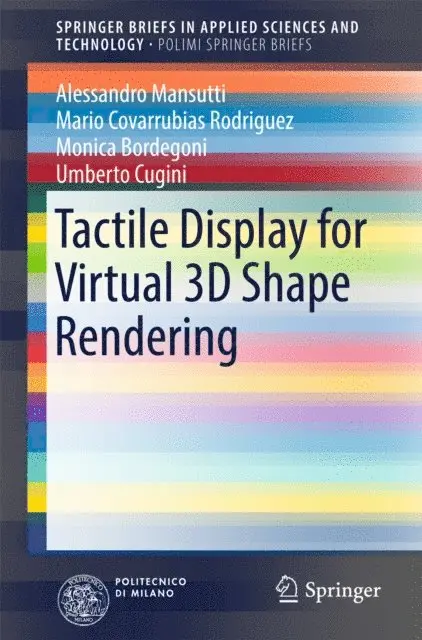
This book describes a novel system for the simultaneous visual and tactile rendering of product shapes which allows designers to simultaneously touch and see new product shapes during the conceptual phase of product development. This system offers important advantages, including potential cost and time savings, compared with the standard product design process in which digital 3D models and physical prototypes are often repeatedly modified until an optimal design is achieved. The system consists of a tactile display that is able to represent, within a real environment, the shape of a product. Designers can explore the rendered surface by touching curves lying on the product shape, selecting those curves that can be considered style features and evaluating their aesthetic quality. In order to physically represent these selected curves, a flexible surface is modeled by means of servo-actuated modules controlling a physical deforming strip. The tactile display is designed so as to be portable, low cost, modular, and high performing in terms of the types of shape that it can represent.
E-bok
Engelska, 2017687 kr
Läs direkt efter köp
This book describes a novel system for the simultaneous visual and tactile rendering of product shapes which allows designers to simultaneously touch and see new product shapes during the conceptual phase of product development. This system offers important advantages, including potential cost and time savings, compared with the standard product design process in which digital 3D models and physical prototypes are often repeatedly modified until an optimal design is achieved. The system consists of a tactile display that is able to represent, within a real environment, the shape of a product. Designers can explore the rendered surface by touching curves lying on the product shape, selecting those curves that can be considered style features and evaluating their aesthetic quality. In order to physically represent these selected curves, a flexible surface is modeled by means of servo-actuated modules controlling a physical deforming strip. The tactile display is designed so as to be portable, low cost, modular, and high performing in terms of the types of shape that it can represent.